Monday, October 11, 2010

More Orson. Yeah!

I meant to post some earlier US Acres comics that were skipped, but had forgotten about them. Sorry for the delay.


Next up is Roy acting very much like Garfield does around seeing a field of flowers. Given the personalities between the two, there's not much difference. Both get a sadistic joy in playing pranks on unsuspecting victims, abusing lower life forms, and superiority over all. The only thing that matters is whether you're soft & fluffy or not. That could explain why certain animals on the endangered species list are more fought against than others. Nobody cares about a colony of bats or colony of frogs, but everybody & their mother will race out to protect baby seals.


Below are two strips that were later adapted as "Quickies". In the animated version, it was Bo who spoke out to the audience. Keep in mind that neither he nor Lanolin had been introduced at this point, so they're still anonymous sheep.


And here's the original version of the latest strip. Can you spot the difference? I'll give you a hint - it's not the title page or the missing Fun Farm Fact. It has something to do with this post's title.


One wonders why they would bother switching out the normal Yeah!s with the hickensian speaking Yeh. A quick search through the Garfield archive gives a possible answer:

Thursday, October 7, 2010

Bloody Knights

It's recently come to my attention that Viz's old-school Knights of the Zodiac (Saint Seiya for you purists) just recently finished it's impressive run, despite never quite gelling with the majority of the reading public. Part of that might be the pacing, which can oftentimes seem quite odd to the modern reader. Another could be that the subject material simply wasn't that interesting. A better reason could be that the audience didn't grow up watching the Anime in their childhood. But I think most of it stems from the fact that practically every character looks identical.

While Kazuo Umezu had the complaint that his characters were too stiff, at least he backed up his stories with endless variety. When I "read" these pages by picture alone, too often, a lot of the pages essensially "sound" the same to me. It doesn't help that the elfish helper has the same facial expression throughout the series.


Oftentimes, you'll hear the complaint that "All Manga characters look the same", and while there are subtle differences, I'm sorry to say that this stereotype applies here. While Masami Kurumada is capable of drawing various characters, all his protagonists have ONE distinctive face, and it's used as often as possible. That goes for the villains too. In this Manga, the strength of a character is defined by how shiny they look. The prettier and bishy they are, the more of a threat they are. I'm sure by the time Hades rolls around, his cloth (armour) is so bright you need shades. This could be avoided by some mud-slinging, which could reduce the tarnish somewhat, but then you'd have to contend with the legion of rabid fangirls who like looking at boys prettier than they are.

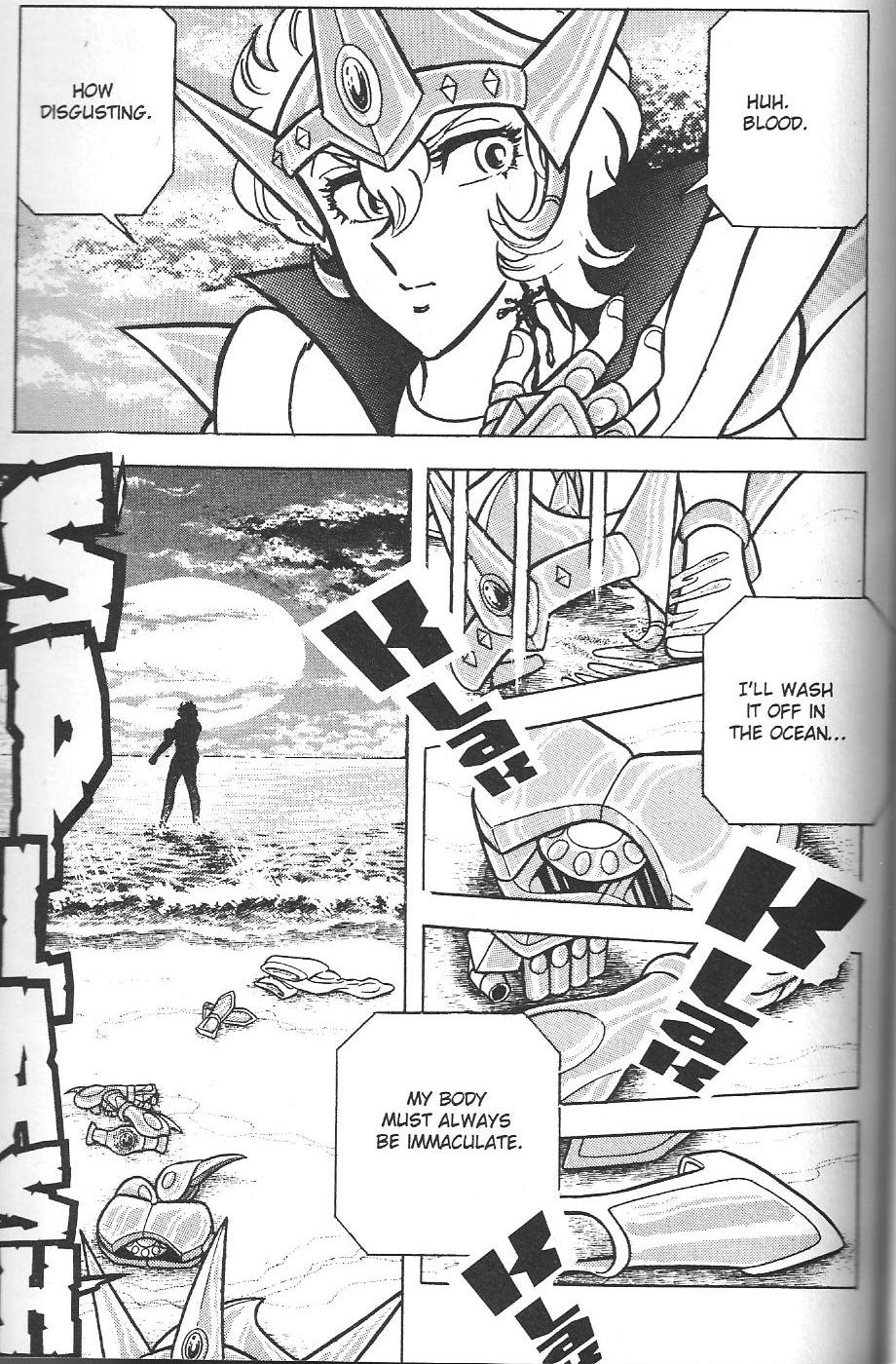
While other comics have the philosophy that "Violence solves everything", Saint Seiya had an unique way of solving their problems. How? By bleeding all over the place.


Got some cloth that needs to be repaired? Just go the Fushigi Yuugi route and give your life force over to them.


But don't go overboard...


Don't worry, he gets better.

Are you threatened by a poisonous technique that's threatening your body? Just poke holes in your body to let the blood flow better. Y'know, to let the blood breath a bit. I'm sure it's written somewhere in a medical manual if you look hard enough.


Need to use a highly dangerous technique to defeat an enemy? Just overload your heart to the point that it'll cause aneurysms throughout your circulatory system.


This move is extremely dangerous, so of course he uses it.


Even a tiny drop of blood from Seiya...


...leads to this infamous page here.


WHY Seiya didn't attack him when his defenses were down is a curiosity in itself. But as Shaenon said, "Nothing that happens in Knights of the Zodiac makes a lick of sense." And that might be the problem right there. Some people like to have a semblance of coherence and logic in their fights, even if the plan is "keep hitting & standing up until the enemy falls down."

Even the fact that all the guys have the same bastard Father is easily solved with:


Yeah, Seiya's not falling for that.

Tuesday, October 5, 2010

Cathy's Last Gasp

Well, Cathy's finally finished her long-running strip as of this Sunday, and I shamefully missed the occasion myself. I had to get the news second-hand from various comic sites who were more devoted to this than I was.


When I saw the last panel, several things jumped out at me. One was that her stomach seemed to be saying something, but I had trouble making out what it was. It was only after I looked further away that I realized her unborn baby was thinking the signature "Aack" in pink. The first thing I noticed was that Cathy's Mother was positioned exactly the same way she was at the conclusion to her wedding:


Guisewite had Cathy stay single for a long time until she realized that she was running out of material for a single woman since she was married herself. Given how much Anne (Cathy's Mother's name) wanted her baby girl to get married and have babies before her looks started to go, this sort of thing must come as something of a relief. Now she can safely roll over and die with a happy expression on her face.


However, even though the strip's stopping at a supposedly ambiguous ending, leaving our imaginations to fill in the gaps, there's still plenty of already available material in the Cathy strip. From these, we can get some idea of what her pregnancy would be like.


Cathy was the working businesswoman, and as such, filled the role of a working woman sans child. The position of working businesswoman with child was left to her feminist best friend, Andrea.


Andrea had to deal with the energetic rebelious Zenith, and later, Gus. They disappeared for years, only showing up when Cathy needed somebody to fill the role of ringbearer and flower girl. By that time, they'd gone the Doonesbury route of aging, appearing as teenagers to Cathy's shock.


And when Cathy's had the option of having another soul in her life, she opted for second best choice.


Guisewite said that at the time, she wasn't ready for Cathy to have a baby, but wanted her to go through the conventions of what having a child would be like. So in essence, Cathy went through most of the strip's run staying relatively stagnant while her friends continued to pace ahead of her. Cathy's parents accepted her new dog with as much grace as you would expect them to.


For those of you curious as to how Cathy would've handled having to suffer through her pregnancy with multiple cravings, look no further than her relationship with her spoiled stomach.


And don't even get her started on Hot Fudge Sundaes with Sprinkles.


Still think Cathy would make a good mother?

Given how long the strip's been running, there's really only one proper way to signify the end of an era:

Sunday, October 3, 2010

Different Orsons

When I reported the news of the revival of US Acres to PlatypusComix, he was disappointed at me for raising his hopes that the comic was going to have more strips. I didn't realize that the way I worded it could've been taken the wrong way. Seriously though, given how Garfield's been going into redundancy in Jim Davis' hands and has only found creativity elsewhere, how else would the farm comic find new life?

The only thing I can do is post the differences at the site with samples of mine. I'm not web-savy enough to figure out how to copy an entire web page without arousing suspicion.

Obviously, I won't be able to do this for long, so enjoy it while it lasts.

Compare this with this.


Compare this with this.


Compare this with this.


Compare this with this.


Saturday, October 2, 2010

Return of Orson


I never expected to do an update of an earlier entry, but it seems that somebody's been making enough noise for Jim Davis to reconsider giving more attention to his lesser-known strip, U.S. Acres. (That, or everybody he would have to share copyright fees with have finally died off)


The interview in question doesn't have too much factual information, save for that Jim's cat is named Pooky, after Garfield's teddy bear. (Sometimes called Pookie in some spellings) The relevant paragraph in question is as follows:
During Garfield, you also created the comic strip U.S. Acres. It ran for three years from 1986-1989. Might we ever see a "complete collection" book released of U.S. Acres? I love Garfield, but I also loved U.S. Acres and would love to read them all again! -- Steven B. in Los Angeles
Wow, Steven B. If I didn't know better I'd say you were a plant. Starting on Friday we're going to start running a U.S. Acres web comic on Garfield.com/
For those of you wanting to skip straight to the farm strips in question, click here:


After going through the small archive, I noticed several things to my dismay. The strip starts at the beginning of August 1st, on a Friday, skipping out on over five months of the comic, when Orson was still being bullied by his brothers. They're still available on PlatypusComix's site, but we shouldn't ahve to rely on somebody else's page to get what we want. Not to mention that they were missing the "Fun Farm Facts" that were part of the comic's original run. (The fact that they're recoloured and flash-based seem miniscule in comparision)


One thing I liked about the Fun Farm Facts (FFF's) were that sometimes they were part of the main story:


While I could make the conspiracial theory that Jim didn't want to pay tribute to the people who mailed in these FFF's, the sad truth is that some of these "Facts" are more obvious than informative trivia.


While scanning the rest of the Orson comics I hadn't shown yet, I noticed that the number for the 5th FFF showed up twice in two weeks. This might've been an early mistake, and to anyone who's still lucky enough to have the entire collection sitting somewhere, add one more number to the final total.


I'm still waiting for the day when we'll see the coloured version of Orson's plaid mud waller aftereffects. Until then, keep complaining.  EDIT - Colour edition found!  Look way at the bottom.

Friday, October 1, 2010

For Better or For Cerebus

If you think about it, there are a lot of similarities between Lynn Johnson’s For Better or For Worse and Dave Sim’s Cerebus. Both comics were created by Canadians, both were overly ambitious, both went on a devoted schedule without a break, both based their characters on members of their friends & family, both were embarrassed by their better earlier works, and both creators had a creator breakdown which resulted in flawed masterpieces.

These are just some of the more obvious parallels between the two, but there are more subtler similarities that can be found within the pages of their comics.

Both had innovative use of their fonts/background noise.


Lynn’s influences include the aforementioned Doug Wright, 50's sitcoms, her life, and Charles Schultz’s Peanuts.


Dave's influences include the aforementioned Doug Wright, the Marx Bros., Rodney Dangerfield, Little Murders, Oscar Wilde and the Three Stooges.


Cerebus had the ambiguous phrase, “Bang bang, something fell.” This was even covered in an essay in Following Cerebus #1, where people tried to decipher the meaning behind those words.


FBOFW made no successful attempts to cover it up.


FBOFW went from a normal-nosed housewife talking about male chauvinist pigs to a woman with a potato nose.


Cerebus went from a normal-nosed misogynist aardvark to looking like a male pig with a fondness for potatoes.


Lynn attempted a hybrid creation of the series that never quite panned out.


Cerebus had a male/female hybrid creature.


Michael had killer socks that could be considered a lethal weapon capable of clearing out the room to anyone present.


Cerebus could smell so bad when wet that not even he could stand the smell, which explains why he didn't use this tactic often.


Anthony pines for Elizabeth, his one true love, even going so far as to long for her after marrying Therese.


Cerebus pines for Jaka, his one true love, even going so far as to long for her after being tricked into marrying someone else for political reasons. And those are his good points.


Therese, Anthony’s first wife was an overly ambitious woman who used Anthony for her own means, going so far as to dictate how he should look and dress.


Astoria was a political woman who had high ambitions, and used Cerebus for her own means, going so far as to dictate how he should look, dress and act.


Anthony intimidated his baby daughter into accepting Elizabeth as a potential mother.


Cerebus threw a baby out with the bathwater in order to make a point.


Elly manipulated politicians by throwing a costume party in order to save a theater.


Cerebus manipulated politicians at a costume party in throwing onion dip in order to save a theatrical man.


FBOFW had archaic devices such as typewriters and women’s lib that would only make sense to someone living in the 50s/60s.


Cerebus had archaic themes that would only make sense to someone living in the comics world in the 80s/90s, such as obscure titles like Flaming Carrot, Bacchus and Rarebit Fiends.


John and Phil went on a camping trip that went disastrous when their canoe tipped over, forcing them to huddle up in a shack for warmth, and were only saved by an aircraft noticing their campfire.


Cerebus and Jaka’s camping trip was menaced by Mary Ernestway’s tale of Africa, Ham’s implied assisted suicide, were forced to huddle together in a snowstorm and was only saved by a volcanic eruption. (No, really!)


Michael’s best toy was a childhood teddy bear that he kept with him well into his adult life.


Jaka’s best friend was a doll, the only remaining memoriam of her childhood, and Cerebus best friend was a mercenary named Bear.


Gordon gave the lame excuse for his bruises that he fell down to hide his Father’s beatings.


Jaka actually got hit by a door in her eye. (At least she didn’t fall down the stairs into a crate full of doorknobs)


FBOFW indulged in some gay denial between Lawrence and his family.


In Cerebus, he does it to himself.


(On the next page, Cerebus indulged some gay-bashing)


In later years, FBOFW would become more verbose, the text crowding out the artwork.


Cerebus did the same, only more so.


Grandpa Jim kept surviving, despite suffering through numerous heart attacks, dementia, aphasia and was somehow still coherent enough to stay alive after his granddaughter’s wedding. In the last strip, it’s revealed he died surrounded by his loved ones.


Cerebus was told a prophecy that he’d only live a few more years before he dies “Alone, Unmourned and Unloved” and survives the gamut of multiple emotional turmoil for the rest of the series’ run. Despite the prediction (it was made by an immortal, so “a few years” could be slightly ambiguous), he didn’t die until maybe 300 years later.


EDIT - and on another note, thanks to forworse's attention to the later FBOFW strips, she pointed out another similarity that I missed.

EDIT2 - found yet Another similarity that was easily glossed over.