This is a site devoted to casting a spotlight on those comics in the Sunday pages that for one reason or another, were never collected.
Also, I'll be paying attention to other comics worthy of wider recognition.
To make up for my annual tributes for Veteran's Day by paying attention to WWI comics such as Charley's War, (which I missed out this year), I posted comics about cartoonists doing tributes to Hunger around Thanksgiving. You'd think that having broached a serious subject once, they wouldn't want to go back to that particular well. But every time I think I've found the last batch of Famine-related comics, I wind up finding more.
To be fair, some of these took place before they did their annual tribute. But they fit themetically well.
In recent comics, there have been instances where Marvin has been shown talking to babies, and even the FamilyDog, but rarely to his parents, with rare exceptions.
When Marvin DID speak, it was usually at the expense of a joke. Like Maggie being the only Simpsons kid to call Homer 'Daddy' when no one was paying attention to her. Only, you know, more filled with mean-spiritedness than pathos.
But there was an instance where Marvin suddenly gained the power of speech in full view of his Father, and made no attempt to cover it up.
All those years of pent-up silence was obviously the result of having nothing of substance to say. And THIS was the apparent moment to respond to a perfectly inane request. You'd think that after all those years of silence (save for crying at night), Marvin's first words would be of higher quality.
So, having had a chance to have a heart-felt conversation with his son, what does the Father think? That his baby's a natural-born prodigy? Enroll him for an early scholarship? Hah hah, nope. Indulge in Moichendising!
Child Prodigies have a tendency to burn out quickly, due to too much attention, pressure and demand on their still-budding talents. Especially in a fragile state where they're likely to do all of their parent's bidding. (What genius is going to say no?) So, better make the most out of them while you still can!
Isn't that just typical of men? As soon as a big secret is revealed, their first instinct is to hide it from the women, who'd very possibly overreact from such a revelation.
Which winds up being a moot point, since they wind up telling her anyways.
And even more moot when word leaks out to the world. Keeping a talking baby under wraps is harder than you'd think, since everybody and their mother want to tell their friends and their foes about a 1-year old with coherent vocal chords. This was clearly inspired by Look Who's Talking, and Look Who's Talking Too, the latter of which was just released in 1990 the year this comic saw print.
Marvin's ability is so impressive that he's featured on multiple magazines and newspapers, two of which have Roseanne in their subheadlines. Pay attention to her measurements in the 1st panel:
Marvin's status improves to the point that he goes on talk shows that are no longer around. He's now outlived the caricatures these people are based on.
The implications of this are downright disturbing. Marvin is already considering getting married to someone just so he can get rid of them later for added publicity. In an era where Hot Mamas are a desired trait, Marvin's mother has been safely left off the radar, because Toddlercon isn't a taboo enough subject that's gained much popularity anytime soon.
At this point, you begin to wonder if Tom Armstrong has certain wish-fulfillment fantasies that he'd like to have play out. Marvin's popularity has exceeded to the point of ridicule that you begin to wonder just where it'll end.
And of course, it does so in the most disappointing manner possible. So much for changing the status quo!
While looking for certain archived comic images, there are some things that pop up that are so unusual that you feel compelled to share them with the world and remind them that such things existed back when nobody was paying that much attention.
Superheroes have made a strong comeback in theaters after languishing on the funny pages for ages, but that's only after they distilled away the most essential elements, and removed all the overwrought narratives, the multi-story arcs that demanded intense attention and knowledge of what was going on in other books in the company line, and artwork that was wonky and incomprehensible at best. (Nowadays, movies have the same creative problems that plagued comics, but that's a lecture for another time, preferably not by me)
The Superhero resurgence may have started with Blade, but the jumpstarter was Tim Burton's Batman, which radically changed the usual audience perception of the cheesy Adam West version, which was still fresh in the majority's mind, years after Frank Miller's Dark Knight take on the character. That may have been in mind when the briefly revived Pogo strip by Doyle and Sternecky diverged in a brief parody that's just as overwrought with creative narrative bombast as the double-entendre laden monologue that influenced Tracer Bullet. The first part (in colour) can be seen here:
After this, things get a little trickier to figure out. Sadly, the text is so faded away in parts that it's practically illegible. Fortunately, I took a closer look and deducted most of what was written: Panel 4:Bright Knight Picks a Fight: A fortunate sudden downpour saves our hero from a flaming end, but now he must lock jaws with the big ultimate foe himself! Panel 5:Caption: Mudgeopolous at Dinnertime Bright Knight: Alright, at the count of five. 1, 2... Boy Pogo: Halfa sammich Goofus? Goofus: Thanks Boy Pogo. Us Arch Enemies allus travels on our stomachs. Panel 7: 1989 OGPI! Distributed by the L.A. Times Syndicate! (Until I found a clearer copy above, I thought the text at the bottom panel read: Must Obey! Receiver by The L.A. Times Syndicate!)
And that's where our adventures end. If anybody wants to see the rest of the story for themselves, they're free to buy a physical copy of the six issues that supposedly make up this run.
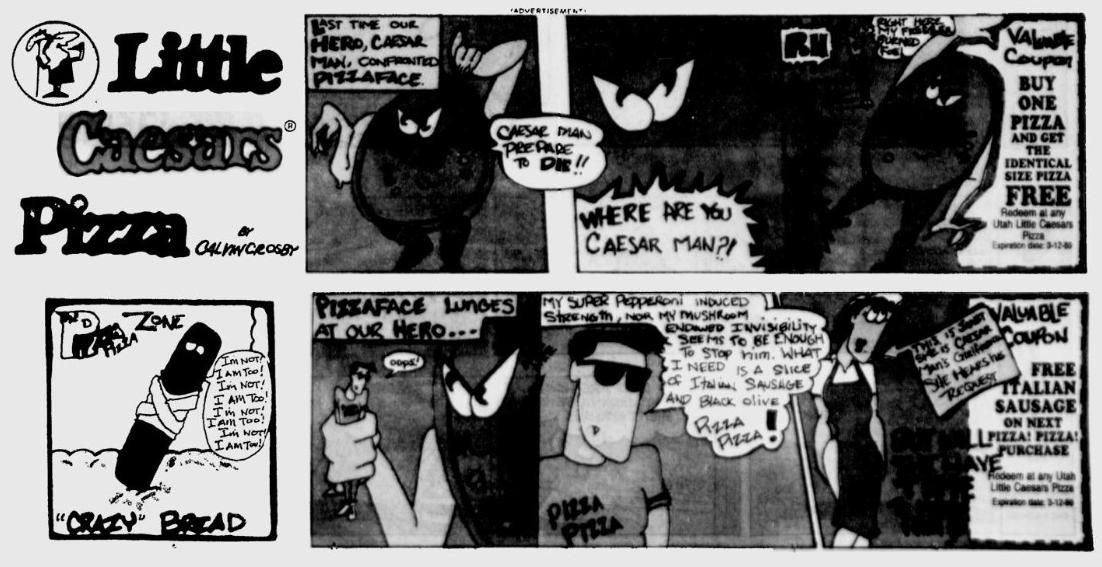
Then, at the other end of the spectrum, we have some promotional material that are quite frankly, some of the most amateurish childish drawings ever done. And the blotted black and white images of the quality coloured pictures don't help.
You'd think a franchise as large as Little Caesars would've been able to splurge for higher quality. The left hand side is also take up not just by the title, but also an accompanying stand-alone panel that's just as amateurish as the rest of the comic.
And like the Pogo comic earlier, it ends on a cliffhanger. Good luck trying to find the conclusion to this thrilling epic, assuming anybody bothered to save a copy for themselves, and weren't embarrassed to keep one for themselves. (If artist Calvin Crosby is reading this, I apologize for my unflinching criticism) I'm not even gonna bother transcribing the inane script here, save for the last panel:
Panel 7: This is (sp)Sobt. She is Caesar Man's Girlfriend. She hears his request. BUT WILL SHE SAVE THE DAY?
The Superhero genre has permeated everything from Archie to Garfield (who's more suited as the Caped Avenger than the LiefeldianPet Force), but not everything deserves to be shoehorned into a specific formula, no matter how much diehard fans insist on saying so. Further proving that not everything can be improved by simply slapping a spandex outfit over a persona in the vain hopes of attracting a wider audience, is the long-forgotten instance of Cheerios branching out its brand into the unusual field of two Laurel & Hardy types with the tagline of "It's Applelicious! And Cinnamoncredible!" which never quite caught on, for some reason.
Most of their time is spent bickering over which part of the cereal sprinkles these bad guys are more interested in, the apple or the cinnamon, but it never lasts for long before they decide to whup some baddie's behind. With minimal effort, mind you - it's not like they have to actually WORK for it.
Despite their potentially limited appeal, the height of their relevance ultimately culminated in a minute-long advertisement staring a very familiar-looking 'gator Kart-Racing Villain.
Save for those annoying sponsors on Sesame Street, today's kids don't even know what Commercials ARE.
Whether this should be lamented or celebrated depends on your fondness for unskippable jingles that Media Watchdogs have been complaining about merchandise being solely targeted at children for ages. But at this current rate, TV shows and movies that are naked merchandising adverts for comics, toys & cards are the only likely places for advertised commercial franchises to be seen in the first place.
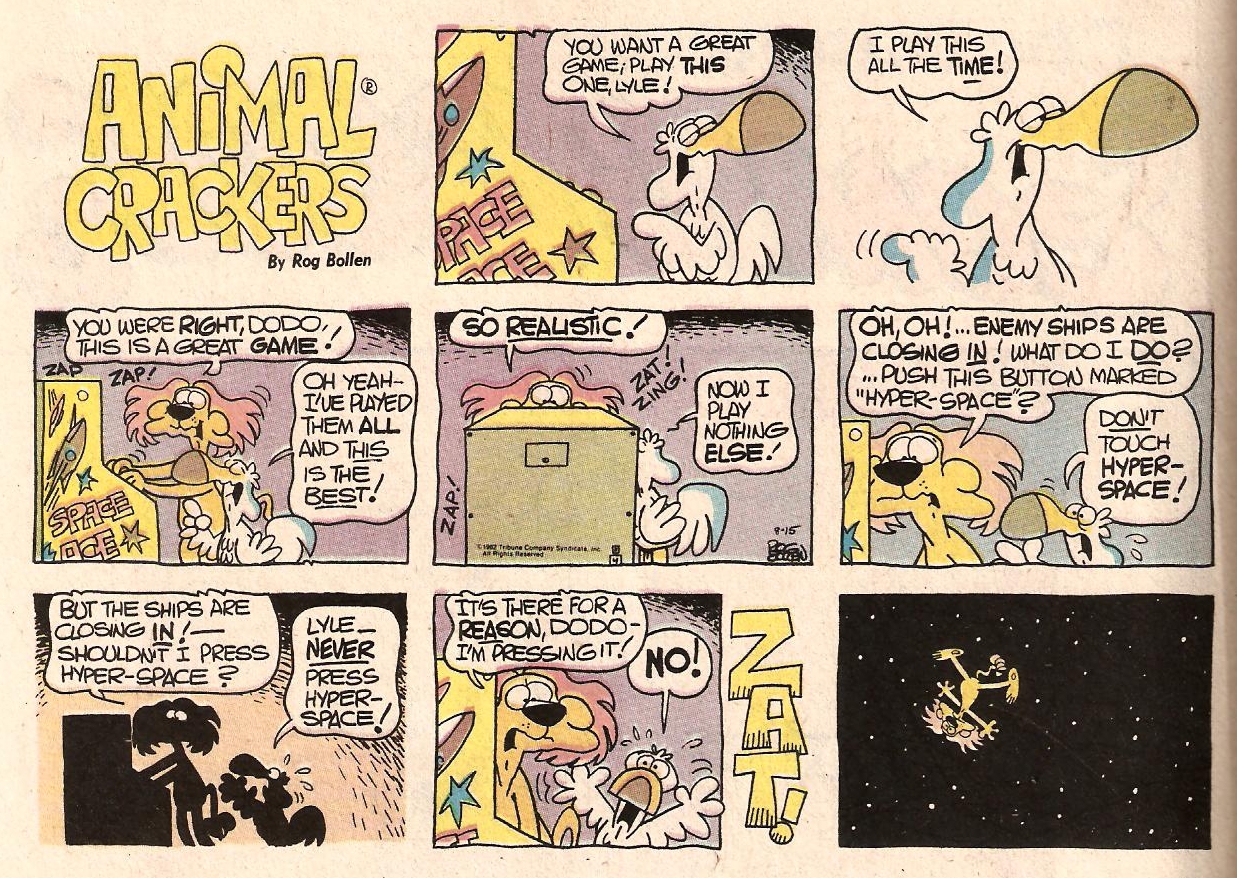
Arcade centers may have fallen to the wayside, thanks to the proliferation of the home console market exploding in popularity, making quarter munchers something of a rarity, appealing only to the few outlets that still allow access to the mainstays that haven't been converted to the home video treatment yet. Not that there aren't some diehards who won't stop at the opportunity to top the latest world record in terms of useless challenges.
This has led to multiple instances of other media implementing their references without really understanding their appeal, such as Tony Soprano "playing" a lap of N64 Mario Kart one-handed just by handling the joystick without actually pushing any buttons. (You need to use both to move)
including the Star Trek episode, The Game, where the whole crew was being subjected to being brainwashed by an addictive game that basically consisted of mentally throwing discs down funnels.
somewhat unusual for a futuristic utopia that prides itself on
Probably the biggest insult would be the cameo appearance of Toru Iwatani, the creator of the instantly identifiable Pac-Man, who quashed his moment of immortality in an Adam Sandler movie. (I'm not even gonna justify naming it - you can find it yourself)
Then there's an outer-space Spider-Man story from Electric Company, that may or may not have been inspired by The Last Starfighter, where an average kid who's really good at a Space Invaders-esque game finds himself roped into an intergalactic war, because reasons.
And yet, despite dozens of genres ranging from Platformers, Street King Fighters, Puzzle Droppers, Rail Shooters and the lot, the go-to representation of console games seem to be the ol' blast-em-Commies-outta-the-sky edition.
The demonization of Videogames is nothing unusual. People have been complaining about how the latest newfangled devices these ungrateful younglings are abusing to their whim will bring about the downfall of civilization as we know it. Well, they're technically correct, since these lawn-standing children are rewriting the rules of the previous generation that will pave the route to the NEXT batch of unforeseen upgrades, which will carry their own baggage of complaints from future Luddites.
But it's not so much the rush of playing the games themselves as is the sense of accomplishment of actually succeeding in a monumental repetitive task. After all, if Video Games were as mindless as everybody says they are, everybody would be passively pushing buttons waiting for their turn. In The Game Believes In You by Greg Toppo, an adult tried his hand at playing a typical gateway game, and was surprised at just how difficult it was. (Granted, most beginner console games were Nintendo Hard)
It wasn't just the learning curve of having to readjust his preconceived notions of hand-eye coordination, but also the intense amount of concentration needed to get through a typical level. He was surprised that despite his apparent smarts, that he was having great trouble at re-learning new traits that for all intents and purposes, should've been deceptively easy. If you pay attention to a gamer's expression while they're playing, they intensely focused on the action happening on the screen. (Unless it's an unskippable cutscene, at which point, they're just waiting for the mini-movie to finish so they can get back to the action)
Indeed the purpose of a good game is to force the player to keep trying over and over, compensating for their mistakes until they succeed in overcoming their surmountable tasks. The very first Mario game level is easily recognizable and iconic, but it was actually designed near the end, so Shigeru Miyamoto could properly showcase everything the beginning player needed to learn about the basics of playing. (Though it took a computer ages to learn what came naturally to grade-age kids)
Despite their high degree of difficulty, the game allows you to try again over and over until you manage to succeed, all for the sake of that elusive A WINNER IS YOU! end screen. This is accomplished by memorizing dozens of patterns, calculating various formulas, testing strengths and weaknesses, using items in every conceivable combination possible and deferring to the game's internal logic, usually consisting of warped reality that naturally appeals to kids. (And resorting to cheats when they're ultimately desperate)
In fact, because of the way games are made, the techniques and tricks you use to get past creative enemies, obstacles and traps in later hair-pulling stages are designed to gradually teach the player how to develop these traits and integrate them into their playing without being fully aware that they're learning. In this sense, videogames are actually better teachers than most schools. (And more fun too)
Another worthwhile quote - If schools were relied on to teach children about Pokémon, they would lose interest almost immediately. Part of the reason is because when schools were first designed, they were intended to be suitable for children whose highest aspirations were to become factory assembly line workers, whose iteration of input and fixed formulas was a necessity. But the latest appliances and digital devices have largely supplanted that need, resulting in teachers having to dictate an authoritarian stance over unruly children. The earliest concept of a school worked just fine in the early 20th Century, but their model no longer applies to the modern world. Everybody learns in a different way, and expecting everybody to conform to a single model is just asking for trouble. Nowhere is this more clearly stated than in Japan's schools, which is more suited to produce Businessmen who are more likely to be brown-nosers and yes-men than innovative trailblazers. In fact, the lack of harmony between Sega USA and Sega Japan was because one company was willing to take risks, and the other wasn't. (As seen in the Sega Vs. Nintendo book, Console Wars)
Rather than demonizing the infantile traits of empowering videogames, scholars should be using the traits of videogames that best appeal to their senses. Rather than have everybody in the class compete with each other over who gets the highest marks or best memorization, singling out the class pets, fostering an epidemic of cheating and stress, it would benefit greatly using a Warcraft model where struggling students can get farther ahead by working together. Instead of grading students over an outmoded grading system where mistakes are seen as a black mark demerit that'll follow them for the rest of their lives. They should be given the chance to experiment with alternate solutions that best suits their needs, substituting calculating methods with more adequate means, where they can take their time to fully understand the logic ingrained behind the theory. Following formulas is good for starters, but shouldn't be strictly restricted to only that if the students already understand the basics, and compensate by using similar models closer to their line of thinking. There's not just one way to calculate algebraic math.
In one instance where a student was failing in a particular field, another student offered themselves up to compensate for her loss, even though it meant losing some points himself. The purpose was to teach how to game the playing field so that everybody gets their fair share. In other words, compensating for their weaknesses until they're able to confidentially assert it themselves.
You notice all kinds of weird things while browsing old online newspaper archives. For starters, due to rushing the scanning process and lack of double-checking the source material, some pages are accidentally posted twice. And other gap in the dates are filled in previous dates that run together that were never divided. For instance, you can look up an article in say, November 28, 1985, and find a paper wasn't available that day, because they were celebrating Thanksgiving, thus yesterday's date would double-up on their features which would compensate for the lack of a paper the following day.
But this wasn't just regulated to national holidays - it happened sporadically. There are wide swatches of missing patches scattered here and there, which makes finding archived quality comics a nightmare for anyone who didn't bother to keep a subscription to every published newspaper ever.
And then, there are the scanning errors.
This probably isn't how it originally appeared in the pages, but I like how Jeff's (the father) face is distorted in the second panel, because it looks like he's in one of those non-twinning in-between frames from multiple hand-drawn animated cartoons. (Something that 3D animation has yet to perfect)
Another feature is that some newspaper comics used to have advertising of available book collections of the most popular strips in the margins. Nowadays, you're more likely to see that kind of self-promotion in the cover header of the latest scanlated issue. (which explains the wide empty spaces at the beginning and end of every chapter)
With the majority of newspaper comic content being readily available online, there isn't much impetus to seek out other comics for their low-impact humour since audiences are more likely to stick with the material they're most familiar with. Having a singular page showing one strip at a time isn't close enough to the newspaper comic model. The closest equivalent would be one large page that'd show every single comic that'd appear on that day. Such a model would be an assault on their bandwidth, but it'd give audiences a wider range of samples to draw from.
This Dilbert strip is actually made worse by the lack of the middle panel
One feature that's been largely eliminated is the prospect of missing or absent comics. For the most part, these were hand-waved away by dint of being unsuitable or controversial enough for the family content of a newspaper. (Whose rationale for attracting reader numbers is the motto "If it Bleeds, it Leads")
If the middle panel had a suitcase, the title post would make more sense.
These strips would usually be replaced by other comics or older material. (Pogo was notorious for having Bunny strips for its impenetrable political comics) Considering their disposable nature, and that today's cartoonists are required to take mandatory vacations, it's surprising that other cartoonists didn't get the chance to jump in and try to substitute as a guest strip for a trial period. Then again, some comics are so popular with certain newspaper subscribers that they're usually the only reason they bother to stay on, so removing them (even temporarily) is a risky prospect. Calvin & Hobbes spent almost 2 years on sabbatical, but remained endearing, so there's 7 1/2 years of material within its 10-year run.
Nowadays, if there's a comic that's been banned from the pages for one reason or another (recall Opus' Burqa issue), it's just a matter of a quick search result to find the offending material, and wonder what the fuss was all about. (Unless you're on a limited-information dictatorship plan) But back then, there was another kind of self-censorship that had nothing to do with imposing values. I'm referring to the most dreaded quote of debt collectors and editorial feedback: "Your submission got lost in the mail."
Back then, cartoons were shipped forward and back via a shipping process that for one reason or another, wasn't entirely reliable. Such a method using snail mail would be considered unthinkable today. Even more unusual would be if multiple comics happened to be "lost" along the way.
Normally under unusual circumstances, missing or mangled comics would get a correction with a proper image on the second page the next day. But I can assure you that no such compensation was given for these comics. Not that much would've been missed with these particular strips, but still, having 1/5th of your intended reading material cut off without any backup is kind of an insult. Fortunately, as far as I can tell, this kind of thing didn't happen often. Of course, that's only judging from the available online stuff. The online archives for other papers which require a paying subscription to access their contents is still out of my reach. I have no intention of giving away good money without sampling the wares. (i.e., what comics those newspapers have)