Showing posts with label Obituaries. Show all posts

Monday, September 25, 2023

Obituary: Joe Matt, and Self-Pitying Horny Comic Biographies

Just recently, Joe Matt died of a heart attack, found slumped at his drawing board.  Fittingly, this was something that was penned by Chester Brown of the triumvirate of the Toronto Three, Seth and Chester Brown, two Canadian Cartoonists who were close friends, though you’d never know it from how often they were portrayed complaining about his complaining.

The sad part is that due to Joe Matt's cheapness, he would put off his health, refusing to go to a hospital which would cost him money, which likely heightened his possibilities of dying sooner.

Coincidentally, I was thinking about the caricatured portrayal of comic biographies and how they tended to have a negative outlook.  The general image of a comic autobiography is to have a nebbish protagonist constantly narrate inner insecurities about life all while remaining indecisive about girls, exemplified by Robert Crumb who took his fears and fetishes onto the comic page.  A trait inspired and endlessly plagiarized by countless imitator cartoonists who no doubt greatly identified with this self-loathing portrayal.

I had these thoughts during the comic I was reading, Fun by Paolo Bacilieri, about the history of crosswords started out fairly interesting, then it segued to a cartoonist who exhibited the kind of nerdish fascination and narrative sensibilities, seeking reconciliation from an ex-girlfriend abroad.  Even though there are much better and varied comic biographies out there, that’s the general image that tends to stick in people’s consciousness.  The genre is still tainted by the prospect of Woody Allen-like main characters.

As such, Joe Matt’s comics about his issues tend to be rather repetitive, constantly complaining about being alone, seeking impossible feminine ideals that Seth described as ‘being caught on a treadmill’.

The thing was, as much as these comics might have had a certain appeal towards a certain segment of the comics market, I never really had these moments of introspection in narrative detail, being more concerned with getting through the day.  My thoughts would likely only come into being after I put some thought to it.

As casually interesting as these comics were, I never really identified with them, since they indulged in extraneous inner turmoil in excessive verbiage and constant pining for unrequited lusts, something I had no real desire for, since it would mean having to open myself up, an ordeal further exacerbated by my social anxiety in talking to complete strangers who I’d have to inform that I was deaf, needed them to face me, emphasize key words, and making sure they understood English; a process that would have to be repeated ad nauseam with every new person.  Not to mention that I was more comfortable being alone anyways.

For a time, I had a brief online relationship with a female German comic blogger, correcting her translation of a comic, and the two of us enjoyed a rapport.  Eventually, it led to video conversations, with the helpful option of writing notes by the side, clarifying details that I would’ve missed.

She helped me with doing the basic translations for the first 2 volumes of Red Ketchup, and I did the rewriting and scanlation edits myself.  We continued our relationship past simple translations by sharing books, something I was reluctant to do, but she shipped her English versions of Walter Moers’ titles, The 13½ Lives of Captain Bluebear, Rumo and The City of Dreaming Books over with no hesitation.  In return, I recommended the comic series, Finder by Carla Speed McNeil.  It might’ve been a little too ambitious for her taste, since she said she wasn’t too crazy about it.  I wasn’t that crazy about Bluebear, so it was fair.  (She enjoyed my recommendation of the early writings of Gordon Kormon though)

Then one day, she said that she would be moving to my country, just one province over in Kitchener, and offered the option to come over to my house.  I was enthusiastic for the possibility of having a physical friend over, someone I had several things in common.  I even pointed out the possibility that she might’ve had Autism, since she certainly matched some of the symptoms exactly.  She had Prosopagnosia (facial blindness), and mentioned having a kind of synesthesia where she ‘heard’ voices in colour, and she said mine was orange, her favorite colour.

I took her sightseeing, showing her my favorite places to find comics and second-hand books, but then I fell sick, and had to lie low for a day while my Mother took her to an Oral training seminar teaching deaf students on how to lipread.  Before she left, I handed over some Neal Shusterman books (the Dark Fusion trilogy of Fairy Tale retellings, Duckling Ugly being the best among them)

The last time I heard from her, she said she was getting married to someone living in Toronto.  I didn’t fall into a screaming fit of outrage.  I just simply accepted this news the same way one would getting an evening weather report.

Upon reflection, I realized that other than giving advice on grammar and toning up her vocabulary to sound more natural, I basically had nothing to offer her.  I had no basic survival skills, couldn’t manage a full-time job, didn’t even have the courage to travel across province to where she lived.  It's also possible that our tastes weren't compatible.

I was always worried about the possibility that I would be alone.  But ever since I self-diagnosed myself as being Asexual, I now KNOW that I’ll be alone, and am fine with it.  I don’t have to share my bed with somebody and worry about my personal space being invaded.

What really hurt was that after she got married, we were no longer in communication with each other.  I still would’ve liked to remain friends after all we’d done together.  She still has my Neal Shusterman books.

Tuesday, November 10, 2020

Obituary: “Who was the Host of Jeopardy!”?

Since 1984 this well-known and widely beloved television game show host lent intelligence and class to one of the most popular quiz programs in TV history, until his passing today at the age of eighty.  --Karl J Martin

In a roller-coaster Chinese cursed year filled with unexpected disastrous cataclysmatic results, the death of Alex Trebek feels more like an anticlimax.  After the diagnosis of stage 4 pancreatic cancer, we all knew it was likely coming, but it still took us by surprise.  He continued to keep up his Jeopardy! appearances, allaying the illusion that everything was still fine, so the ensuing impact still felt like a low blow.

If there’s one thing that everybody seems to agree on, it’s that Alex Trebek was widely looked upon as a gentleman with hardly anybody saying a bad word of him.  He was one of the few universally loved and trusted figures left.  This was accomplished via his indefatigable gracious manner and sense of humour, always ready and willing to make a joke. "I try not to take myself too seriously," he told an interviewer in 2004. "I don't want to come off as a pompous ass and indicate that I know everything when I don't."

From MAD 347, "If God were One of Us".

For as long as I’ve known, he’s always been the host of Jeopardy!, and had a distinctive mustache.  But before that, he tried out at various roles, covering news, sports and other gameshows that have long since passed public consciousness, such as "The Wizard of Odds," "High Rollers," "The $128,000 Question", "Double Dare", "To Tell the Truth" and "Classic Concentration."  The ironic part is that back then, Alex Trebek remarked that “I don't want to do this all my life. Hell, I don't even watch game shows.”  Hardly the words of someone who would become a defining element of a nationally syndicated game show.

From MAD 350, "Quotes You Can Bet Were Never Said"

Perhaps it’s because Jeopardy! demanded a higher degree of knowledge from the contestants that other shows didn’t that elevated Alex Trebek to giving higher quality services that was absent elsewhere.

It also didn’t hurt that Alex Trebek kept his known reputation as a honorary Canadian, being a natural ambassador, and his playful attitude helped play down his reservoir of knowledge, even as he was regarded as the guy who “was arrogant because he had all the answers”.

And yet, even when the contestants were doing unevenly, when the contestants bet badly on True Daily Doubles, when the answers given were incorrectly stated, he never made anybody feel bad about having given the wrong answers.  Even on the rare instance where all three contestants failed to win in the final round.

When the Coronavirus was rampaging and Alex was recuperating, there were some old Jeopardy! reruns shown, back when the show had it’s name shown in giant blinking lights (leaving out the grand prizes presentations before announcing the final Jeopardy category, which was just filling up airtime).  One thing that surprised me was that back then, the interview with the contestants - which normally took place after the commercial break - happened before the commercials.

Somebody really should compile a collection of his most humourous lines.  Sometimes he’d give amusing feedback when reading the categories.  In one such instance, in an interview with one of the contestants, he’d mentioned he wasn’t good in classic opera.  And guess what specific category showed up?  The very same category the contestant was bad at.  To this, Alex simply muttered, “Uh-oh.”

A suitable replacement for Alex would be impossible to find, but the most speculated candidate would be Ken Jennings, fabled 74-time winner.  That would be quite the coup, going from long-lasting contestant to taking over the role of gameshow host.  Sadly, it turns out that Ken Jennings along with two other former Jeopardy! contestants is going onto another quiz game, The Chase.  We'll see if the show has any brand-name recognition a year later.  As a joke, Alex Trebek suggested that the person to replace him would be Betty White of Golden Girls fame, since audiences would want "somebody younger, somebody funnier to replace him."

The outpouring of affectionate compassion displayed towards Alex Trebek is in stark contrast to another certain gameshow host who thus shall remain nameless.  For future reference, the unnamed individual-1 shall henceforth be known only as "Ol' Whatsisname".

In fact, there's a surprising number of Jeopardy! comics devoted to crime, which is a stark contrast to the $64,000 Show, scandalized for informing the long-running challengers of the answers beforehand.

"What if we gave the contestants the answers?"

"Isn't that how the trouble started?"

"But then, they'd have to figure out the questions."

And that's how Jeopardy! was born. 

It's going to feel weird not having Johnny Gilbert introduce him anymore.  But at least Alex produced a lot of shows before his death.  His last airing will fittingly enough, be on Christmas Eve.

Wednesday, April 22, 2020

RIP - Microwave

With animals freely wandering into cities without a care and the air becoming cleaner, today marks the first time National Earth Day is ACTUALLY thematically faithful.

And on top of everything, the Microwave that'd been faithfully used for 30+ years finally conked out. This model, a Litton Generation II Multi-wave was useful not just in how quickly it heated up food compared to the later models, but also beneficial in that the interior had a flat base, without a rotational model in the middle, allowing room for larger pots to be cooked inside.

There was the visible smell of smoke emanating from the kitchen, and I wondered if I was responsible.  But that couldn't be.  The hard-boiled eggs I cooked were taken care of that morning.  And the stew was taken out of the oven.  I was later informed that it was from the engine side, which produced a vibrating noise that would've been in imperceptible to my underdeveloped ears.

Finding a suitable replacement isn't going to be easy. Especially one that'll last longer than 3 years.  I also found the early model to be more powerful and functional compared to the later models.  I've become so accustomed to using the microwave for heating up everything that I prefer the melted bread to the toasted one, even when the bread would wind up sticking to the plate unless lifted quickly enough.  I later devised a method to transfer the bread from the hot plate to a cold one so I wouldn't be forced to eat it as quickly.

Whenever I cooked any food inside, I would always prefer to keep it on the default highest setting, no matter how much splatter it would cause inside.  The food always tasted better to me the hotter it was.  And if the water from noodles happened to spill over (which happened often), I would do my utmost best to cover up the mess as best as possible before anybody noticed.  As long as the proof of mess was cleaned up in a hurry, I was confident I could get away with the crime, no matter how many times I failed.

The last time the machine was in for repairs, it was because the code buttons for setting heat times for frozen items (peas, meats) wasn't working. When the Repairman came, there were only three numbered buttons that didn't work. After he left, four more numbered buttons didn't work anymore. And my Dad paid good money for that.  He said the only way he could've fixed it was by finding the right parts, which weren't around anymore.

At the end, the only buttons that still worked were 3, 6, 8, 0, Start and Clock. (later, the number 9 started working again) As a result, I usually inputted times in multiples of 3 for quick and easy use. Also, to input the time, we had to wait for 3:00, 3:03, 3:06, 3:08, 3:30, 3:33, 3:36, 3:38, 6:00, 6:03, 6:06, 6:08, etc. otherwise we'd have to wait hours before the proper time would come up again.

To get an idea of how old this model was, the lightbulb had long since burned out, so that opening the door and seeing only darkness within was expected.  Likewise, the knob that opened/closed the front door was falling off. At first, Scotch tape was put over the knob to keep it in place, before being replaced with masking tape the colour of the microwave. My Dad later replaced the tape himself, but I wasn't satisfied with how he did it, since there was too much of a gap. So I held the knob close and redid the taping to make it feel more natural. If he noticed anything, he didn't tell me, and I preferred to keep it that way.

In its last years, the door was also beginning to sag, and certain secret methods were used to keep it locked in place.  Before throwing it out on the front lawn, the cable wire was removed along with the knob to prevent anyone from using the defective microwave ever again.  In the meantime, I'll have to rely on the generosity of neighbors fortunate enough to have a spare microwave lying around until a suitable replacement can be found.  Years ago, I actually found a close non-rotatable microwave at a garage sale for $10, but it was given away without my knowledge simply because it 'made too much noise'.  That 'noisy' spare sure could've come in handy right now.

It'd been around for as long as I'd been alive. I'd practically lived growing up with it. Losing the microwave was like losing a friend.

These images aren't from the defunct microwave in question, but online auctions that have passed. They're the closest to the one I had.  I had no idea other models had dials on them.
LOOK at that flat smooth base, with no annoying rotating center to get in the way!
Plenty of room to stuff large cooking pots inside!

Sunday, July 8, 2018

Steve Ditko's Principles

Steve Ditko, the reclusive Objectivist Randian artist who was responsible for the creation of Spider-Man, Dr. Strange and even Squirrel Girl, died.  Or rather, he was found dead in his apartment at the ripe age of 90, 2 days after he was found.  He also created Killjoy, who's quite positively his goofiest creation - and that's saying something.  He only showed up in two issues of E-Man, the complete stories which can be found here.  You can clearly see the Spider-Man acrobatic influence, even after he no longer wanted anything to do with the hero.

I won't attempt to decipher his interpretation of Randism that he latched onto with a fervority, though unlike others who adopted the philosophy of "It's every man for themselves!", he betrayed convention to form, and was simultaneously the crankiest curmudgeon and nicest person you ever met.  Given the clear Black-and-White nature of comics, it's clear that he found a home there, and objected to the corrupt underlying criminal enterprise that made up the Comics Industry, and only outletted his talent for comic properties he felt were truly worthy of his work.

Just why he stopped working with Marvel will forever remain a mystery, though it's speculated that he had a falling out over Stan Lee's shameless huckerism and objected to his term of "considered" as in, "I have always considered Steve Ditko to be Spider-Man’s co-creator” before outlining the artist’s many contributions."  Now that he's gone, we're no closer to the truth, since Ditko was notorious for declining interviews (the last one being in ), and an urban legend that he turned down $1 million dollars for revenue from the Spider-Man movie.  (Why would Marvel hand over money to a weirdo freelance artist when they were so unfair towards Kirby?)  Given his tendency to snub his nose at money and only take on projects that caught his fancy, one wonders just how he managed to earn a living (apart from producing minicomics) from the artform that defined him.  Likewise, his comics could be a mixture of panels filled with brief dialogue / monologue bits, or dense reams of walls of texts that'd make Cerebus proud.  (Look at any splash panel of Mr. A)

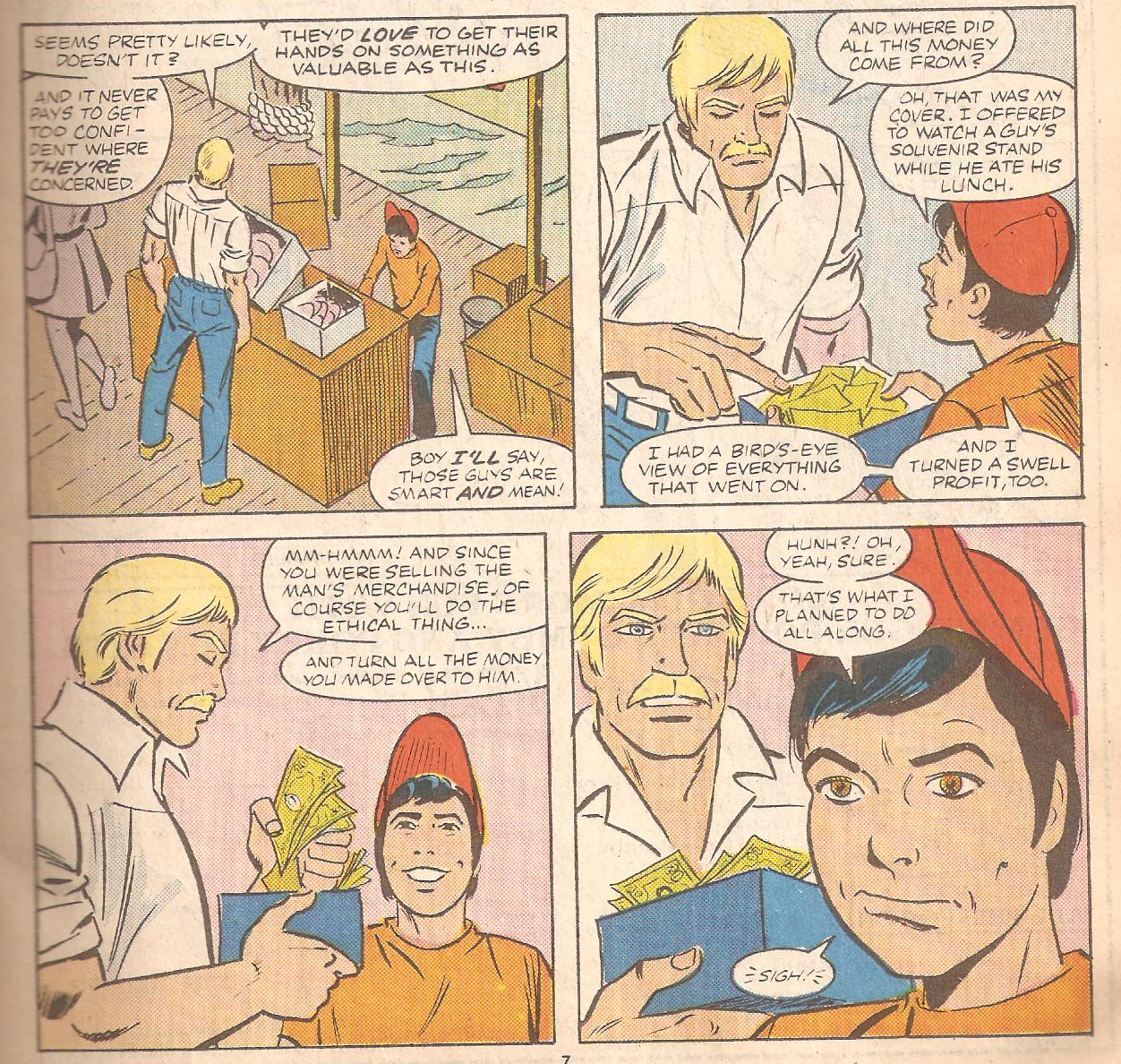
Stupid Comics posted a scene in Chuck Norris Karate Kommandos where near the end, "the cast talks about "James "Shogun" Clavell's The Children's Story, an Ayn Rand-ish fable about a dystopian future America where children are brainwashed by an authoritarian collectivist dictatorship."  But there's a certain scene in the 2nd issue that I feel deserves a closer look:

While he largely turned his back on the comics' world, that didn't stop his throes of admirers (who he was reluctant to lavish praise upon him, lest his head swell too large), and answering letters in his own inimitable way, all handwritten, no typewriter.


Probably the most surprising reveal from this above entry was that he had no knowledge of Carl Barks, the "Good Duck" artist.  Considering that almost anybody who gets into the business gets so because they started out via reading Uncle Scrooge comics, this is an amazing oversight.  It's like getting into the Newspaper Comic business without knowing who Calvin & Hobbes were.  (To be fair, Berkley Breathed had no knowledge of Pogo when he started Bloom County, and basically threw everything he could think of, breaking rules that he didn't even know existed)

Probably the best portrayal of Ditko's worldview would be from a short story originally published in the 160-page graphic novel Steve Ditko's Static in 1988: that was shown on Brietbart of all things - that is now offline, but I was able to save a copy of the 4-page piece of madness that you can see for yourself.


As with any Strawman argument, the story collapses if you think about it too much.  Having a single drop of blood taken from you once a year to help people worldwide isn't too bad a premise.  Where it falls apart is leaving this charitable donation down to just ONE man, instead of outletting it to MANY people.

Fun fact - for the longest time, I always pronounced his name as DIK-TO, not DIT-KO.  I wonder if anybody else had the same problem?

Monday, January 29, 2018

Mort Man Walking

Mort Walker, creator of Beetle Bailey, Hi & Lois, and multiple other innovative comics with his imitable doodles, just died.  Though you'd be forgiven for thinking he'd passed on years ago, given the sheer redundancy of the newspaper page, and the desire to see newer comics that pushed the boundaries of experimentation. 

In addition to his impressive factory output, he also put effort in preserving cartoon history at a time when such childish entertainment was still seen as disposable.  (Not to be confused with the Cartoon Museum in London which collects British comics)

He also coined nonsensical-sounding names for the ubiquitous symbolic visual shortcuts inherent of comics, such as sound effects, flop sweat, and cursing, which he called Quimps, Plewds, And Grawlixes, which never really caught on with the later generation for some reason.


His comics were known for being problematic with portrayal of women, which Mort Walker casually brushed off, saying that he was constantly constrained by newspaper censors who'd cover up his lovely ladies using black markers.


The Army in particular didn't take their casual mocking lightly, which only made Beetle Bailey more popular.  The more the authorities decried it, the more the lower ranked private personal identified with it.


Which just goes to show you that the more you try to stop people from seeing something, they resist all attempts to do so.  Though sometimes they succeed, which is why censors of 'good taste' keep trying.

Oh yes, there was also the occasional crossover with Hi & Lois, which didn't exactly reach the heights of crossover appeal achieved in Sam's Strip, which was years ahead of its time.

Ironically enough, for someone who went to such lengths to preserve lost arts, Mort Walker didn't do much to produce material that would last throughout the ages, going for the quick and easy commercial stuff that would be easily marketable anywhere.  The few times that he did go out of the way to make commentary were remarkable in being unremarkable, being sandwiched between so many instances of mediocrity.


New characters would be routinely introduced throughout the years to reflect changing times, but they were just as ephemeral and insubstantial as any other.  The lack of ongoing stories made it easy to jump in, but the limited character interaction between multiple parties played havoc with your memory thanks to a continuous stagnation of the status quo.

You could jump in any random Mort Walker comic within the last 50 years, and feel like you hadn't missed anything of substance.  That in itself is his greatest strength and weakness.