Showing posts with label Fox Trot. Show all posts

Tuesday, November 10, 2020

Obituary: “Who was the Host of Jeopardy!”?

Since 1984 this well-known and widely beloved television game show host lent intelligence and class to one of the most popular quiz programs in TV history, until his passing today at the age of eighty.  --Karl J Martin

In a roller-coaster Chinese cursed year filled with unexpected disastrous cataclysmatic results, the death of Alex Trebek feels more like an anticlimax.  After the diagnosis of stage 4 pancreatic cancer, we all knew it was likely coming, but it still took us by surprise.  He continued to keep up his Jeopardy! appearances, allaying the illusion that everything was still fine, so the ensuing impact still felt like a low blow.

If there’s one thing that everybody seems to agree on, it’s that Alex Trebek was widely looked upon as a gentleman with hardly anybody saying a bad word of him.  He was one of the few universally loved and trusted figures left.  This was accomplished via his indefatigable gracious manner and sense of humour, always ready and willing to make a joke. "I try not to take myself too seriously," he told an interviewer in 2004. "I don't want to come off as a pompous ass and indicate that I know everything when I don't."

From MAD 347, "If God were One of Us".

For as long as I’ve known, he’s always been the host of Jeopardy!, and had a distinctive mustache.  But before that, he tried out at various roles, covering news, sports and other gameshows that have long since passed public consciousness, such as "The Wizard of Odds," "High Rollers," "The $128,000 Question", "Double Dare", "To Tell the Truth" and "Classic Concentration."  The ironic part is that back then, Alex Trebek remarked thatI don't want to do this all my life. Hell, I don't even watch game shows.”  Hardly the words of someone who would become a defining element of a nationally syndicated game show.

From MAD 350, "Quotes You Can Bet Were Never Said"

Perhaps it’s because Jeopardy! demanded a higher degree of knowledge from the contestants that other shows didn’t that elevated Alex Trebek to giving higher quality services that was absent elsewhere.

It also didn’t hurt that Alex Trebek kept his known reputation as a honorary Canadian, being a natural ambassador, and his playful attitude helped play down his reservoir of knowledge, even as he was regarded as the guy who “was arrogant because he had all the answers”.

And yet, even when the contestants were doing unevenly, when the contestants bet badly on True Daily Doubles, when the answers given were incorrectly stated, he never made anybody feel bad about having given the wrong answers.  Even on the rare instance where all three contestants failed to win in the final round.

When the Coronavirus was rampaging and Alex was recuperating, there were some old Jeopardy! reruns shown, back when the show had it’s name shown in giant blinking lights (leaving out the grand prizes presentations before announcing the final Jeopardy category, which was just filling up airtime).  One thing that surprised me was that back then, the interview with the contestants - which normally took place after the commercial break - happened before the commercials.

Somebody really should compile a collection of his most humourous lines.  Sometimes he’d give amusing feedback when reading the categories.  In one such instance, in an interview with one of the contestants, he’d mentioned he wasn’t good in classic opera.  And guess what specific category showed up?  The very same category the contestant was bad at.  To this, Alex simply muttered, “Uh-oh.”

A suitable replacement for Alex would be impossible to find, but the most speculated candidate would be Ken Jennings, fabled 74-time winner.  That would be quite the coup, going from long-lasting contestant to taking over the role of gameshow host.  Sadly, it turns out that Ken Jennings along with two other former Jeopardy! contestants is going onto another quiz game, The Chase.  We'll see if the show has any brand-name recognition a year later.  As a joke, Alex Trebek suggested that the person to replace him would be Betty White of Golden Girls fame, since audiences would want "somebody younger, somebody funnier to replace him."

The outpouring of affectionate compassion displayed towards Alex Trebek is in stark contrast to another certain gameshow host who thus shall remain nameless.  For future reference, the unnamed individual-1 shall henceforth be known only as "Ol' Whatsisname".

In fact, there's a surprising number of Jeopardy! comics devoted to crime, which is a stark contrast to the $64,000 Show, scandalized for informing the long-running challengers of the answers beforehand.

"What if we gave the contestants the answers?"

"Isn't that how the trouble started?"

"But then, they'd have to figure out the questions."

And that's how Jeopardy! was born. 

It's going to feel weird not having Johnny Gilbert introduce him anymore.  But at least Alex produced a lot of shows before his death.  His last airing will fittingly enough, be on Christmas Eve.

Wednesday, January 25, 2017

A Window into my Life

Things had been quite hectic at my Parent's house last year.  There was a lot of minor construction being done, which involved re-roofing the tiles, installing new insulation, exchanging Gas Heating for Electric, a new electronic reader, and installing new Windows inside the house.  (And I'm not talking computer software here)

This last renovation took longer than the others, since my Dad was rather finicky about making any rash decisions that could impact his living conditions.  He's solely responsible for yard maintenance, mowing the lawn, pulling weeds, doing minor repairs, shoveling snow, and other tedious little tasks to make the lush greenery on the grass look presentable.  He's admitted that he's had nightmares of the hedges surrounding the yard suddenly being ripped from their roots and replanted upside down.
In order to find the kinds of windows he was looking for, he was looking all around, comparing different dimension strengths, checking their advantages and disadvantages, looking for industrial strength that would not only keep the circulation of air during hot and cold weather, but also factoring in different opening options that would be best.  In a sense, he was literally window shopping.

Then, once he finally found a choice he was satisfied with, he started doing measurements, checking the dimensions of the replacements, and making sure that when the new frames were installed, whether the blinds would still be able to fit back once the replacements had been set.  These new windows weren't just being put inside where the old ones had been - no, the whole frame would change dimensions, potentially covering up the screwholes where the old blinds used to be.  Otherwise, that'd require drilling new holes into the foundation, something he wanted to avoid if necessary.

This momentous task wasn't something he wanted to rush into, so by the time he finally made his choice, it took him three years.  (I also mentioned he's a slow eater, which factors in his decision-making skills as well)  My father is the opposite of those TV sitcom dads who go around fixing things beyond repair due to their technological know-how.  No, he'll do major prep time, do calculations over and over to make sure the numbers are right because like me, he hates making mistakes.  The difference between him and me is that I like to get things done, and experiment around, not belabor a product that may never come.  Ironically enough, this work ethic doesn't apply to my writing.  If I get interrupted when I least expect it, it throws a wrench into my plans, throwing my whole planned schedule out of whack, demotivating me to the point where I don't even bother jotting down my ideas in the first place.

When the day finally came to replace the windows on the second floor, I helped him with shuttling the blinds from the bedrooms, bathroom and computer room to other locations, such as the guest room bed, the basement table, and a carpeted bedroom floor.  The actual installation took just a little less than an afternoon.  Yet, after that, the blinds were left off the new windows for at least three weeks.  This meant anybody within viewing distance could just peek into the upper floors of their house with the proper viewing equipment.

This was quite problematic for me, because I relied on having these blinds block the light streaming into my eyes.  It was most problematic for my Mother's office, because the sun happened to be strongest from her direction.  A stopgap was applied by having a towel draped over the metal area where the blinds used to be, reducing the glare somewhat.  Most problematic was the bathroom and bedroom, where I took the occasional mid-afternoon nap during stressful situations, which proved almost impossible, because I'm extremely sensitive to bright lights, and had modified the blind with duct tape so no light could stream through.  (To be frank, I never expected the blinds to be removed, so didn't see any point in leaving them open, since what fool would want to subject themselves to the bright outdoors early in the morning?)

The most problematic aspect was having no available protection available in the bathroom, which was the only place I felt comfortable reading.  (My family has affectionately nicknamed it "The Library" considering how much time I spend there)  Part of the reason being that the lighting doesn't reflect off the surface of some of the shinier papers of American comics I take out of the library.  Others being that I don't feel claustrophobic or distracted by the nearby bathroom elements such as the towels and wallpaper there.  As such, I was forced to do my reading elsewhere, or wait until dark to not get bothered by the sun outside.

Also, this bathroom had the towel rack removed to make room for putting the replacement windows, and those also took their sweet time being put back as well.  This wouldn't have been so problematic if this particular bathroom didn't have a shower and bath, which made washing up problematic.  There wasn't anyplace safe to put a wet towel, save for on the stair railing, which was quite easy to forget once you'd locked the door.  I had to carefully plan out my shower schedule, coordinating my previously mindless ritual, which played at odds with my regular routine.  I had to keep a watchful eye, making sure that no one outside was looking, preying on my paranoiac fears, having been confused over the purpose behind the "It's Okay to say No" PSAs.  I didn't understand why there were people out there who'd be so interested in seeing my privates.  Surely, my naughty bits were areas of vital National Interest from Foreign Powers who wanted to compare sizes for some indiscernible reason.

When the blinds were finally put back in place, it looked like the prospect of having light streaming in my eyes was over.  However, that wasn't the case for the bathroom.  An unforeseen side effect of the new frames is that they're now significantly higher than they used to be, while the blinds remained the same length.  As a result, there's a small imperceptible gap of light now streaming through the bottom that was previously blocked.  This minor detail would've gone unnoticed by the majority, but as someone notoriously sensitive to bright light, it stuck out to me like a sore thumb.  And the bathroom is where I do most of my major comic reading.

To overcome this annoying obstacle that's come to light, I now have to take a container of mouthwash or soap, and place the bottle alongside the newly-installed towel rack, and place it against the lower end of the blind so that the light doesn't stream from the bottom.  Sometimes I get so used to feeling comfortable that I forget to put the cleansers back in their proper place, which drives my Dad further nuts.

At least he doesn't have to worry about me tampering with his products at night.

Sunday, December 18, 2016

Slug-Man "The Final Confrontation III"


Apparently, the market for inside jokes regarding various Sunday Comics filtered throughout children's drawings was an extremely limited market, appealing only to me, considering how few links it gained.  Since my last entry regarding childish drawings wound up being so unpopular, I decided to change tacks, and showcase something similar that I figured would garner larger interest.
The second Fox Trot Anthology collection, En Masse, had a secondary comic along the likes of the larger Calvin & Hobbes collections - a Slug-Man comic drawn through the vein of Jason Fox's warped vision.
Apart from the coloured Sunday comics, this was the only new material to make up the bulk of the collection.  And I was reluctant to purchase a book containing material I already had just to gain a few pages of a short story that I wasn't really that invested in in the first place.  Not to mention I was hoping that it'd be reprinted in another anthology elsewhere further down the line.

Fortunately, a Facebook user had the whole thing available (and still is), on her page, and I was able to bypass my hurdle of paying for something I was reluctant to shell out for in the first place.  So far, these pages haven't been reprinted anywhere else, and none of the later Fox Trot collections had any bonus material, save for a look into the cartoonist's creative process of creating a typical Fox Trot strip.
One good reason might be that this kind of material could easily be classified as an Old Shame.
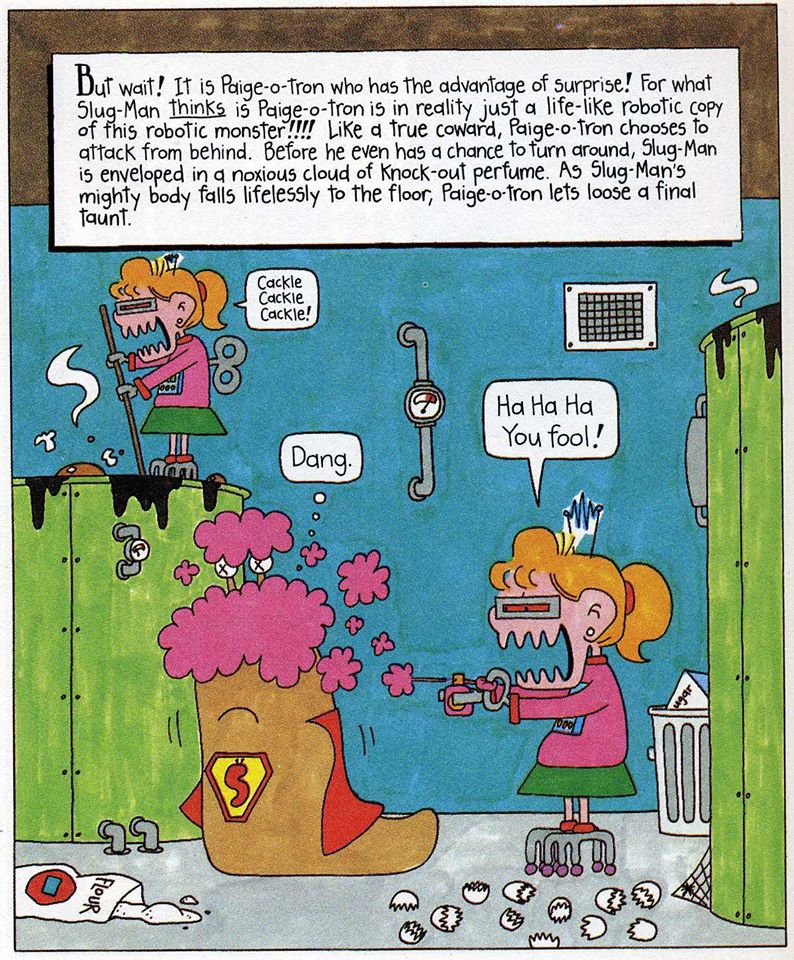
Much of the appeal of Slug-Man comics was hearing Jason's attempts at trying to mimic the over-the-top aspects of a typical Superhero comic with all the Adam West Batman Show cliches present.  Paige-o-Tron is a nakedly disguised representation of Jason's animosity towards his sister, which isn't that far removed from other comic creators venting their frustration towards real-life figures on the funny pages.
But much of that enjoyment is significantly lessened when seeing an actual full-length Slug-Man comic with none of the stylistic beats of a Sunday strip.  Perhaps a project like this would've required quality control to look closer to an amateur's attempt, or reduce the flowery purple narrative boxes that cover up the majority of the artwork, leaving hardly any room for (un)natural dialogue.  Or maybe my standards are just too high.
Something that's been recently pointed out is that there's a large influx of movies that get by, by being purely average.  They don't aspire to reveal any inner humane truths - they just go through the motions, rehashing reheated dialogue and scenes from other movies.  They're neither Sleeper Hits or Must-Sees, or So bad it's Good, but more along the lines of So Okay it's Average.  And that's where these Slug-Man comics lie.
It took me awhile to work around just why I was so reluctant to splurge the hard-earned cash over for 
that I had no real vested emotional interest in.  (Even though it'd fill in a hole in my collection)  Having mostly flipped through the pages in a hurry in order to absorb the contents, I didn't have much time to think through the main reason.  And then I hit upon it - apart from the Superhero beats (which I've never really warmed up to), the majority of the Slug-Man comic simply isn't that particularly clever or funny.
It's not so much that the comic plays the Superhero cliches straight - it doesn't do so in a manner that's any different from what's been done hundreds of thousands of times already.  This isn't a satire on a tired genre - it's an outsider's perspective of the medium, filtered through a child, as penned by an adult man.  With all these elements, you'd expect there to be some kind of commentary that would be accessible to all audiences.  But apart from some light touches here and there, it plays the whole thing totally straight.
If you look at the upper right corner of the Slug-Man cover, you'll see that the price has been constantly slashed down to the point where it's practically given away for free.  If Jason couldn't give these comics away, then what possible value could be foisted on these pages, which aren't even consistent from panel to panel?  "Seal of Quality", indeed.  And I use "Quality" in ironic quotation marks.
One thing that always annoyed me about abundant narrative boxes was how much they detracted from enjoying the comic, revealing useless details about how you're supposed to feel about a character or events playing out in front of you.  Much of the work stemming from writers who believed the power of their work was only emphasized by the amount of verbose baggage they cram their hacked stories together, and not trusting the artist to convey their vision across.  Which oftentimes results in such clumsy sentences such as, "He jumped fifty feet high!" "He punched him all the way across the room!" "He's drinking his tea now!"  And the pertinent facts that are relevant are buried in the huge paragraphs they've laboured on, to make sure that every single line is read.
You could ignore the majority of the narrative boxes, and just focus on the main action (like I did), and you'd still wind up with greater comprehension of what happened.  Comic fans nowadays may complain of "decompression" where a story that normally took place in the span of a single monthly comic issue was instead stretched out over the span of six months.  But those are bad usage of writers not understanding how to properly use decompression, and Comic fans mistaking the large amount of overwritten narrative boxes for content.
It may not seem apparent, but only the cover and last page are full-sized comic pages.  The regular content of the Slug-Man comic was displayed on a four-panel comic grid that were chopped up for easier readability.  The "quality" of the comic otherwise, I'd argue that it's easier to read this way.  The narrative box keeps switching from top to bottom, forcing the reader to focus their eyes across the page, depending on where they're likely to look next.
If there's a tentative sameness to S-hero stories, it's because much like the authorities, the heroes don't actively go out of their way to stop disasters before they happen.  They only step up once the factors start to personally impede onto their lives.  Oftentimes, jailing up or having the criminal masterminds run away to fight another day thanks to a contrived distraction that just happened to pop up in the nick of time helps as a useful narrative crutch for popular reoccurring villains.  But it can become annoyingly obvious when overused to the point of absurdity.
The general solution to any conflicts in Superhero comics  is to punch problems in the face until they're solved.  That may be a gross oversimplification, but the instances where conflicts are resolved without violence (including where two heroes fight each other over a misunderstanding) is remarkably small.  The whole purpose is to give a semblance of calm to the status quo, however long that lasts, until the next major revamp, the latest creative team wanting to shake things up to appeal to long-jaded readers who're constantly in need of their next fix, and need to have long-running franchise comics relevant to today's issues, even though newer characters from younger creators not tied down to corporations stealing million-dollar ideas from underpaid artists would be more appropriate.  No, I'm not particularly bitter, but I know a few people who are.
As typical of a Jason Fox get-rich quick scheme, the comic ends with a full advertisement page, filled with merchandising products that will never ever be available.

Saturday, January 23, 2016

What is the Form of a Question?

This Monday, viewers were treated to a rare feat on Jeopardy!  By sheer chance, every single contestant decided to wager everything they'd won onto the Final Jeopardy! question... only for all three to lose their savings in one fell swoop.  This kind of occurrence has only happened six times during Jeopardy!'s 50+ year run.  At least it didn't happen during a Tournament of Champions.

An actual 3-way Tournament of Champions tie would be an incredible upset, resulting in audience outrage.  Not long ago last year, we were treated to the exploits of a rather remarkable achievements of a young paralegal who came out of nowhere to dominate the Jeopardy! board.  Online reaction was mixed, being amazed and appalled at Matt Jackson's autistic-like ability to perfectly time his answers as soon as Alex Trebek confirmed they were right.  Those haters weren't looking forward to having another contestant who'd keep staying on the game for what looked like months on end.

They reminded me (naturally!) of an early MAD satire of a gameshow starring a contestant who was rather unpopular, despite his impressive ability of accurately making rapid-fire predictions down to the decimal point.  In between rounds, we found out some interesting trivia about Matt Jackson, including the fact that he had a Jewish mother and a Christian father, as well as a twin brother.

During Matt Jackson's run, Alex Trebek mentioned that previous champions were hoping that he'd keep up his winning streak, since they were terrified of having to face up against him for the Tournament of Champions.

In one particular Daily Double (Oct. 7), Matt Jackson bet the sum of "Five" in a Music category. (WHY he kept persisting in a category he was having trouble with is a mystery)  After making the wager, Alex said "$5000?  Alright then, here's the clue..." to which Matt Jackson got wrong, but a measly $5 was deducted from his score, which was a major factor, because it was still a close game; and Matt Jackson lived to play for another day.

As it turned out, the latest contender for breaking Ken Jennings' 74-day record ended after a mere 13 days, losing to Michael Baker after being overconfident in betting in Final Jeopardy!, but then it was a very close game, having just a $200 advantage over his closest competitor.  Michael Baker seemed like a worthy replacement... only to wind up losing the very next day.

When shown in the Tournament of Champions, Matt Jackson's introduction, whose trademark of opening with raised fingers of his running streak, and a creepy unwavering timed smile was inverted by opening up with a smile that tapered down to a disappointed smile.  That reversal could've been considered prophetic, considering how disappointing Matt Jackson's results were.

In the semi-finals, he continued his usual pattern of racking up maddening numbers of moolah, easily outpacing the other opponents.  But then he fell apart after reaching the 2-day final rounds.  His strategy of quickly pressing the buzzer and choosing the mid-number categories to get the Daily Doubles faster only works if he's the only one implementing that strategy.  His contender, Alex Jacob, who copied that tactic to great effect left Matt Jackson constantly playing catch-up.  Losing valuable money on wrong Daily Double answers didn't help Matt either, and by the end of the first Final Jeopardy!, he'd lost most of the money he'd made, despite impressively keeping pace once he finally got his rhythm going.

Also, in deference to Matt Jackson's line of rapid-fire answering, Alex Jacob used the counter-intuitive method on every Daily Double by taking his sweet time giving an answer, looking constantly worried, then popping a question... which would turn out to be right every time.  The man certainly knew how to play his audience.

As it turns out, answering Jeopardy! questions isn't as easy as it looks.  In addition to being prepared, there's the overhead studio lights and mounting pressure to keep up the pace, even when you win multiple games in a row.  Eventually, that strain begins to build over your head until you crack.

Tuesday, January 19, 2016

Absence of Valise

You notice all kinds of weird things while browsing old online newspaper archives.  For starters, due to rushing the scanning process and lack of double-checking the source material, some pages are accidentally posted twice.  And other gap in the dates are filled in previous dates that run together that were never divided.  For instance, you can look up an article in say, November 28, 1985, and find a paper wasn't available that day, because they were celebrating Thanksgiving, thus yesterday's date would double-up on their features which would compensate for the lack of a paper the following day.

But this wasn't just regulated to national holidays - it happened sporadically.  There are wide swatches of missing patches scattered here and there, which makes finding archived quality comics a nightmare for anyone who didn't bother to keep a subscription to every published newspaper ever.

And then, there are the scanning errors.

This probably isn't how it originally appeared in the pages, but I like how Jeff's (the father) face is distorted in the second panel, because it looks like he's in one of those non-twinning in-between frames from multiple hand-drawn animated cartoons.  (Something that 3D animation has yet to perfect)

Another feature is that some newspaper comics used to have advertising of available book collections of the most popular strips in the margins.  Nowadays, you're more likely to see that kind of self-promotion in the cover header of the latest scanlated issue.  (which explains the wide empty spaces at the beginning and end of every chapter)

With the majority of newspaper comic content being readily available online, there isn't much impetus to seek out other comics for their low-impact humour since audiences are more likely to stick with the material they're most familiar with.  Having a singular page showing one strip at a time isn't close enough to the newspaper comic model.  The closest equivalent would be one large page that'd show every single comic that'd appear on that day.  Such a model would be an assault on their bandwidth, but it'd give audiences a wider range of samples to draw from.
This Dilbert strip is actually made worse by the lack of the middle panel
One feature that's been largely eliminated is the prospect of missing or absent comics.  For the most part, these were hand-waved away by dint of being unsuitable or controversial enough for the family content of a newspaper.  (Whose rationale for attracting reader numbers is the motto "If it Bleeds, it Leads")
If the middle panel had a suitcase, the title post would make more sense.
These strips would usually be replaced by other comics or older material.  (Pogo was notorious for having Bunny strips for its impenetrable political comics)  Considering their disposable nature, and that today's cartoonists are required to take mandatory vacations, it's surprising that other cartoonists didn't get the chance to jump in and try to substitute as a guest strip for a trial period.  Then again, some comics are so popular with certain newspaper subscribers that they're usually the only reason they bother to stay on, so removing them (even temporarily) is a risky prospect.  Calvin & Hobbes spent almost 2 years on sabbatical, but remained endearing, so there's 7 1/2 years of material within its 10-year run.

Nowadays, if there's a comic that's been banned from the pages for one reason or another (recall Opus' Burqa issue), it's just a matter of a quick search result to find the offending material, and wonder what the fuss was all about.  (Unless you're on a limited-information dictatorship plan)  But back then, there was another kind of self-censorship that had nothing to do with imposing values.  I'm referring to the most dreaded quote of debt collectors and editorial feedback: "Your submission got lost in the mail."
Back then, cartoons were shipped forward and back via a shipping process that for one reason or another, wasn't entirely reliable.  Such a method using snail mail would be considered unthinkable today.  Even more unusual would be if multiple comics happened to be "lost" along the way.
Normally under unusual circumstances, missing or mangled comics would get a correction with a proper image on the second page the next day.  But I can assure you that no such compensation was given for these comics.  Not that much would've been missed with these particular strips, but still, having 1/5th of your intended reading material cut off without any backup is kind of an insult.  Fortunately, as far as I can tell, this kind of thing didn't happen often.  Of course, that's only judging from the available online stuff.  The online archives for other papers which require a paying subscription to access their contents is still out of my reach.  I have no intention of giving away good money without sampling the wares.  (i.e., what comics those newspapers have)

Sunday, October 18, 2015

Great, Now I'll HAVE to Read the Articles


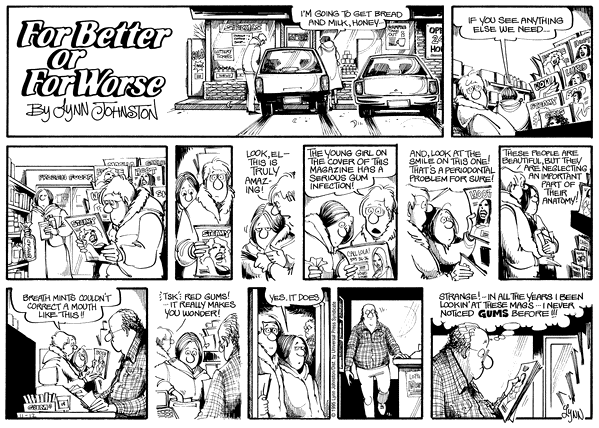
Just recently, it was announced that Playboy, long-time purveyor of editorials and erotic content made the stunning business decision that they would no longer be featuring nudes in their once-respected (popular) magazine.  This would normally be considered a death knell for a publication that once featured the works of artists (several who worked for children's comics) such as Harvey Kurtzman, Will Elder, Jack Cole, Jules Feiffer, B. Kliban, Gahan Wilson and Shel Silverstein.  Then you remember that none of those previously mentioned names have contributed to the magazine when it was at its peak of its popularity since the 70s.

Having been made redundant by the vast amount of alternate content available on the web (the internet is now closely associated with porn than Playboy), they've figured that their modus operandi of appealing to the lowest common denominator was no longer low enough to deal with their raunchier competitors (Penthouse, Hustler, Foxy, Club) who weren't afraid to show more than just teasing images.  What once was shocking has now become the norm, and the amount of skin shown in Playboy would hardly raise an eyebrow today, compared to what else's available out there.  Not that I would know - I haven't cracked open a Playboy in my life.  (Note I didn't say anything about the other magazines, though)

For years, Playboy was praised for the quality of its essays, but I never believed this claim, figuring that its main draw was the nude shoots, since the dull impact of words could hardly win over the direct impact of its pictures.  (I never even bothered with reading playmates likes/dislikes, since they were effectively irrelevant)  It seemed like a convenient excuse for exercising the mind to make up for browsing lower-functioning content.

The only staple of current customers were faithful fans who'd stayed with the magazine since their youth, who were now looking at models young enough to be their grandchildren... assuming they had any kids in the first place.  So despite falling into obsolescence while still having enough brand name recognition (and the perplexingly popularity of the Bunny suit among female Manga characters, including Ranma, Sailor Moon and Haruhi Suzumiya), Playboy figured that the only way to combat ubiquitous online (and self-generated) nudity was to adapt or die.  So Hugh Hefner decided to change in the most seemingly self-destructive way possible, short of printing the pages with Mission Impossible mission statements.

Surprisingly enough, shortly after the announcement, the Playboy website had a sudden surge of popularity from curious bystanders who wanted their minds to be engaged.  (Source from a site that has sensationalist news photobombs in its sidebars)  Whether those numbers will translate potential newcomers to repeat viewers is still up in the air for now.  The rise of hits on Playboy's site suggests that there's a fair number of people who want access to informative articles without being associated with questionable content that hurt its reputation.  However, if Playboy doesn't manage to provide enough stimulating material, chances are readers will abandon the tastefully dressed girls in favor of less pandering tastes.

You can only distract people by the Sexy (Vote for Bart!) for so long until they're bored enough to seek attention elsewhere.  Then, they'll look for The Sexy elsewhere.