Showing posts with label Dilbert. Show all posts

Monday, March 27, 2017

A Handshaking Primer

There was much preamble made about Donald's infantile power grab to assert dominance by yanking the shakee's arm in his general direction, and holding their sweaty palms an uncomfortably longer time than usual.  That strategy completely fell apart in the presence of Justin Trudeau.  (A well-described Epic Standoff summarized here) If there's one thing Canadians can't be faulted on, it's not knowing Americans better than they know themselves.

And then there was his outright refusal to shake the hand of Angela Merkel, the German Chancellor.  There was speculation that he didn't want to touch a woman who wasn't a perfect 10, or helping him down stairs.  But it's also possible he was shaken after Trudeau beat Trump's handshaking strategy by his own hands.  After being humiliated like that, why risk making yourself look foolish again?

Of course, all this boils down to a simple case of handshaking ignorance, since there's no course on the proper way to shake someone.  I haven't had much experience in this, but the few instances I've had suggests that there's a large void of information on what should be a very basic act.

First off, most people tend to just limply offer their hands in a floppy manner, letting it languish in the shaker's grip.  This is wrong.  You're not supposed to merely shake from the wrist alone.

A good proper shake should originate from the shoulder, energetically pumping at the elbow like you're drawing water from an old pump.  The recommended length of time is three to six shakes, releasing after a scant five seconds after the activity's over.  Pleasantries can be exchanged during this action; and lingering longer with someone who's not your secret lover should be avoided.  It also shouldn't be considered a power move to intimidate, crushing the shakee's hand.  Unless both parties are of considerable or equal strength.

Furthermore, the palms of the hands should be firmly placed between the hollow of the other's palm.  Using the same hand (Left hand & left hand, Right hand and right hand) is preferred, but not the mirrored image. Otherwise, unfortunate implications and injuries might occur.  Unless you're heavily engaged in elaborate welcoming / farewell reception rituals, involving high slaps and synchronized gestures that only members "in the know" would recognize, the general reception should be to keep it basic.

Extra tip - wiping down the other person's sweat in open view is also considered bad manners, though I've never seen anybody openly do that.

Incidentally, I had a panel I intended to use, from Archie's Dennis the Menace ripoff, Pipsqueak Visits the Farm, but was unable to find it, on account of having given the digest said comic was in away, confident I wouldn't need it again.  (Hindsight is always 20/20)  Ironically, for a lackluster comic, it contained an extremely rare instance of a mutual handshake done properly without any comedic elements added to it.  Anybody who has a physical copy on their shelves will know what I'm talking about.

Tuesday, February 16, 2016

Putting my Knee Down

I almost didn't contribute a Weird Romance this year.  I'd been otherwise preoccupied with other things that'd been distracting me; the least of which was that I noticed that I was having trouble walking.  Lately, I would attempt to go up stairs, or crawl around, and feel a lingering pain beneath the waist.

Then I noticed that my knee was bloated and swelling on one side.

It didn't take too long to figure out the cause of this symptom.  Normally, when I switch positions while sitting on the computer, I'll opt to sitting on my knees for extra pressure, since I enjoy the feel of heavy G's on my person.  Unpredictable light touches make me nervous, but direct heavy force calms me.  I've always carried a heavy backpack since my school days, since I feel comfortable knowing that I've got everything I need in there.  (It also makes it easier to lean my arms against a thick spine of books while riding the bus)

However, one thing that religiously devout people don't mention about being on your knees all the time is that it builds up callouses, just like any other part of your body.  I was utterly surprised to find out that other people didn't normally develop white crusty blisters on their elbows and knees.  I thought it was a naturally occurring symptom.
Not mine, but a medical representation.
Mine also had two smaller calluses below the knee where I rested my legs.
I've been so used to being on my knees while on the computer that I didn't even notice that my knees were developing pus-filled burst blood vessels until it became too painful to ignore.  I tried to relieve it with some leftover cream, but it'd apparently passed its expiration date some years ago, since it wasn't working.  Obviously, this condition wouldn't be easily cured overnight, which meant a visit to the walk-in clinic, but I'd have to wait the next day, after making an overnight appointment beforehand.
My general philosophy of "Maybe if I ignore it, it'll go away"
wasn't proving to work out after the second day.
The worst part was having to tell the clinic people that I'm Deaf and have Aspergers, to the receptionist, then to the nurse (who I always mistake for the doctor) and again for the doctor himself, since it's been ages since I last went, and they'd forgotten they had my file on record.  Also not an easy concept to manage for someone with social anxiety.  Fortunately, having somebody else to fill in the details of how to speak to me helped.
I can't understand how anybody can get used to asking the same questions
multiple times a day.
When the doctor showed up, the Nurse gave him the heads-up on my condition, but failed to pass on the necessary information on how to properly talk to me, so upon finding out I was Deaf, he talked to me in a shouting haltingly manner, which I told him wasn't necessary.  (Normal speech in a clear concise manner is enough)  His previous contact with Deaf clients were mainly elderly people who refused to acknowledge or admit that their hearing was going, so he didn't have much experience under his belt.  I was the first Deaf person below retirement age he'd ever seen.

The doctor gave a prescription, and a warning to stop sitting on my knees for the time being.  While it sounds obvious, it's not very easy for someone so ingrained with certain habits to break them, despite all evidence to the contrary that these actions are hazardous to your health.

I thought I'd have to reorganize my current writing space, so that I could work standing up by leaning up against a long flat surface (somewhat like against the back edge of a filing cabinet), since it'd save the effort of having to buy a new piece of space-wasting furniture, and it'd be easier than having to use one of the newfangled "standing stations" that revolutionize office work.  But then it was decided I needed a chair that didn't restrain my legs from spreading wide enough.  (Preferably one with elevated armrests)
I take a weirdly morbid sense of pride in my calluses.
Currently, the swelling's gone down, and the pain's been relieved, but there's still a worrying red spot that hasn't gone away.  And chances are it won't take long for me to fall back onto my old patterns, despite repeat proclamations of the risk and dangers I'm putting my body under.

Tuesday, January 19, 2016

Absence of Valise

You notice all kinds of weird things while browsing old online newspaper archives.  For starters, due to rushing the scanning process and lack of double-checking the source material, some pages are accidentally posted twice.  And other gap in the dates are filled in previous dates that run together that were never divided.  For instance, you can look up an article in say, November 28, 1985, and find a paper wasn't available that day, because they were celebrating Thanksgiving, thus yesterday's date would double-up on their features which would compensate for the lack of a paper the following day.

But this wasn't just regulated to national holidays - it happened sporadically.  There are wide swatches of missing patches scattered here and there, which makes finding archived quality comics a nightmare for anyone who didn't bother to keep a subscription to every published newspaper ever.

And then, there are the scanning errors.

This probably isn't how it originally appeared in the pages, but I like how Jeff's (the father) face is distorted in the second panel, because it looks like he's in one of those non-twinning in-between frames from multiple hand-drawn animated cartoons.  (Something that 3D animation has yet to perfect)

Another feature is that some newspaper comics used to have advertising of available book collections of the most popular strips in the margins.  Nowadays, you're more likely to see that kind of self-promotion in the cover header of the latest scanlated issue.  (which explains the wide empty spaces at the beginning and end of every chapter)

With the majority of newspaper comic content being readily available online, there isn't much impetus to seek out other comics for their low-impact humour since audiences are more likely to stick with the material they're most familiar with.  Having a singular page showing one strip at a time isn't close enough to the newspaper comic model.  The closest equivalent would be one large page that'd show every single comic that'd appear on that day.  Such a model would be an assault on their bandwidth, but it'd give audiences a wider range of samples to draw from.
This Dilbert strip is actually made worse by the lack of the middle panel
One feature that's been largely eliminated is the prospect of missing or absent comics.  For the most part, these were hand-waved away by dint of being unsuitable or controversial enough for the family content of a newspaper.  (Whose rationale for attracting reader numbers is the motto "If it Bleeds, it Leads")
If the middle panel had a suitcase, the title post would make more sense.
These strips would usually be replaced by other comics or older material.  (Pogo was notorious for having Bunny strips for its impenetrable political comics)  Considering their disposable nature, and that today's cartoonists are required to take mandatory vacations, it's surprising that other cartoonists didn't get the chance to jump in and try to substitute as a guest strip for a trial period.  Then again, some comics are so popular with certain newspaper subscribers that they're usually the only reason they bother to stay on, so removing them (even temporarily) is a risky prospect.  Calvin & Hobbes spent almost 2 years on sabbatical, but remained endearing, so there's 7 1/2 years of material within its 10-year run.

Nowadays, if there's a comic that's been banned from the pages for one reason or another (recall Opus' Burqa issue), it's just a matter of a quick search result to find the offending material, and wonder what the fuss was all about.  (Unless you're on a limited-information dictatorship plan)  But back then, there was another kind of self-censorship that had nothing to do with imposing values.  I'm referring to the most dreaded quote of debt collectors and editorial feedback: "Your submission got lost in the mail."
Back then, cartoons were shipped forward and back via a shipping process that for one reason or another, wasn't entirely reliable.  Such a method using snail mail would be considered unthinkable today.  Even more unusual would be if multiple comics happened to be "lost" along the way.
Normally under unusual circumstances, missing or mangled comics would get a correction with a proper image on the second page the next day.  But I can assure you that no such compensation was given for these comics.  Not that much would've been missed with these particular strips, but still, having 1/5th of your intended reading material cut off without any backup is kind of an insult.  Fortunately, as far as I can tell, this kind of thing didn't happen often.  Of course, that's only judging from the available online stuff.  The online archives for other papers which require a paying subscription to access their contents is still out of my reach.  I have no intention of giving away good money without sampling the wares.  (i.e., what comics those newspapers have)

Sunday, June 14, 2015

Smile, Darn ya, Smile!

Just recently, I posed with my family for a photoshoot, since we missed out being photographed together at my sister's wedding, when it would've been the most convenient chance to have all of us captured at the height of our looks.  I suggested simply photoshopping various photos together to save us the time and energy, but my comments were left unheeded.

It took some considerable time and effort to plan a date with all of us, since anybody who's familiar with office scheduling knows, trying to plan a gettogether with so many people is something of an exercise in frustration and futility.

Also, it'd been a while since the wedding, and I hadn't bothered to get a new fancy suit, since I get invited to social events so rarely (except when occasion and tradition demands it).  So when I attempted to fit into my old duds, I was somewhat shocked at how tight they were.  It took some considerable effort to finally put my pants on, and I wound up feeling like Morticia Addams wearing her skintight uniform which the actress said, "Looked fantastic, but was practically impossible to move in."  (I hadn't bothered to test-wear my clothes beforehand, necessitating some preliminary exercise that could've shed some pounds off)  This wasn't helped any when it was determined that the shirt I was wearing wasn't fancy enough.  Then it was the wrong colour, and clashed with the basic black of my jacket (which also required some innovative contortion to fit into).
I put my arms in this position, then slowly edged my jacket downwards.
Further mitigating this factor was that when it came to changing my socks and shoes, I couldn't bend down enough to reach my laces, let alone slip into the soles.  I had to resort to taking my pants off in the bathroom, then slip on my shoes with the pants leg bunched around my ankles.  We were going to a lot of trouble to look like sophisticated upper class, when 99% of the time, we're generally dressed in casual clothes.  I would've worn my Pyjama outfit if I could've gotten away with it.  It all looks the same from a distance, anyways.

Once we finally got ourselves on the prospective location of the backyard instead of making the trek to a nearby lake (which helped prevent further stiff Frankenstein walking), we were ready for our closeups, and the photographer to do his rapid-fire shooting with his trusty Nikon D7100, the only multi-purpose camera professional photographers need.  When being shot at, that's something safe to be the receiving end of.  (Unless you're a celebrity in the midst of your scandalous personal secret shame)

However, the biggest deterrent to the whole project was yours truly.

I'm somewhat of a night owl and social recluse (being deaf does wonders for alienating you), and tend to face the sun as much of an everlasting obstacle.  I am convinced that there's an ongoing conspiracy to rearrange the landscape and nearby objects just so there'll be a patch of sunlight positioned just where I'm trying to relax.

Furthermore, I hate having flashes light up my face, and take great pains to avoid being photographed in the first place.
An example of a failed selfie.
I'm generally sensitive to bright light, and one of the many deterrents I take for protection from the harmful radioactive rays of the sun is by guarding my face with a baseball cap and sunglasses that look like they belong to a secret Government organization, which makes me look like a slobby Man in Black.  The only problem with this getup is that I tend to be somewhat lax in my appearances, and don't bother to comb my hair, let alone clean my glasses, since I find the dust helps reduce the glare when taking said sunglasses off.  And once my shades were removed, my intimidation factor withered in the face of my mother who insisted that I clean them to her specifications, since the camera would surely pick up microscopic dust particles lying around my lenses.  Today's cameras are more powerful than those of yesteryear, and can capture every unflattering facial feature, save those of celebrities who are photoshopped into perfection.

It was only by sheer chance that a weekend afternoon happened to be partially cloudy, which helped not only with the lighting, but also with cutting down the glare in my face.  Also, the camera was a digital camera, which I greatly favour over the old-school models which take room-filled flashes resulting in seeing unblinking stars that stay, even with your eyes closed.  If those flashless cameras had been around, I'd be more receptive to having my picture taken.

But even with that element in my favour, I was still helpless in the thralls of one other singular self-destructive habit - I'm not very good at smiling on demand.

Even when my face was contorted into the shape that I thought was shaped into a smile, I was told that I was frowning instead.  Apparently, pressing my stiff upper lip upwards doesn't seem to work as much as I feel it does.  It's often been said that it takes less muscles to smile than frown, but I've never understood this saying.  The easiest way to frown is to put your face in a neutral position, and let gravity do the work.  I strained as much as I could while looking in the mirror to hold a face that I thought looked perfectly natural, but was told I was grinning too maniacally.

The ironic part is that when I was younger, I was able to display natural smiles, and there were plenty of photos showing the proof.  I suggested transferring those smiles onto my face, but this suggestion, like my earlier one was summarily rejected.

To make matters more confounding, my brother-in-law, who only had to pose for 1/4 of the photos (lucky bastard), when he wasn't being photogenic, was doing amusing antics behind the photographer to make us laugh.  I'm told I have a natural smile when laughing, but have also been told that I tend to laugh too loudly.  So when put in this compromising situation where I should've smiled, what do you think I did?  I suppressed my smile, trying not to laugh.  My problem is that I've internalized the Groucho Marx / Buster Keaton method of humour, by never allowing my facial features to crack too much when telling subtle jokes.  This has a tendency to backfire, since at first glance, people aren't aware that I've told a joke in the first place, since I'm always giving out straight lines.  I'm a consummate straight man without a partner to react in my favor for me.


This predicament reminded me of the Children's book by Nancy Willard and Tomie de Paola, Simple Pictures are Best, about an elderly couple, who, in an attempt to look as sophisticated as possible, wind up implementing every aspect of their interests and hobbies into the photo.  And once they've finally got everything set up perfect, the elderly couple wind up being unable to smile.  The photographer's assistant has to help things along with trying to entertain them, without much success, until his antics wind up attracting the unwanted attention of a nearby bull, whose presence winds up yielding the desired results.  Once all the dust has finally settled down, the negative is developed, revealing the masterpiece... which is obscured by the body of a bull.  While the elderly couple look on the photograph with dubious looks on their faces, the photographer upon his departure, remarks the piece of advice he'd been saying the whole time, "Simple Pictures are Best."
The man wearing shoes in his ears makes sense in context.
Fortunately, we managed to have some better pictures of me inside the house where I felt more comfortable.

This rare photo of me and my sister is one of my mother's favorite pictures, since she said it so perfectly captures our essences.  My sister is cheerful, outgoing and friendly.  I'm sullen, introverted and smirking.  Her clothes are prim and proper.  Mine are rumpled and unkempt.  My sister looks pleased to be where she is.  I look like I'd rather be anywhere but here.  Furthermore, our umbrellas happen to convey our moods.  The one common constant between the two of us is that we're both carrying books.  Despite our differences, we love to read.
Let your umbrella reflect your smile.

Saturday, September 6, 2014

Influential Books

There's been some kind of meme going around with the following theme:  In your status, list 10 books that have stayed with you in some way. Don't take more than a few minutes, and don't think too hard about it. They don't have to be the "right" books, or great works for intellectuals, just ones that affected you in some way.  As chain letters go, you could hardly do worse.

After looking back over my list, they're all stories that deal with alienation in some way.  Comprehensive notes for the stories are as follows:

1. The young adult books of Gordon Kormon

The Canadian writer got his start with the troublemaking duo Bruno and Boots at MacDonald Hall boarding school, long before Harry Potter made such administrations seem appealing.  Interestingly enough, I wasn't a big fan of his works at first, but that was because I was in a small classroom with other orally deaf students, and the teacher made us read The War with Mr. Wizzle in a slow and methodical manner, making sure that we understood the material, effectively cutting off the joy of quickly reading and absorbing the story naturally.
She was technologically sound, but it really wasn't to my taste.  Oftentimes, her teaching methods and my learning ability were at odds with each other.

Since my only consensus in doing a book report was to hit all the checkmarks of what was required (what I liked, what I disliked, what the story was about), I hardly paid attention to the little details that were part and parcel of the story, such as what the book was about.  If I'd had a more concrete example to work from instead of having to rely on my internal critic, my reports would've been more organic and fluid instead of static.  As such, I wasn't able to really enjoy Gordon Kormon's stuff until later, far away from the prying eyes of literary critics whose only modus operandi is to overanalyze the text to the point of removing all joy from reading.  Of course, it's doubtful I would've been able to accurately give specific reviews to my teacher's liking, since I had (and still do) have a tendency to remain maddeningly vague and elusive about certain plot details out of an irrational fear for not spoiling the story for anyone who isn't already intimately aware of the details.  It's why I only look up reviews of comics, books and movies after I've already become acquainted with the subjects in question, so I can have my opinion verified, and even get an alternate look if my POV doesn't match the majority opinion.

Ironically, many of the technological concerns that were present in The War with Mr. Wizzle, such as having a computer rely for printout of data, or limited number of letters for names are charmingly anachronistic and outdated today.  These were modified to incompatible technology in later updated reprintings.

But it was Gordon Korman's attempt at youth literature aimed at an older audience that I consider among his strongest works, such as Don't Care High, an apathetic school rediscovering its long-forgotten school spirit, Son of Interflux, a rivalry between the businessman of a successful company of useless (yet essential items) and his artist wannabe son, A Semester in the Life of a Garbage Bag, an unlucky student fastidiously scheming to get an all-paid vacation to a Greek island of reputed luck, and my personal favorite, Losing Joe's Place, the madcap adventures of a guy and his two friends doing everything they can to keep his brother's apartment from leasing over Summer Vacation.  Don't Care High is actually the weakest of his attempts, but still got marks for the portrayal of the future School President Mike Otis.  Chosen completely at random, the boy is someone who speaks in monosyllables, never changes his outfit of a plastic pink raincoat with diaper pins regardless of weather, and drives a modified fancy car that doesn't exist on the market.  His most frequent saying to anything is "There are a lot of things at this school I don't understand."  Needless to say, I identified greatly with him, even though he hardly ever did anything.

2. The Wave by Todd Strasser

A true story about how a teacher's attempt to make his class more efficient wound up implicating a cult mentality throughout the school that bordered on frightening.  I later found out it was the novelization of a movie that was originally intended to be an After School Special back when they weren't just regulated to preachy moralistic shows,

The story was powerful enough to be remade into a German movie, which compressed the events into a week, which some critics expressed disbelief that a school would fall victim to fascism so quickly.  Interestingly enough, the events that inspired the book and movie actually occurred over the course of five days, which goes to show that truth is stranger than fiction.

It showed me how people were successible to peer pressure, and got me interested in cult mentality, such as Moonwebs.  I figured at least *I* would be immune, since such cults would require constant intervention from people, constantly exposing new ideas without time to develop or explain them, and I'd need time to process everything I was being told, and make sure I understood everything clearly, which would require constant repetition.

However, despite not falling prey to peer pressure, I still fell for propaganda of an unintentional source.  When I watched Transformers (sans close-captioning) at a friend's house, which aired the Jetfire episode, where a strong transforming robot put up a good fight before deciding to switch teams, and winds up sacrifing himself in the process.  Despite not hearing anything, I was able to easily identify sides, and could determine who the leaders were.  However, when I picked up a copy of the Transformers Marvel comics, I was surprised to find out that the Autobots were the good guys, and the Deceptions were the bad guys.

The reason being - I didn't trust Optimus Prime, because I couldn't see his lips.  (Beast Wars would've made that irrelevant)  Moreover, their logos were at odds with each other - the Autobots looked like they were crying, while the Deceptions were smiling.  As a kid, I was still operating under the illusion that "only bad guys die".  It was a sobering realization, and since then, made it a point to not make rash decisions on deciding who the good and bad guys really were.
Even the Marvel comic was confused, getting Ratchet's logo wrong.
And yet, I still got taken in by the misdirection of the Israeli / Palestein conflict, and in 20th Century Boys.
Even in the best of times, no one is immune from outside influences.

3. Matilda by Roald Dahl

A gifted young girl whose speciality is in reading miles ahead of her age group.  Although I wasn't much for most of her choice of reading material, she was the first literary character who's defining interest was in books.  This, more than the elaborate pranks she'd play on her less than intellectual family and her brief psychic powers were what spoke most to me.  Interestingly enough, the first draft was dramatically different, fully focusing on the child's pranks, and winding up using her telekinesis to manipulate a horse race, sacrificing her life in the process.

4. The Teahouse of the August Moon

I first read it before I even knew it was made into a movie or play.  What particularly impressed me was how much... SLOWER the Oriental's lives were compared to the hyperactive fast-paced storytelling of American media.  Their values seemed completely at odds with what we ordinarily think of as normal, and yet made a kind of sense from their POV.  It was among the first of many stories that got me interested in Japanese culture as a whole.


5. The short story "Mazelife" from Monkey Brain Sushi

Monkey Brain Sushi was a collection of Japanese short stories, some of which were excepts of longer novels.  There even was Japan's Junglest Day, a stiffly drawn Manga about WWII Army refugees, a talking canteen and a space alien collecting for charity debating philosophy about the nature of misery.  (Even among Manga concepts, it's kinda weird)

The most memorable story is Mazelife by Kyoji Kobayashi.  It chronicles a man known only as "K" (a possible allusion to Kafka's other hapless protagonists, but more likely an extension for the author's acronyms) who is tired of having to go through life being confronted with human feelings, so he develops (or tries to) a computer program to simplify his life into a system of computer codes that can be systematically followed.  However, this proves to be far more difficult than he thought, since every possible permutations for doing something as simple as preparing a sandwich would result in thousands of binary circuits (not counting the option of eating said sandwich, and how to eat it)  So he decides to simplify his life further by devoting it to a God.  But WHICH God?  As borderline obsessed K is with trying to find the perfect God to worship, the choice he winds up making turns out to bite back on him HARD in the end.

It's a rare work that has the courage to start (and maintain) a humourous tone throughout, and completely subvert that into a rather depressing ending.  Fully putting your life in someone else's hands is just as disastrous as not wanting to take responsibility for your actions.

6. The Hitchhiker's Guide to the Galaxy

During recess and lunch hours, I would spend my time not going outside, but standing around in the library carrying my heavy backpack which due to its weight and pressure, was not considered a back problem, but my only source of comfort.  In one of the rare moments of intervention between me and my Resource teacher (a teacher for deaf students like me), I was told numerous times that I looked odd simply standing there, but I paid no mind - I felt comfortable, and that was all that mattered.

At the time, I was still largely ignorant of the library cataloging system, and mainly browsed the titles on the shelves willy-nilly, hoping to come across something that seemed interesting.  While checking the category under humour using library catalogue cards (they still existed back then), I came across a collection that was listed with the subgenre of Science Fiction.  I'd always been interested in Sci-Fi, despite only catching brief episodes of Star Trek Next Generation, but hadn't latched upon the idea that something that was based on outlandish scientific ideas could also be funny as well.

Everyman Arthur Dent perfectly captured the essence of someone being constantly out of his comfort zone at all times (even though he hardly did anything in the books), which was explained patiently in a patronizing manner by Ford Prefect who brought him along for reasons unknown.  But it was Marvin the Paranoid Android I really warmed up to.  I was beginning to develop a rather cynical and pessimistic worldview, and there was this robot showing off its ability to overdramatize the pure awfulness of the universe in an understated manner.
He even did the Ice Bucket challenge long before everybody else started daring themselves to.
He hardly even had to be coerced into doing it in the first place.
Thanks to him I was able to define myself as a Pessimistic Positive Nihilist.  Somebody who only sees that behind every Silver Lining, there's a Cloud, yet won't hesitate to describe the bleakness as absurdly as humanly possible.  Therby giving proof to the lie that there ain't no double negative that can't not be disagreed against.  Never simply say "yes", when two "no"s, will do.  Mathematically, it all works out in the end.

7. Battle Angel Alita

While I was beginning to embrace my inner pessimist, there was another aspect of myself that I was beginning to grow increasingly uncomfortable with.  My head was increasingly filled with thoughts of an uncomfortable nature, and I noticed that my tastes were dramatically different from everyone else's.  This wasn't just a cause of being contrary to everybody (though that certainly played a part), I simply couldn't relate to anybody that was around me that wasn't my sister who shared my common interest of comics.

Originally, I wasn't going to include any comics in my list, until I saw that others had titles such as Maus and Watchmen on them.  Since only long-length narratives applied, this would leave newspaper comics off, though if the daily funnies were allowed, Calvin & Hobbes would be at the top of my list.  (Other influential contenders being For Better or for Worse, Fox Trot and Herman)

I was feeling increasingly despondent and disconnected from everyone.  There were things that everybody liked that were completely anathema to me, and there were things I was obsessed with that no one else seemed to share.  In fact, I was scared of how much I related to Anime and Manga at the expense of everything else, including homegrown entertainment.  I had trouble relating to anyone to the point where I began to doubt that I was even capable of being good.  I started shoplifting junk foods I didn't want to pay for in a conscious desire to be caught and rightly punished for my misdeeds.

I'd only come across the Manga series at various intervals in bookstores, which were full of gore and violence with a philosophical bent, reading the 4th, 2nd and 6th volumes in that order.  The nature of the landscape and setting changed so much through its run that I thought they were three individual Manga titles starring post-apocalyptic fighting girl robots.  I thought the genre was popular enough for it to spawn worthy imitators.  In fact, considering the popularity of endearing kick-ass fighting teenage girls, it's surprising it hasn't become more widespread.  (Characters such as Cassandra Cain and Cammy White wound up being spiritual influences though.)

Coming across the serialization of the later volumes came at a turbulent time in my life when I had serious doubt about my self-worth, and hit enough intellectual and emotive points that I thought were already beyond saving someone as wretched as myself.  Knowing that there was somebody - even a fictional character - that would embrace warped ideals while simultaneously being revolted by them was as close to relief I got.  It helped me feel better about myself.


8. Flowers for Algernon

Although comparably smart in High School, I still had trouble relating to people, and understanding basic social concepts beyond saying "Hello" upon greeting, and not much idea of what to say afterwards.  One of the main reasons I read varied Manga was to get a wider range of insight into people's minds.  Despite this, I was extremely ignorant about the internal racial hatred and race relations that existed in the South, and being confronted with the kind of warped logic makes me start thinking unwelcome thoughts that make me uncomfortable to confront.  I even had to be taught why somebody called the N-word on Degrassi was such a big problem, and would've felt completely out of my element reading the book, since at the time, the movie wasn't even captioned.

The English teacher seeing that I was struggling with understanding the theme, suggested an alternate Sci-fi novel more to my taste, and I immediately took to it like a fish to water.  The idea of a retarded man undergoing a surgical process to become smarter was something I could relate to, more than the subtle undertones that would've surely gone over my head.

To this day, I've watched the movie starring Atticus Finch, but have yet to read the book, despite knowing that there additional details that were left out.  I keep telling myself I should give it a try someday, but can never manage to make enough motivation or time to do so.  It's one of those classics that everybody likes to keep on their shelves, but never actually go out of their way to read.  I'd rather have my shelves groan with titles I'm immensely vested in, rather than titles I've never even cracked the spines of.

9. An Anthropologist on Mars by Oliver Sacks - namely the section with Temple Grandin.

When I graduated from Grade School to High School, it was a major transitional issue.  I was indoctrinated into a new routine with multiple teachers instead of just one, and mainstreamed into a regular school with other students.  Most of the other deaf students who I'd grown up with lived in other parts of town, and we were spread out all over the province.  Only a few came to the same High School as I did.  Over time, anybody I could talk to was systematically taken away from me. One friend from moved to another province after two years.  The remaining friend from my Grade class was monopolized by a deaf girl from the same class.  She wasn't even romantically interested in him, and I found it increasingly difficult to get a chance to talk to him alone.  On the rare occasions where I could manage to get some time together to talk briefly, we were followed everywhere - including inside the boy's bathroom!

Moreover, I was relentlessly taunted and teased to the breaking point.  When I tried to point out these hecklers to my Resource teacher, I was dismissed and told that they were just playing around.  I had to mentally force myself to enjoy being left alone, otherwise I would've been crushed by the loneliness.  I grew increasingly frustrated to the point where when the deaf girl was leaning in front of an open window on the second floor, I simulated pushing her out with my hands, without ever getting close.

Although she didn't see me, the rest of the class did, and I was reprimanded for my actions, even though I hadn't done anything wrong.  There was also an incident where I hovered a heavy vice from woodshop over her head, which may have been an additional factor that made people nervous.

These actions and more earned me a trip to the Principal's office where I was completely unable to convincingly give a reason for my seemingly violent actions, and was suspended for three days.  On the way to my parent's car, I voiced out my frustrations with the deaf girl which I was unable to say in the presence of a crowd of adults all against me.

It never occurred to me to actively talk about my problems at home, since in my mind, the two were separate from each other.  The only connection between school and home was homework - anything else would be bringing more of the former into the latter, and I didn't want to bring more memories of what happened home with me.

During my puberty years, I was too intimidated to even consider taking time out of my schedule to go see a psychologist, who attempted to relieve my tension by coming to my house on a regular basis.  I could never understand why anybody would want to stay after school.  To me, that was the equivalence of having extra homework time that could be better put to doing actual homework.  I was more concerned with rushing out of class as soon as the last bell rang in order to catch the bus going to the metro, otherwise I'd have to stay with the rest of the rowdy teenagers teeming, pushing and shoving each other in a vain attempt to make room for themselves.  Within the crowded confines of a later bus, I developed a fear of crowds, and by extension, people in general.  To this day, I'm still intimidated from being around children, because they're generally unpredictable in their behavior, and I'm always worried that I'll either say or do something that'll impress upon their impressionable little minds.

One day, this psychologist gave me what looked like a routine questionnaire, consisting of hypothetical situations such as how a person would react under certain situations.  This was a welcome change from trying to get me more accustomed to feeling fabrics that made me uncomfortable, since I always tended to overthink these sessions, so I gladly gave my logical answers.

A few days later, it was revealed to me that I had Asperger's Syndrome.  It turned out that my psychologist had found the then-unknown syndrome while looking up information for another client, and found that they perfectly matched my way of thinking.

My general reaction to finding out I had Asperger's was, "I KNEW it!  I always knew there was something different about me!"  Suddenly the multiple factors, such as never quite fitting in with the crowd, having ultra-sensory issues to mild touch, and revulsion to everyday elements made sense to me.  I finally had an answer to why I always seemed off-kilter from everybody else.  There was a scientific mental reason, it had a name, and all the symptoms matched my way of thinking.

Memory can be a funny thing.  At the time, I went around proudly telling anybody close to me within earshot that I had Asperger's, my Relations teacher was going through a bad divorce, and wasn't feeling particularly sympathetic for my cause.  He wound up betraying my trust by siding with the deaf girl, because he felt that my symptom was just an excuse for my actions.  As a result, I was convinced to hide my diagnosis as so not to be labeled with being overly violent.

Somewhere in my field of logic, I decided to keep my symptom a secret, partially so I could use it as a story element in an upcoming Novel I'd write, having the relatively obscure symptom revealed to the world, not unlike Michael Crichton's Velociraptors getting a sudden boost in popularity.  Though on that front, I've probably waited too long.  The other more plausible reason was that I wanted to see if people would accept me for who I was before I revealed my disability to them.

10. The works of Neal Shusterman, such as "The Dark Side of Nowhere"

Ending on a lighter note, Neal Shusterman is well-renowned for creating Twilight Zone-esque stories that while seemingly far-fetched, are still within the grounds of plausibility.  The Eyes of Kid Midas is a cautionary tale about wish fulfillment with ever-escalating consequences.  The Shadow Club is another book about cult mentality spreading beyond its intended limits.  And there are collections of short stories that are as imaginative in their brevity.

Since I'm not that good at summarizing stories with multiple plot twists, I'll just say that The Dark Side of Nowhere takes place at a remote part of town where practically nothing interesting happens.  The protagonist, Jason, wonders why all the adults in his town is so enamoured with seemingly simple and boring non-events happening around them, such as breathing air and touching grass.  Perfectly mundane activities that would be among the level of excitement of seeing a documentary on watching painted grass dry.  The most interesting thing that happens is one of their classmates dying from a ruptured appendix.  From that point on, things only gradually grow more interesting than Jason ever intended, when he and a group of equally disfranchised teenagers are gathered to do some secretive training with fancy gloves, which would gradually reveal their true nature, and what their purpose really is.  As the old Chinese curse goes, "May you live in interesting times..."

Friday, May 24, 2013

Still Bummed from Abusing the Mouse

I haven't exactly been able to indulge in much writing lately, and that can be chalked up to several factors: complications around my various part-time jobs, playing online video games, and just being lazy in general.

But the main contributing factor was my mouse which tended to double-click at odd intervals all the time.

This may not sound like much, but for the past several months, this seemingly annoying feature kept playing against me.  Every time I would click it once, it would sometimes immediately double-click, causing unwanted files to be opened or going back two pages at once.  Furthermore, going to the options menu and changing the double-clicking speed did nothing to assauge this glitch.

Until you've had your reliable navigation device act against your orders, you can't understand the world of frustration I'm coming from.  Choosing an Internet browser on the taskbar causes two windows to open.  Renaming a file makes it open by accident.  Moreover, moving multiple files causes ALL of them to open at once.  Trying to move a sentence around becomes an editing nightmare where you have no idea whether your words are going to betray you or not.  Compounding to the madness was that the mouse would sometimes UNCLICK while I was dragging, leaving multiple instances where I would find myself moving a different object from my intended one.  Cropping images would result in either zooming in the picture or editing a smaller piece than I intended.  That lack of certainty made me constantly wary.

And every time these unintended actions took place, I would get invariably mad and actively bite the little tool, convinced that if I pressed down on it hard enough, it would work properly.  This school of thought comes from the same place as kicking machines in order to make them work properly.  Of all the bad influences comics are considered a menace for, this one squarely falls in their realm.

After some online research, I found out that there was probably some dust that was interfering with the controls, which would explain why it was so wonky all the time.  I attempted to clean the sides out with some scrap paper and an air blower I normally used to pump my hearing aids of moisture.  For awhile, it seemed to work, but then things would go back to double clicking again, and I'd be back to my old standby of doing a robotic feral cat impression.  Eventually, I got so frustrated that I actually popped up the underlying clicker cover.  I was sure that having uncorked the surface of the problem area and cleaning out the underlying area I'd been unable to reach would solve the annoying double-clicking.  It didn't.


Experiments made with an alternate mouse confirmed that it wasn't a technical issue, since it worked perfectly fine whenever I clicked once.  I could've simply switched back to the old model, but I'd grown used to the laser guided mouse, compared to the old ball mouse model, and needed the fast movement and ease of progress.  I'm always afraid of trying out new things because I worry that I'll enjoy the new thing TOO MUCH and it'll take over my life, and I won't be able to return to the old ways.  I resisted using the internet and email for years because I'd heard horror stories about people suffering from social addiction.  After fighting an uphill struggle involving having to complete my college dossier, I joined the club of online addicts along with millions of other sufferers.  (Well, it wasn't so much of a struggle, as bowing to the inevitable)  I'm amazed at people who purchase the latest technological marvels in their Beta form even before they've gotten all the kinks out, and are willing to plop down hundreds of dollars on the latest device that for all intents and purposes, may not even work that well, and become obsolete within the span of a month.

This is another common feature of new technologies introduced in comics - outright resistance to the unintended disaster the device causes,
until it proves its worth during an emergency.  So yeah, you can blame comics for that too.
I'm very finicky when it comes to tactile stimulation.  I've worn jackets with their zippers missing because they have non-detachable hoods on the lining.  My shoes' arch support area have to be FLAT - no elevated cushions allowed.  Not an easy feat when everybody wants "pump" platforms in theirs. Trying to find new clothes that suit my requirements is always an uphill struggle, because changing fashions demands that I comply with the majority, when I'm more comfortable with what I'm used to, even if I'm a lone voice in the wilderness no longer being adhered to.  I've kept my old toothpaste cap for years, because the later models feel uncomfortable when I twist them off.  I can only drink Apple Juice from a plastic container, because I can taste the "rust" from a metal can.  (Strangely enough, I have no problem eating pineapple tidbits from the can, because I find the acidic factor works in its favor)  I can't even keep my supply of Apple Juice in a fridge that's different from another manufacturer because it tastes "off", even though the temperature is the same in both models.

This Princess & the Pea syndrome keeps holding me back because there are certain sensations that makes it impossible for me to function without constant distractions.  For instance, I can't talk to somebody if they're facing an open window, because the bright light makes it impossible to read their lips.  That's a biggie, but there are other minor details that I find annoying that keep me off my game and prevent me from operating at full capacity.  The mouse issue is one of them.

I heard that mouses (mice?) were relatively cheap at $10 each, so I was shocked to find out that the average computer mouse would sell for about $30+ nowadays.  And these are high-tech mice (mouses?) mainly used for playing online role-playing games, with multiple added buttons on the side.  But I didn't want any of that - I wanted a simple functional mouse that had a reliable scrolling wheel.

Sadly, the model that I coveted didn't seem to be in stock anywhere I looked.  I'd always been surrounded with similar old models in my household, so it never occurred to me that there might be updated models that operated differently from what I was used to.  I found a few mouses that looked fine upon first sight, but they didn't meet my requirements because they felt different scrolling down than when scrolling up.  I want my mouse wheel clicking to be CONSISTENT.  I found another mouse that was laser-guided, and scrolled comfortably, but it was too small for my hand.  Later, I found a mouse that seemingly matched all my qualifications: it was laser-guided, it fit comfortably in my hand, and it made a satisfying clicking sound when I scrolled.  But the ridges on the wheel annoyed me.

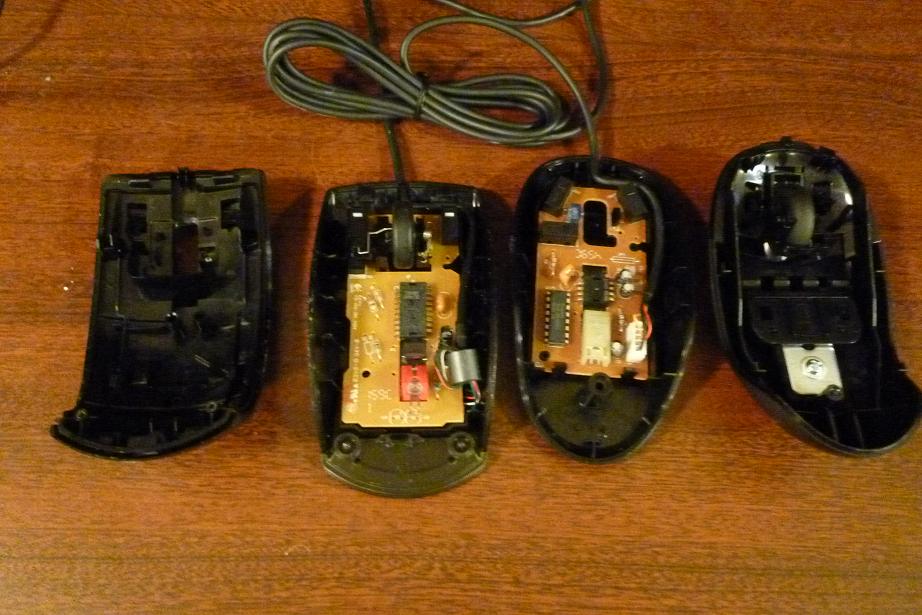
Being unable to find a working mouse to my liking, I asked a computer friend of mine if he happened to have any old models lying around.  He did, but they were all the kinds used for playing online games.  However, he helped me out by telling me that I could open up my mouse, which I never knew I could do because the screws were hidden by the sticky pads underneath.  Once I opened up the thing, I was amazed at the amount of hair and dust that'd accumulated inside.  You know how a corner of your keyboard tends to get dirty without your knowing?  Take a small piece of paper and drag it through the F-number boxes, and you'll get a fair idea of how much crap was in there.  No wonder the thing wasn't working properly!

However, there was a slight complication.  Upon opening up the mouse, some pieces fell out, and I hadn't taken the time to take notes on which part went where.  However, because I'm notoriously stubborn when it comes to accepting outside help, I resolved to solve the dilemma myself.  I won't bore you with the details of how I managed to put Humpty Dumpy together again, but when I was done, I found some pieces of plastic with no idea what they were for.  But the mouse seemed to work fine without them, so I didn't press it any further.  But then the double-clicking started happening again, necessitating opening up the patient again.  After various matching, I eventually determined that the plastic pieces were actually broken off support material that had broken off during my earnest abuse on the mouse.  In short, it's internal organs were a mess, and it was my fault.

I tried to do some transplant surgery with other spare mouses I had lying around, but found out their plastic skeleton designs were significantly different from mine.  Upon further exploratory surgery with different models, I found that later mouse designs had the scroll wheel attached to the cover, which were different from my preferred model with the wheel at the bottom.  I could've taken the easy route and removed the offending plastic obstacles, but my lack of confidence and experience in handling plastic surgery prevented me from doing so.  Besides, I had no way of knowing if removing the offending part would work, and the cover would be ruined if I tried to put it back in the original mouse.  Of the four spare mouses I had, I only managed to switch between two fairly similar models.  That goes to show how rival companies stick close to their competitors.

Finally, in a dilapidated place next to an abandoned library, I found a computer store that sold the kind of mouse with the following qualifications I wanted.  So far, there's just one small glitch - I don't like how the stickers underneath feel when I move it about.  There's just no pleasing some people.
On the left is my preferred model.  On the right is the latest model.
Note where the scroll wheel is attached.
At times like these, I'm reminded of a Wayne & Shuster solo skit where a man was talking about his failed dates:

"I went out with a woman.  She liked me, but her parents didn't like me.  I went out with another woman.  Her parents liked me, but she didn't like me.  I went out with a third woman.  She liked me, and her parents liked me.  

"But her husband hated me."

It's such a relief to be able to move things around and not worry about when the computer's going to turn against me.  I'm hoping the scratchy underside will be resolved in the next few days.  As for the name of this post, it comes from the title of a Dilbert collection when it was still about amusing things other than office humour: