Friday, April 5, 2013

Roger Ebert Thumbing no Longer


Well-reputed and caricatured film reviewer Roger Ebert just died.  Tragically his death came just after news of his cancer going into remission, after the previous surgery bout left him looking like a smiling version of Stephen Hawking.  Even after this recent facial disfigurement, he still continued to do reviews, only online and stopped making television spots.  Clearly, the man loved movies and made no distinction in his admiration for the medium, even though many of them would drive him crazy with their inane premises and thread-bare plots.

Ebert and Roeper didn't quite have the same amount of chemistry that he'd had with Gene Siskel, built up over the course of many years.  Part of what made their relationship work was how much they'd grown used to the expectations of the other, and that's not something that can be easily replicated with a quick stand-in.  Their Odd Couple courtship and contrarian review outlook made them a joy to watch when they argued over a movie one loved and the other hated, and the rare occasion when both liked the same movie.

In addition, he was also a firm advocate for Anime back when interest in the medium was still relatively new.  Even so, he could sometimes be quite contrary to public opinion, and sometimes questionable for his personal tastes.  As a commentor put it, "He gave thumbs down to both The Unforgiven and The Silence of the Lambs, both of which went on to win Oscars and become classics. He (...) gives thumbs down on things because they weren’t what he expected. He expected The Outlaw Josie Wales, and when he got The Unforgiven so he gave it a thumbs down."  For instance, he gave Jungle 2 Jungle a better rating than Little Indian Big City, simply because the former starred Tim Allen.  (Frankly, Big Indian probably works better as a comic, given its cartoonish premise)
"If you, under any circumstances, see ``Little Indian,Big City,''
I will never let you read one of my reviews again."
This wasn't helped with his controversial assertment that videogames could never be art.  Technically speaking, this is true up to a point regarding repetitive pixelated games that don't challenge any preconceived notions.  If we're talking in terms of special effects, home consoles are rapidly approaching the vantage point of computer animation in their cut scenes.  But games are hardly played just for the cinematic features alone.  If they were, they would be nothing more than miniature movies with minimal effort.  One of the dirty secrets that make Video Games so enjoyable is that they're HARD.  Otherwise, we'd be content just to move our player from point A to point B and win.  It's possible that he approached Video Games along the same cliches and rituals that typically plague B-movies.

For the most part, games are enjoyed more for their playability than their stories, though the story certainly help.  To put the analogy further, FIRST we watch the movie, get to know the characters, THEN we're affected by what happens to the characters on the screen.  Along the same notion, FIRST we get used to the controls, THEN once we've explored the world, we identify with the moving central figure and get upset when things go horribly horribly wrong.  There's a reason GAME OVER isn't the new THE END - it means the story's not over yet, and can still be improved on.

But we're basically comparing apples and bananas here.  They play by different rules. Movies are completely different from Video Games in that YOU control the narrative.  More likely, what Ebert meant was that Video Game MOVIES aren't high art.  If he made that statement, he would get less derision for his ignorance.  Heck, Battleship, a movie made out of a board game got made, and it was hardly what could be considered "high art", but closer to good clean dumb fun.

There's already a lucrative writing industry for doing novelization spin-offs of popular videogame franchises such as Halo and Assassin’s Creed.  These are not your garden variety novelizations, but serious adaptions done by award-winning science-fiction authors who are big fans of the games and make it their mission to deliver a product that'll give the same experience of playing said games.  Quite a far jump ahead in terms of quality compared to the Worlds Of Power and Nintendo Adventure books.

The fact of the matter was, Ebert simply wasn't used to Video Games, and was a complete novice in a realm of veterans.  I'm reminded of a story of a foreign girl who came from a restrictive regime, and as a way of easing her introduction to a new country, was treated to a light comedy.  Upon exiting the theater, she was asked for her opinion, and she said that it was the scariest thing she'd ever seen.  What exactly was it about the comedy that traumatized her so much?  It was the scenes filled with disembodied talking heads and severed moving body parts.  She wasn't used to the language of movies, which was why she found it so terrifying.  By that same token, Ebert couldn't see the beneficial value in Video Games.

Where Ebert failed in terms of electronic entertainment, he more than made up for his scathing reviews.
Just as it was gratifying for Ebert to sing high praise of a movie that deserved wider attention, it was funnier when there was a bomb that needed to be taken down some pegs.  It's the critical equivalent of shooting fish at the bottom of a scrapped barrel hole, and Ebert would run the gamut as far as the analogy would allow him.  Many of them are collected in his book "I Hated, Hated, HATED this Movie", the title of which comes from his review of North, which is deserving of its derision.

Some of my favorites are his takes on Forces of Nature, Friends & Lovers, Frogs for Snakes, God Told Me To, Goodbye Lover, Halloween: H20, Hell Night, The Jackal, and what I thought was a made-up title, I Spit on your Grave.

Somewhat fittingly, his former partner, Gene Siskel also died from cancer complications shortly after he said he would take a short break and get back to work quickly so he wouldn't get overshadowed by Ebert.  Two weeks later, Gene Siskel died, leaving the fat reviewer alone to hog the spotlight for years to come.  This will probably spur research over whether excessive movie-watching can lead to cancer.  (In fact, there's already research showing that sitting down too much is the new smoking)

Monday, April 1, 2013

April the Foolst

Not a hoax.  Not a joke.  Not an imaginary story.  On April 1st, it's generally a tradition to present fake news and events on otherwise reputable media newssites.  Some are worthy enough of being mentioned in the papers the next day, outlining which ones were big enough to fool a large amount of people a high proportion of the time.

As a result, audiences can become jaded with these kind of media stunts.  There's only so many times the same trick can be played before the theme grows tiresome.  Which means that marketers have to devise even cleverer schemes to get noticed.
Dear Diary... My horoscope told me to start an art project today.
Then there's the typical gossip headlines that make you do a double-take and grab your attention and don't let go.  These differ from the typical tabloid headlines in that they sound so unlikely they must be made up.  Then you do some digging, and find out that it actually is true.

The only way to counter these surprises is to take all expected news with a grain of salt.  For some of us, every day is April Fool's Day.  But you don't have to worry about me resorting to such deliberate tactics.  I'm a big believer of honesty, since it's easier to tell the truth than to constantly think up plausible lies on a regular basis.  I may whitewash the truth, tell little white lies, don't tell the whole truth, pay trite compliments I don't believe in, say a project's done when it'll actually be done later, but I cannot outright tell a deliberate lie.

I'm always amazed at people who are pathologically capable of twisting the truth in order to make themselves look better than they really are.  It turns out that the reciprocal is true - while there are honest souls out there who break down at the thought of telling a lie, there are dysfunctional families who've grown up in a society where telling the truth only leads to harsh reprisals, and consequentially, learn that lying is better than the alternative, so when it comes to telling things that actually happened, they experience internal pains.  This background is necessary in understanding how veteran police investigators catch their suspects in an untruth they've built for themselves.

In closing, the background for this month's party seems to be a possible outtake for the abandoned Judgement Day movie.  While there's potential interest in doing a Simpsonized version of Akira, there's not much inspiration for doing an extended comic version of Judgement day.  Creating one would mean drawing more Garfields as well as additional people in the extended cast that's only hinted at in the 30-page book.  Part of the problem is that while remaking a beloved cult franchise in another art style is doable, adding new elements to a skeleton script with limited mass appeal is somewhat more difficult.  I've had several fleshed-out ideas with a fellow SRoMG contributor, but apart from a few remixed comic images, nothing's really taken fruit.  Still, if there are any aspiring artists out there who'd be interested, let me know.

 The Semi-Formal Storm Function
If your neighbors didn't write you off as a full-goose-looney after the Winter Defiance Party, try dressing up and having a semi-formal lawn party during a driving rainstorm!  This is the only time you may have to call a party off because of good weather.

Saturday, March 30, 2013

Lowering the Boom


In the olden times of translating comics, foreign sound effects had to be whited out and then the relevant text painstakingly handwritten to ensure that the replaced font would match the artist's handwriting.  Compared to  that laborious practice, passing the torch of letterers to computer programs can seem like a quick fix.  Programs like these are a boon for people with excellent drawing, but lousy lettering.  (Nothing can be done to fix lousy writing though - computers haven't learned how to become influential editors yet)  There are notable detractors who'll lament the cold usage of static font that displays none of the warmth of a finely honed penmanship, even as modern writing has relied more on typewritten texts than lead on paper.  Some programs have gotten so good that they're able to blur the line between human and machine perfectly.  However, this is still a long way off, since defects do occasionally pop up.

One such occurrence is in Papercutz's Smurfs line where the HEY LOOK! font were a tribute to Harvey Kurtzman's comic title.  Upon first glance, the sound effects look equally innovative.  But until the latest book, The Baby Smurf, I hadn't quite noticed how much the sound effects were basically copied down to the shaky letters.

In the relevant scene, Jokey Smurf gives the newborn baby a token of appreciation in the form of an explosive practical joke that he hands around to everyone, friend and foe alike.  This is an early life lesson that should be encountered the earlier the better, and once the baby learns of this cruel fact of life, the better off he'll be.
Don't worry - the baby walks away without a scratch.  A little soot maybe, but essentially harmless.
Later, when everybody in the village learns of news that due to a mix-up, the baby Smurf was dropped off at the wrong address.  (Which makes one wonder who ELSE would Baby Smurf belong to?  It's not like there's plenty of other Smurf villages out there for Gargamel to terrorize - just this specific one) After some interference from Grouchy Smurf, in a show of Moe overload, suddenly finds himself unwanting to relinquish a cute new arrival that emulates him in miniature, kidnaps the baby in an effort to keep him all to himself, until he finds out that life as a fugitive in care of a young child is beyond his capabilities, and is eventually forced to return the baby to ensure the little tyke's survival.

The celebratory party that takes place after is something of a much grimmer affair, lacking the usual  spontaneity and happiness that one usually associates with Smurfs, and even Jokey Smurf's attempts a humour fall flat.

Upon first sight, there would seem to be no difference in terms of mood, but I noticed that the sound effect consistently remained the same size throughout.  For comparison's sake, here's the original scene in all its violent glory.

As you'll see, not much has changed.  But what's different is the follow-up scene where everybody is demoralized.

As Chuck Jones mentioned in his biography, Chuck Reducks, a lot of humour comes from defied expectations of perceived outcomes.  In that Golden Age of Warner Bros. cartoons, sound effect editors felt that they should have maximum volume so the audience could hear it all the way to the back of the theater.
A particular sound editor, Robert North was in charge of the various sound effects that would take place in a typical cartoon.  From the screech of the Coyote's heels on asphalt to the whistle as he falls through the ground to the deafening CRASH on the ground.  Only, this editor had accidentally tweaked the dial in the opposite direction for the CRASH sound effect so the only thing that was heard was a barely audible "plop".
That was the only time I ever heard Bob laugh, and he laughed so hard he fell out of his chair.  But being a professional sound effects man, he recovered himself, jumped up, and announced, "We've got to fix that."
Jones:"Bob, if you touch that, you're a dead fixer, and you will never mix another picture."
Bob: But we've got to get it right.Jones: What, Bob, is the purpose of an animated cartoon?Bob: To [make people] laugh.Jones: In all the years we've worked together, you've never laughed before.  Why did you laugh?Bob: It must have been very funny.Jones: And you want to take it out, don't you?Bob: (Unconvinced) Okay... but I may get hell from Jack Warner.
The sound effect stayed.  It was a happy accident, but I had to be ready to recognize it.  It may never have happened again.
There's a relevant quote that I can't quite find about an enthusiastic comic fan wanting to do a story with EXTREEEEEEME 90's Liefeld moments of constantly shifting from one gun-toting tough-guy scene to another.  (I think the Joker was in it)  There were dozens of bad guys with gunfire coming from all directions.  Then there were bombs going off everywhere.  The guy listening to this mostly pointless story of one-upmanship made polite inquiries to let the events breath on their own, until he countered with, "And then there's a nuclear explosion."  At that point, the fanboy's enthusiasm evaporated with a resounding "Oh."

"You see?  You've kept the level of action so high that when it comes to actually showing a real explosion, it gets lost in the shuffle."

There's a time for increasing suspense and dramatic character interactions turned up to eleven, and there's a time to slow down and let the characters catch a breath.  Very few comic creators out there are able to fully pull this seemingly simple trick off.  It should be up to the letterer to ensure that those intentions remain during the transition.

Friday, March 22, 2013

Red Ketchup Vs. Russia


It's been almost a year since I translated the first half of the second volume of Red Ketchup, and it only occurred to me that I should at least attempt to make the second half available this year.  A year between scanlation side projects is simply too long a wait time, regardless of quality.
This made me laugh more than I care to admit.
The ironic thing was, shortly after I mentioned that my translator hadn't been very forthcoming in giving me further updates, I was suddenly given a deluge of the remainder of the Ultra Kamarade volume.  The reason for the extra long delay basically boils down to one rather silly reason - I couldn't remember the exact font I'd used for the back cover in the first album, and didn't feel up to going through the whole list in order to find out which one it was.  That coupled with the various other side projects I was otherwise preoccupied with made putting the remainder text in the balloons seem rather easy by comparison.  This is a reoccurring problem I have - I'll go head along at the outskirts of the project I'm involved in, eager to get the whole ordeal over and done with.  Then, once I've made steady progress and can see the endgoal in sight, I start to slack off, believing that the job'll be done eventually.  It's a combination of the old Tortoise & Hare fable and Zeno's paradox - I'm ever so slowly inching towards my endgame, but the amount of time it takes me to get there takes me longer than it normally would if I didn't become so overconfident in my ability to deliver the goods.

Another reason for the long delay was that after I posted the first half, very few people bothered to download it in the first place, leaving me to feel that there wasn't much of a demand for Red Ketchup in the first place.  This might've been tempered by a certain warning image that likely scared some people off:
This one, f'r instance.
Apparently, people really don't want to see humanoid birds get harmed, even fictionally.  There's a double-standard that protestors are more likely to defend against an endangered animal if they're cute, rather than bug-ugly.  You're more likely to hear arguments for saving snow seals than kodomo dragons.  This was a theme in Scott Westerfeld's Uglies series, where a beautiful plant was threatening the livestock of other wildlife, because it was growing like a weed, crowding out other plants a chance for their day in the sun.  Sometimes too much of a good thing can turn out to have potentially devastating effects, as seen in Neal Shusterman's dark fairytale adaption, Duckling Ugly.  But that's nothing new - we're essentially a vain species.  Just recently, a study was shown that people are more likely to take medical advice from doctors if they're fat.

What spurred my interest back in the project was a recent article that signaled attention towards this old Canadian comic using my old blog post as a reference.  The number of commenters there suggested to me that there was still viable interest out there.  They also brought up the suggestion that Canadian-borne Drawn & Quarterly might have some interest in producing the title in English, though it's certainly more risque than their usual titles by Seth, Michel Rabagliati and Adrian Tomine.  It's somewhat closer to the dark humour of Yoshihiro Tatsumi and Chester Brown, so there's still hope there for a certain red-haired FBI agent strangling a penguin's neck out.

Part one
Part two

Sunday, March 17, 2013

License Recommendation: Magi: Magical Labyrinth


(Disclaimer: this was originally going to be a License Request post appealing for a Manga series I just recently marathoned, but only later found out it'd already been licensed by Viz a month ago.  Still, my arguments in favor of it still stand.)

I didn't hold out much hope for this, since it started out with a pretty predictable formula of an optimistic rowdy youth hiding a great power, with the ever-prevalent theme of friendship being the most important value.  That, and it was serialized in Shonen Sunday, which is the weak sister to Shonen Jump's Manga with their episodic stories.  Not to mention that the surest way to motivate anyone was to threaten a cute little girl into a horrific situation.
What unfeeling human would let a little girl get eaten by a monster?
However, once I got past the initially silly premise, I found myself drawn into the world of magic and humour.  (The surest way to win me over is by seamlessly weaving jokes into the narrative) The story revolves around Aladdin and Alibaba - two names that'll sound familiar to anyone well acquainted with fairy tales.  But this isn't the Disneyfied Aladdin and the Prince of Thieves that you'd be more familiar with.  Here, Aladdin is a plucky young boy with a magical flute that holds a Djinn that's all muscle and no head.
Obviously compensating for something.
Alibaba (a run-on name if there was ever one) is a jack-of-all-trades shifting from one demographic to another, trying to elevate himself to a higher position from his lowly state.  Later on, we also see a Jafar (or more specifically, Ja'far), but he's so far removed from the stereotypical Evil Chancelor figure that he's actually closer to the historical Ja'far who was the only authority figure in charge keeping his kingdom afloat and falling into ruin.  Any arguments he brings up are purely logical in themselves, and are more in protest to his lord's more outlandish proclamations
A face you can trust.  Really.  Trust me on this.
But the title is slightly misleading - it doesn't really focus as much on dungeon exploration as you might think.  The first raid ends in the 2nd volume, and they don't get the chance to explore a new dungeon until the 10th volume.  That discrepancy gap would be annoying for Zelda enthusiasts hoping to get the chance to explore a new unexplored cavern, but it never feels like filler.  In between expeditions, the team are split up, wander about with their prospective adventures, meet up again, form new alliances, meet new enemies and set the stage for the next adventure.

It feels very like an ongoing RPG with ever-escalating rising challenges.  No sooner do our heroes get past one threat than a new one appears.  Normally, when you read such videogame adaptions, there's the sense that you're not fully invested in the storyline unless you're already familiar with the gameplay mechanics of the source, and some of the in-jokes can be lost to non-gamers or people who haven't bothered getting the console for that game.  But there's no such barrier here.  Each new magical element comes with their own rules and is introduced with minimal exposition and builds up on what's been shown before.  The team will recuperate after a grueling battle against the dungeon boss and getting the treasure, only to be ambushed by a team of opportunist thieves taking advantage of the heroes' fatigue.  After all, unlike regular dungeon raids, you don't get your health refilled upon completion.  Every battle feels like a constant stream of adrenaline, leaving the reader on the verge of exhaustion, wondering whether they'll get out of this predicament or not.

However, as with any child-friendly Manga, there's bound to be problematic culture clashes.  And Aladdin's compulsive habit of constantly groping any bountiful girl's breasts certainly falls in that realm.  And that's not counting some of the saucier Djiins that can be found elsewhere.  Clearly, this Arabia is based more on the Scheherazade tales of lore, and less on Koran religious overtones.  It'd do no good to censor out Aladdin's filthy little habit, since like Goku's casual groping people's privates to determine their sex, it's a pretty important story element.

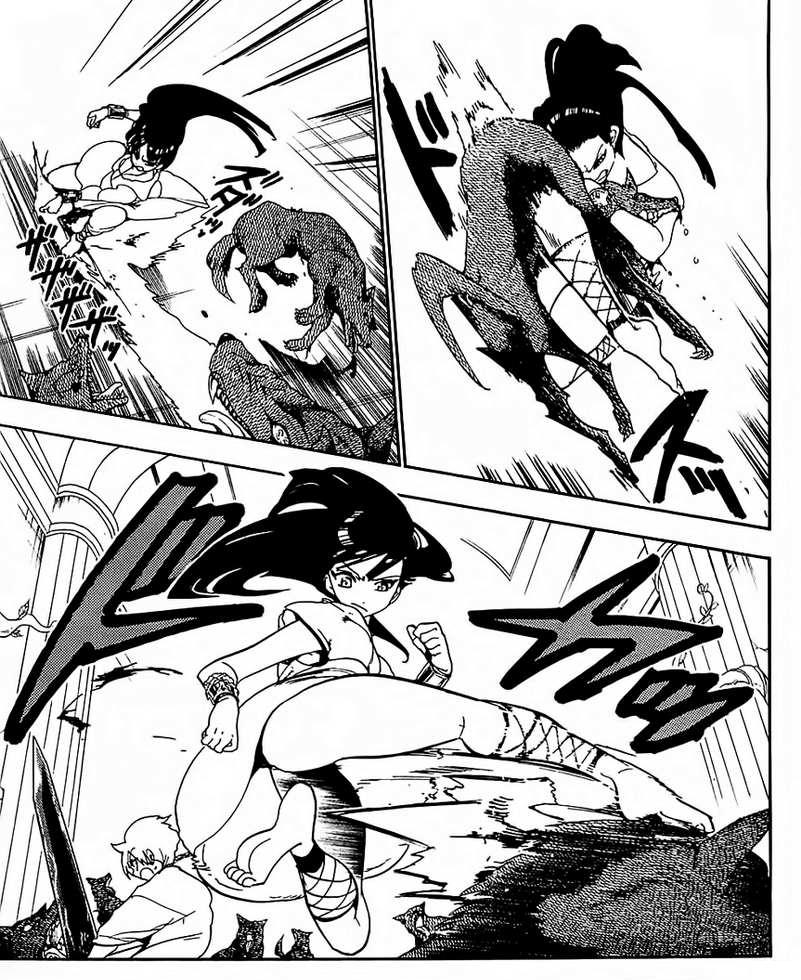
But the role of skin reveal shouldn't be that much of a deterrent for reasons that'll be outlined later below.  So far, a personal fan favorite would be someone who reminds me very much of Cassandra "Batgirl" Cain; Morgiana, the straight-faced stern looking girl of the Finalist Clan, composed of the toughest warriors on the planet.
Striking a classic heroic pose with some role reversals.
Unlike most Tsundere tough girls who start out as tough-boiled eggs but let their defenses down in the presence of their love interest, Morgiana betrays no convictions this way.  She gradually softens up and begins to open herself to others, but she never loses that fighting edge.  What's most noticeable is that despite her aerobatics involving a variety of kicks, with her barefooted legs, there's remarkable very few crotch shots of her in action.  The lack of male gaze in her fighting techniques led me to believe that the author was a woman, and the Omake (extras) at the back confirmed it.
Are you paying attention to her movements and not her poses?
If so, it's working!
In later stories, Aladdin even enroles in a magic school that has a energy diagram that's very reminiscent of the Nen chart from Hunter X Hunter.  Anybody familiar with the complicated nature of Nen training should appreciate the similarities, since it's certainly well-thought out and not just a shameless pandering to the Potter fanbase.  The result is a more interesting read compared to Negima with their stock loli Barbie figures.

But it's not just the action that dominates - there's still time for talking head scenes that manages to stay riveting in terms of arguments.  The current arc has what's a war between two different magical nations, each with their varying policies.  One believes that magicians should found their own country, taking control over the majority of the unpowered population that's more interested in lazying about and have no further ambition.  The other side believes that all citizens can contribute to their nation, regardless of class.  This is a gross oversimplification of the clashing viewpoints, but it serves as a worthy explanation.  And the major bad guys aren't even the main instigators behind the conflict!  It happened purely organically as a result of a country's agent having conflicting emotions over the side he's working for.

And much like the original Arabian Nights it takes its influence from, you're constantly left wanting to see what'll happen next.  The full realm of variety and innovation makes it a contender for what could very well be the next Full Metal Alchemist.

The constant one-up-manship for rising power levels between opponents rivals One Piece in terms of imagination.  It succeeds in a level of dealing with magic without emulating Fairy Tale, which is an accomplishment in itself.  And the artwork and character design are closer to what would be more appealing to typical Manga fans, compared to the relatively goofy art of Eichiro Oda.  Plus there's the added bonus of not that much repetitive exposition that's such a common theme in typical One Piece arcs.

I'm looking forward to it coming out in August!

Thursday, March 14, 2013

Miscellaneous Sundays

For a site labled Sunday Comics Debt, I realize that I haven't exactly been quite forthcoming in producing lost newspaper comics for quite some time now.  The reason for this is somewhat obvious - I've already
my stock of comics that would be considered worthy of a reread or outright notable.  Also, there's the shift from my newspapers being less experimental in replacing old strips with new ones, and a consistency throughout which led to fewer comics being sampled.  The only comic I haven't uploaded yet are The Flintstones, and there's hardly much of a demand for those, since they're easily found elsewhere.  (If I'm proven wrong about this and people actually are interested, I'll upload what little I have)

The exception to my homegrown comics were the various comics I would get to sample when my Bubby would go to Florida, and bring back some newspapers from her time there.  However, she didn't always go out of her way to save these priceless relics unless I made certain to ask her beforehand, so several comics were therefore lost.  On the one hand, while there were comics I'd never seen, there was still the question of quality of these strips, only a handful of which were truly worth saving and sharing with the world again.  In later years, I've become greatly disfranchised with newspaper comics, and haven't bothered to keep any full collections of Sunday pages, and just clip out various comics that I personally feel are funny.  The only comics that regularly get my attention are Pooch Cafe and the relatively new Bleeker the Rechargeable Dog.

Below are the few comics from that brief span that I found acceptable.  First up is the not-so-cleverly titled Wright Angles.  There's hardly any information to go further from this small sample here, apart from the fact that the author, Larry Wright enjoys writing comics with cats in them.  Further research has shown that the strip has been repackaged and retitled as Motley Classics.

Until the advent of the internet made searching wikipedia pages for plot spoilers of the latest comics a necessary evil, finding out the backstory for a new comic with no forewarning could be something of a challenge.  It can take a while for an avant-garde comic like The Far Side to really get their brand of humour going, and sometimes some comic strips can have an off day.  So I would be forgiven for thinking that Arnold was composed purely of static images of a kid named Arnold who only yelled "AIEEE!" to his friend, with all other side characters being conveniently offscreen.  So I was surprised to find out that my first impressions were pretty much spot on.  Apparently, Arnold has something of a cult following.  Who knew?


The last one is emblematic of what would be a reoccurring theme for newer strips - building on the skeletons of more successful working models.  Free For All clearly plays on the format that would be the foundation of Doonsbury and Bloom County: talking heads that belied the personality of the crude artwork.  In fact, the premise actually started out similarly to those comics in the form of a college strip, and was even made into an animated TV series.  Until I looked it up, I had no idea it was even optioned for a TV show, which goes to show how obscure this strip was.

While the main character is Johnny Jenkins, the scenestealer continues to be the alternate zany guy who can afford to be much more outlandish than the vanilla protagonist.  In this case, that role is usurped by Clay Zeeman, the guy in white shirt, shades and spiky hair is  who through a series of scams and tax fraud, has managed to acquire more money than he knows what to do with, which is somewhat dangerous for someone with the personality of Steve Dallas and the hairdo of Binkley, which feels wrong on several levels somehow.  Innocence shouldn't be paired up with cynicism.  Fortunately, all his spare time is spent lounging on the couch injecting drugs and playing video games, and figuring out more ways to acquire more money.  Truly a man after my own heart.

Sunday, March 10, 2013

The Underlying Reason


Recently, I've been enjoying a recent crime-time drama, Motive about a TV show that has shades of Columbo in it. After the finale of Special-OPs negotiation team Flashpoint, it's gratifying to see another Canadian series that plays on the traditional cop show formula.  Each episode starts off with brief synopsis of the murderer and the DOA, leaving no doubt of who committed the crime.  The only difference is that after the two main players are introduced as the Killer and the Victim, we don't get to see the actual crime committed, but only reenacted through flashbacks of what led up to that point.  Once the lead detectives go through the procedures of how the victim was killed and start zeroing in on the correct suspect do we find out WHY the victim was murdered in the first place.  It's nothing terrible groundbreaking, but still somewhat pleasant to watch.


There were two details that jumped out at me in particular for last week's Motive episode, "Against All Odds".  The first was the grocery store clerk putting away cartons of milk.

The logo was Lactancia, which were the exact type that's available at stores here, and also the same brand bought at home.  This would stink of product placement, but only if you received that particular milk in your hometown.  Often, I'd see commercials for cereals that weren't available, very much like the infamous Raymond Brigg's Snowman commercial of IRN-BRU.  Fancy-looking, but you'd have to import it in order to sample it.

The second noticeable detail was the address for one of the suspects near the end.


That little detail might be surprising if you're expecting the location to be in America, and finding out that other locations worldwide have a similar makeup.  Despite its familiar American setup and the friendly snarky banter between the two lead detectives, the whole series takes place in Vancouver BC.


This is quite different from when allusions to Canada were purposely left out in order to expand our market, because audiences wouldn't be able to identify with TV characters if they weren't American.  (The book Canada for Dummies exemplifies this by explaining that Americans believe that deep down, EVERYONE wants to be American, and are surprised to discover not everyone feels the same way)
Fortunately, times have changed, and allusions to exotic Canadian landmarks and themes have managed to sneak their way in, from subtle Maple Leaf signs on officer's uniforms to the Space Needle to Tim Horton's coffee shops.


Degrassi Junior High, Degrassi High, The Odyssey, and The Raccoons were some of my favorite shows growing up, simply because they were unlike anything else on TV at the time.  If there's a reason why Canadian media tends to be more oddball, it's not just because of the climate (though that's certainly a contributing factor), it's also because we're faced with stiff competition from our more popular cousins down south.  Canadians have to work twice as hard as our American rivals to produce anything that'll be noticed.  That's probably why so much of our homegrown media can at times be quite innovative and weird compared to the competition.  To get an idea of what it sometimes feels like, the story-within-a-story TV show A Sky of Heads from Concrete were some of my favorite stories of the comic's run.

And yet, while we seem to have made great inroads with our Television shows, we're still struggling with the movie industry.  With exceptions such as Bon Cop Bad Cop, C.R.A.Z.Y., Men With Brooms and Seducing Doctor Lewis, the majority of French Canadian-themed movies tend to be serious and clinically depressing to the point of making Russian novels look like bastions of positivity in comparison.  A particularly cynical director's cut of Pig's Law had an unwanted baby be plowed under by a harvest combiner.  You'd think a climate that fosters good humour would want to produce material that'd be ambassadors of same.

In closing there was one final detail I particularly enjoyed.  When the lead detective browsed the convenience store, she picked up a box of Sugar Bombs, as in Calvin's Chocolate Frosted Sugar Bombs.  Detective Angie Flynn even goes off in a Columbo-esque non-sequitur saying that these cereals were full of sugar and were here favorite things to eat as a kid.

Friday, March 8, 2013

Unleashing a Torrent of Toren Smith

Like most veteran Manga fans, I was shocked to hear of Toren Smith's sudden and untimely death.  I hadn't thought about the man in a long time, but was surprised to hear he died so suddenly.  He was uncomfortably close to the age of Douglas Adams' demise - dying way too soon.  He was probably the most influential ambassador and promoter of Manga, even though he was painfully shy about being seen in public.  There's not much I can tell about the man's life, though there are accounts from close friends who give more informative accounts of the man's history than I ever could.

You talk about pioneers braving the elements, blazing a trail to a new path that no one else's ever seen before?  Toren Smith did it all - he traveled to Japan on his own dime, living on ramen on a day-to-day basis, lived in an apartment with Yakuza ties, all for his love of Manga.  One memorable horror story was where he was living with GAINAX founding members who didn't bother to clean up or wash, and their room was so smelly their house was considered a health hazard and destroyed.  And after all he went through in Japan, he went back there for repeat business.  His life story was the stuff of legend, and it's somewhat surprising it hasn't been made into a Manga autobiography yet.  (Hopefully, it'd be a better read than the lukewarm cliff notes biographies of respectable celebrities such as The Dalai Llama, Che Guevera and Gandhi)

From the start, he faced an uphill struggle trying to convince publishers on both sides of the pacific that there was a potential market for Japanese comics.  Initial resistance to stories such as Oh My Goddess! were so high that Toren Smith put his own money and reputation on the line to ensure that it would have a fighting chance.  For this fan favorite title, he deliberately skipped ahead after the first chapter to  introduce Urd, the saucier rival to Belldandy's maidenly housewife figure.  Such a feat would be considered unthinkable in today's Manga-saturated society, though there are certain recent titles that have attempted this line of skipping ahead, such as the various "best of" collections of Golgo 13 and Oishinbo, and the lackluster sales of wine Manga Drops of God led the publisher to do some advance work of the story, even if the content suffers in comparison.  (Dark Horse also attempted similar results for 3x3 Eyes during their Super Manga Blast run)

His first outreach program was translating Mangas that would appeal to the Heavy Metal crowd.  To ensure their popularity in the male-dominated comics market, they released titles that would appeal to their demographic, such as Drakuun, Outlanders, Caravan Kidd, Last Continent, Venus Wars, Rebel Sword, Version, Cyber 7, Hellhounds, Spirit of Wonder and The Two Faces of Tomorrow; none of which are available for scanlation online.  More mainstream titles such as Gunsmith Cats, Ghost in the Shell and Lone Wolf & Cub would gather a larger audience.

What politer news sites will neglect to mention is that some of his most widely-read translated material were most probably part of the Eros line, famous for titles such as Bondage Fairies, Sexcapades, Spunky Knight, Super Taboo, Silky Whip, Slut Girl... you get the idea; which, until the Peanuts license was properly secured, were Fantagraphics main source of income.  While most translators would've been content to simply translate the dialogue balloons and sound effects with various grunting noises and cries of pleasure, Toren Smith went the extra mile to ensure the erotic line produce material worth fapping over by painstakingly reworking the dialogue and redrawing the background details.  In the realm of entertainment, it's the small stuff that matter.
It's not like you read porn for the plot and sterling conversations, right?
This sample image reminds me of the scene in Waltz with Bashir where the General had his subordinate fast-forward the porno tapes past the sex scenes so he could get to the "meat" of the story.

General: Faster.  Faster!
Soldier: Impossible sir!  I cannae break the laws of physics!
General: Aaaaaand... STOP!
TV: Prithee forsooth kind sir, doth thou desireth to rest a moment?  Thine arches doth ache.

The ironic part is that his mandate of providing high quality sample from the original artwork and not cheap photocopies along with rewrites that laboured to be read naturally was what led to his downfall.  To be accepted seriously alongside the competition of homegrown American comics, Manga paperbacks were printed on double-bounded stock paper and released once a year.  Twice if the customer was lucky.  So when Tokyopop started releasing fluff titles such as Chobits and Love Hina volumes on a bi-monthly basis on cheap paper stock while barely bothering to translate the SFX, the sudden availability of popular titles in batch form made them more desirable compared to the old model of releasing long-form Mangas one chapter at a time.  This was back in the dark DARK ages where titles such as X/1999 were shown at a rate of 20 pages a month in Anime magazines.  If you've ever read any of Clamp's works, you know that it takes more than a volume for the story to really start.

For all his contributions and efforts in promoting Manga, he was simply unable to adapt to the sudden changes around the turn of the century when Manga finally became popular enough to warrant quick releases.  Even today, there are still comics customers who prefer the old business model of receiving their fix through a rigidly enforced schedule.  To get an example of this sudden shift in the market, here's an excerpt from a Toren Tech interview:


TS: The manga market is not what it used to be. I always tell these guys up front exactly what sort of sales they can expect. Well, a year ago, I could tell them that they could expect sales of like 40,000 a month. Now I have to tell them differently because, y’know...

AH: Things are tough all over.

TS: Yep. The manga market has simply settled down to what I think is probably more of a realistic level for it.

I mean, before it was riding on a wave of hysteria more than anything else. Where it is now is at a nice stable level as far as what we can expect for manga in the American comic book market. Certainly I think more people should be buying the books as opposed to some of the rubbish that’s out on the stands. But realistically, I think we’re at a very good level right now.

We’ve gotten a letter from a guy who’s a professor of Japanese at Cornell University who said that our translation of Nausicaa was near perfect as it could’ve been made. That makes us feel real good to hear that because that’s what we’re trying to do. Yet there were several places in Nausicaa where we changed things to make it read well in English.

The purists don’t like that. They don’t want to read our writing, they say--“We want to read Miyazaki’s writing.” The ideal situation would be if everyone would go out and learn to read Japanese so they could read Japanese comics. Obviously, that’s not going to happen. Still, I get letters saying, “Why don’t you just print them the way they do in Japan and get people to read the panels in backwards order?”

AH: Now that person’s got to be kidding.

TS: We’ve probably gotten several hundred letters like that and I don’t understand how these people can think this way. I mean, you can’t sell it in America!
His model of adapting Manga to the typical comics market was noble, but flawed, since his rationale was that readers were willing to pay full price for a new chapter while forgetting that the majority of chapters were first available in large magazines alongside dozens of various comics of differing quality, much like a fat newspaper comics page.  Not to mention these issues had already been published elsewhere, so why go through the trouble of pushing them on the comics rack when you could cut through the middleman and put them on the bookshelves in the first place?  It was the equivalence of acquiring popular posthumous series The Girl With the Dragon Tattoo, and releasing it on a chapter-by-chapter basis, because that model worked perfectly fine for novels of yesteryear.

Toren Smith's greatest lament was that all his past contributions to founding the Manga industry as we know it today was overshadowed by his resistant to change to the new business reality of quick-'n-easy mass production.  In addition, at a time when readership and fandom was at an all-time high, he spoiled the party by predicting a bust period for hastily produced Manga available for cheap.  A prophecy that was later proven to be correct.  He was someone who rallied against the mainstream, wanting to change it for the better, and only became disfranchised once it grew popular, but not the way he wanted it to.  He was a hipster before it became cool.

I saved the majority of the interviews and FAQS on the old Dark Horse Manga page before it was revamped to the new user-unfriendly format available now.   If anybody's interested, they can download the contents here.  I should warn you that there's a large amount of material present - over 200 pages worth!  And some of the entries are of forum discussions of Studio Proteus' business decisions.  One of the most amusing things about the letter columns is the frequent announcements that Hiroaki Samura plans to end Blade of the Immortal very soon... in *1999*, and it didn't conclude until late last year.

Here's a page I wasn't able to copy properly for formatting issues, since the program I originally saved in wasn't compatible with Word.


The only thing I'm missing is an Animerica Extra (or Super Manga Blast) letter of an argument between Toren Smith and Simon Cooper.  If anybody could help me fill in the details, I'd be grateful.

Speaking of which, I hope Toren Smith got the chance to finish his work for Blade of the Immortal, which he considered "his baby", which remains one of the few licensed titles that's still released in "flipped" format that's only rivaled by Yoshihiro Tatsumi's works.  It would be gratifying to know he saw how it all ended before he shuffled off this mortal coil.  He even went so far as to proclaim BOTI to be far superior to Lone Wolf & Cub, which was "rife with junk", and if it were up to him, would cut at least half of the stories out in favor of the stronger stuff.  Fortunately, due to fanboy OCD mentality of acquiring every single issue, no matter how lousy, we got to see the entirety of the legendary classic.  I still wouldn't be averse to seeing BOTI available in its native form, even if it'd mean revamping the dialogue to fit the natural pace.

While it's not by Toren Smith, below are the article The Heartbreak of Mangaphobia showing the regular high resistance from typical comics readers, and an except from a Previews Review account on Dark Horse, with added reader commentary.  More after the cut:

Friday, March 1, 2013

Marching in a Storm


Not much to say about this month's batch of comics, other than they have very little to do with the theme of March, save for the last one, and only tangentially.

Dear Diary... I sunk a tube of toothpaste and two hairpins in a fierce naval battle today.

While Garfield is well reputed for being a lethargic fat cat with realms of imaginative concepts throughout, this party concept is probably the laziest one that was thought up:

The 10 Minute Coffee Break Party

You can party anywhere, anytime!  Liven up those coffee breaks with your own miniparty.  Photocopy your face (or anything else) and decorate your work area!

This feels like something that was thought up at the last minute, with nothing else but a looming deadline, and office surroundings being the only inspirational reference material handy to provide content.  Fortunately, the remaining party months are more varied in themselves, so you can consider this a momentary lapse.

To make up for that glaring oversight, here's what I consider to be the second-funniest comic in the whole 1993 calendar, if we're going by visual gags.

Brace yourself - the funniest comic won't show up until November, so be prepared for a load of mediocrity until then.

Wednesday, February 27, 2013

A Knockout From Orbit

I'd like to say that my lack of blog updates is due to personal events infringing upon my life, and that would be partially true, but not as life-threatening as it actually sounds.  Lately, I've been preoccupied with replaying the Zelda Skyward Sword game and sneaking snippets of playtime in between my available free time.  I'm currently playing it on Hero mode, which, as any Zelda affectionado can tell you, is quite the challenge.  Fortunately, just before I gave it back to my sister, I managed to save up a whole bunch of craftable items
Playing the game all over again is at times slightly easier, and slightly harder.  I now know what I need to do, but I have to avoid getting hit three times.  Fortunately, the enemies and puzzles are left defeated and solved, otherwise the whole experience would stink of Nintendo Hard territory.

Also, at times when I have a planned blog topic, but don't have the relevant scans ready, I find it necessary to delve back into my archives to find an alternative placeholder until I have my presentation ready.  Normally, this wouldn't be a problem, but I'm something of an Obsessive-Compulsive personality when it comes to unfinished projects.  I simply find it extremely difficult to concentrate on anything else until I get whatever Sword of Damocles is hanging over my head.  On the one hand, this keeps me from thinking about other stuff because I'm so upset over not having the relevant materials around.  On the other hand, this intense focus helps me keep focused on getting the job done, otherwise, I'd never get my projects off the ground in the first place.

So as a means of apology, it's time to make a mini-contribution to the now sadly-defunct Orbit Project.  (Probably should've saved the available comics while they were still available)

This particular trilogy of strips starts off on a rather innocuous meeting with a rather benign alien.  Of course the old adage "Don't talk to strangers" isn't constantly repeated ad nauseum by overly concerned parents for a reason.  Pay no attention to the scribbles near the bottom.  They're early attempts to decipher the code toe the riddle, which any well-reasoned adult with child logic should be able to solve.
 
Presumably, there were all kinds of in-between events that took place between the Dailies and the Sunday comics, which should be evident with Tyrone's reasonable panic over Orbit's sudden disappearance.  Pay attention to a certain familiar-looking device in the background...

In the end, Tyrone makes an unlikely rescue using Orbit's Christmas Hoverbike.  At times like these, I'm left wracking my brain at how this series of events could've played itself out in between the intervals of the last comic and this one, all leading up to a rather silly pun.  Any contributors out there care to take a guess, or better yet, find the original Orbit comics to help fill in the gap?

Tuesday, February 19, 2013

License Request: Bichon


Usually when I make these License Request columns, they're for old personal comics that I'd love to see officially translated over here, even though there's little chance of them ever being so.  But this time I'd like to recommend a fairly recent comic that's more for a potential audience than anything else.

Like most young boys, Bichon is compassionate and overly sensitive.  However, there's a certain trait that sets him apart from the others:

He likes the pink swirly stuff.  Okay, so he's at that young impressible age before gender differences are clearly lined out and defined.  Surely he doesn't know any better, right?

Nope.  He clearly has gay tendencies, which is reinforced with decorations of Rapunzel, Stitch, Totoro and Maya the Bee in his room.  In a way, it takes a certain kind of fearlessness to be able to display that kind of emotion openly.  Even though he hasn't quite opened up to his sexuality, it's clearly evident which side of the fence he's leaning towards.

Bichon is a quasi-biographical account of David Gilson's childhood through a filtered lens, and what the author hopes will appeal to a larger demographic.  A recent issue had an imaginary scenario of Bichon as an openly Gay president advocating for Gay marriage.  His namesake is obviously based after the Bichon Frise, the overly pretty dog.  The unfortunately named Poo Poo from Pooch CafĂ© of the very species is constantly put down on for displaying effeminate qualities, even though he's male.  There are some who embrace their identity, and others who reject the stereotypical labels foisted upon them.


I'm not gay, but I can understand the appeal of wanting to like things that are deemed too "girly" for their usual taste.  I'll admit that in The Wizard of Oz, I greatly admired the Lullaby League for their gracefulness and melody while the Lollypop Guild seemed overly tough in comparison.  The girls' stuff seemed more appealing compared to the rough and tumble physical stuff I was supposed to be accustomed to.  To someone who wasn't fully versed in the formula of action shows, this divide between sweetness and brutality frightened me.  There was simply no middle ground.

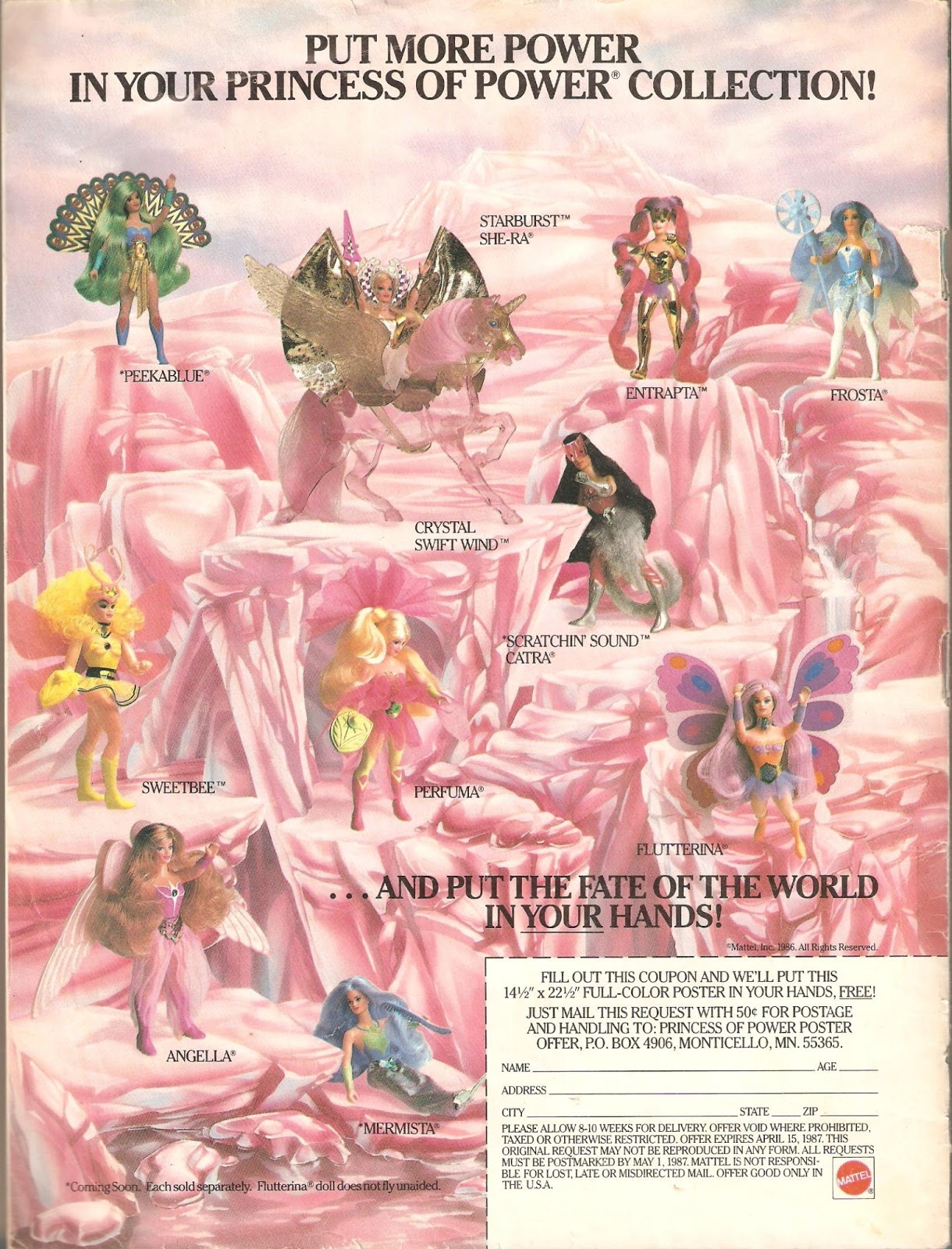
Being exposed to the other sex's POV can make it easier to make the transition to the other side.  In fact, Barbie and Polly Pocket commercials were advertised fairly regularly in conjunction with the boy toys, which kept the gender balance somewhat equal, and prevented the viewership from being a total sausagefest.  The only time I ever saw a boy in a girl commercial was in Keypers where he seemed interested in getting a chance to snoop into his sister's diaries, or whatever secrets they were hiding in those plastic snails.

It's widely acceptable for girls to start liking action movies, masculine sports and S-heroes, but it's still an uphill struggle for the reciprocal of getting the brasher sex to admit a fondness for demure media.  So venturing out into this largely unexplored (if slowly expanding) field is somewhat brave.
Changing values isn't always easy, but it wasn't that long ago (last century to be specific) that pink was for boys, and it was considered manly to cry, a trait that's faithfully followed in a large number of "tough guys" Manga.  Things have started changing already with the Bronies obviously in awe of Unicorn Power.


While homosexuality has improved in the last few decades from mental disease to primetime comedy, studies have shown that Gay men are still bullied more than lesbians.  The truly ironic part of all this is that this stigmata of not fitting in has actually led to gay teens causing more pregnancies than their straight friends.
Puts the whole sin of not procreating in a whole different light, doesn't it?


Pretty much everybody needs somebody who appeals to their demographic.  There are specially designed Barbies in African countries that aren't dependent on the typical pale model figure.  I know that I greatly identified with child protagonists.  The boy from Flight of the Navigator looked EXACTLY like me, right down to the stripped T-shirt I wore.  Lately, there's been a rise in protagonists with Asperger's Syndrome, and I always seek out these books and movies to see just how much I relate to these portrayals, and whether the authors get certain subtleties down pat or if the reception leaves me cold.  Calvin in particular was a great influential reading buddy while growing up.  I find it surprising that there's so much resistance to show identities that are not considered "mainstream".  I was able to identify with someone who looked like me, so why couldn't other minority characters fill in a niche void that obviously needs filling?

There's Fantagraphic's Wandering Son, but that deals more with transgenderism, and I find the issues and a little slow to my taste.  Archie's made inroads with Kevin Keller, the openly Gay teenager, but why stop there?  Personally, I look forward to the day when being Gay is considered something less of a defining characteristic for somebody and is just another trait.
Just look at how HAPPY he looks to get his present.

Bichon ran in the French Tcho! magazine, which ran Manga-influenced BDs such as the Nadia-inspired Agito Cosmos and the stereotype-laden Zblu Cops.  So I was greatly surprised and disappointed to find out that the Tcho! magazine had just ceased publication.  At least they finished the latest Lou! story, The Crystal Age before the magazine went under.  While the Tcho! magazine may be cancelled, fortunately the titles will continue to be released in album format.  Yoshihiro Togashi of Hunter X Hunter fame may get a lot of flak for his continuous hiatuses, but to me, it feels more likely he's just emulating the European model of spending a year to create a book that's then filtered out via sneak previews in Shonen Jump.  The chapters keeping the specificied page rate is just a convenience at this point.

It seems somewhat fitting that the last official "end" of the magazine paid tribute to Bichon on its cover.