Sunday, September 18, 2016

A Matter of Interpretation

For the longest time, if you wanted to watch the latest blockbuster hits, but happened to be Deaf, you would have to wait until it came out on VHS or DVD, which would keep you out of the loop for up to six months to several years;  all the while, more movies would be released, keeping you further backlogged and unable to discuss potential spoilers without looking up second-hand plot summaries.  Only recently was there technology that would allow hard-of-hearing viewers to enjoy the experience of action movies.  Other than the explosions, half the fun comes from the inane catchphrases thrown about.

That is, unless you happened to live in Montreal, with its unusual Draconian language-protection laws.  Feeling that their French language was under attack from being bombarded via easy access to English media, Bill 101 was abused to go after any store signs or packaging that didn't have FRENCH emblazoned in large font, and an English version below in smaller font.  There would be grand fights over whether Eatons or Eaton's with an apostrophe was proper or not.  There was also the crackdown on a menu for having pasta on it's menu for sounding too Italian.  This would be on par with claiming that Sushi sounded too 'Asian'.  These were literal Grammar Nazis who could threaten to close a small business if it wasn't part of a larger franchise name.

With this backstory background in place, the following event may (or may not) make more sense.  Jeffrey Liebman, a deaf man was all set to enjoy the latest Star Trek movie, only to be told that he wouldn't be able to access the captioning device.  The reason?  They refused because there weren't any French subtitles available.  If the French Deaf can't enjoy the movie, then the English Deaf couldn't enjoy it either.

I'm not a regular movie-goer, much more preferring to stay in the comfort of my home, where I'm not easily distracted by the crowd, and can control the pace of the film to my liking.  But my sister's more of a social animal than me, and was only able to have some subtitles available for Deadpool, the 'Merc with the Mouth' who, ironically enough, has his mouth covered for pretty much the majority of his screen time.  (And even if he DID have his mouth shown, it's doubtful she'd be able to understand him, given how decomposed his fleshy area is.)  Her husband pretty much had to go and argue with the theater manager for a long time in order to get the necessary captioner device in place.  They're fitted in a cup holder-like slot to face the viewer, and aren't disturbing to other movie fans, since the text only shows up in front of their seat.  He went to the theater ahead of time on the day to check that the captions worked. When they got there that evening, they didn't work, and he had to go find a manager to sort it out. Turned out someone forgot to turn on the machine in the projection room.  The closest controversy these things could present is that they have the script for the movie embedded in their electronics, but unless you have someone with the necessary know-how to hack into the device, the risk assessment is significantly small.  (It's similar to reading a theater script before seeing the actual play)

Even independent film reviewers aren't immune from this problem.  You'd think that preventing bad publicity from someone who had a license to publish scathing editorials would be a consideration, but apparently, that's not a high priority.

All this could be attributed to a gulf between the English/French divide.  But another explanation is the lack of compromise between the Hearing/Deaf.  As an invisible handicap, Deafness doesn't have the exploitable visibility of blindness or motor function loss, and thus, people aren't as willing to be as forthcoming unless we wear a sign saying "I'm Deaf" for the world to see.
For the uninitiated, the last cow has her ears hooked up to the cowbell.
For the most part, regular hearing people are simply unwilling to throw a bone, simply because accommodating a Deaf person understand what's going on is too much of a hassle.  Well, sorry that the mere prospect of not being able to hear properly is so inconvenient for you.

Even though I don't go out to movies that much, I'm still extremely limited in other aspects of being able to socialize normally.  If I want to understand group discussions, it's absolutely imperative that I have an interpreter present, so that I can understand what's going on.  By the time someone's stopped talking, I'm still playing catch-up with the first word.  Even if I paid intense attention, I'd still only catch snatches of the beginning or ending of sentences being bandied around the table.  It's a game of conversational ping-pong that I'm grossly outmatched in.

Regular hearing people just don't understand the mere prospect of how difficult life can be when you're Deaf. As if the mere prospect of "you just have to listen harder" would wipe away the discomfort of being unable to hear properly.  What most hearing people fail to understand it the scope of how difficult it is to make use of a talent that's already frayed to begin with.  It's not as if constant use of our ear muscles could hope to strengthen the weakened eardrums or hair follicles after vigilant use.  That's not what being Deaf means.

Being deaf means being unable to hear sounds in the normal noise range, and that can be attributed to general confusion about how loud decibels can be.  Every ten decibels is not ten plus louder than the previous level, but ten times louder than the previous incarnation.  One decibel is the standard base.  10 decibels is 10 times louder, 20 decibels is 100 times louder, 30 decibels is 1000 times louder, and so on.
The average deaf person can have a hearing loss of 60 decibels, which at first sight, doesn't seems so much, but means that they hear 1,000,000 times less than usual.  MY hearing loss is between 90 to 120 decibels, which is between a billion to a trillion times LESS than the average human.  Without my hearing aids, the only noise I could hear would be a rock concert next to a roaring jet engine.

Given that most teenagers prefer to play their music at full blast, imagine how frustrated they'd be at having the dial turned down all the way from Eleven to one.

When I was in Grade school, I was outfitted with an FM System where I had the teacher wear a mini-microphone device around their neck that would repeat whatever was said through an electronic device connected to my hearing aid.  I can tell you from personal experience that I NEVER understood a single thing I heard from the electronic, and only went along with it for years simply because I was told to.  In my remaining years of High School, I found the contraption to be so useless to me that I simply stopped giving it to the teachers, which must've come as something of a relief to them, and solely relied on an Oral Interpreter for understanding the going-ons of the classroom.

My mother fought long and hard to ensure that there would be enough funding for me and other Deaf students to have Oral Interpreting throughout my High School years.  In College and University classes, Deaf students are allowed to have interpreters present to help them understand what's happening in class.  So why wouldn't it make sense to have these helpful assistants available during High School during our peak years when learning is most essential?

"But don't you have hearing aids that can help increase the amount of stuff you can hear?"

Yes, but as effective as that tool is, it's still inefficient in other ways.  While a hearing aid helps tremendously in letting me hear sounds that otherwise wouldn't pass detection (via an extremely LOUD whistle when not lodged inside my ear canal), it's not very efficient in weeding out variable noises.  See, a hearing aid doesn't just amplify the sound of the person talking next to me, it amplifies ALL noise in the room.  From the background traffic to the hum of the radiator to the people chattering in the background.

Such advice is equivalent to telling a double amputee that they shouldn't have much trouble tying their shoelaces, since they've got prosthetics to do the job for them.  "They're perfectly capable of working, so what's the problem?"  If weeding out all these sounds were as easy as it sounds, the average person would be able to understand with perfect clarity what someone on a telephone is saying in a noisy environment.  It's the same principle - when your only source of sound comes from one place and it's a confusing hodge-podge of noise, how can you possibly understand anything that's being said?

"But can't you simply read lips to understand what they're saying?"

Normally, yes, but not everybody is as avid in reading lips as I am, and that came from years of experience from constant intervention, interaction and filling in the blanks and double-guessing what everybody's saying.
When you watch TV shows or movies, you're granted the luxury of the actor showing their valuable face time by making sure their handsome and beautiful mugs are in full view of the audience whenever possible.  But that convenience is sadly lacking in real life where you're more likely to see the back of someone's head while engaging in conversation.  Good luck reading lips from the wrong side.

And even if you position yourself into an ideal place (without being in a bad lighting spot), seeing both side's lips is rarely likely to occur in reality, since people are hardly going to rotate themselves around to me.  When people are engaged in conversation, they're likely to forget the presence of someone who can't hear their every word, and trying to play catch-up with both sides changing dialogue at a moment's notice means I'm constantly a few seconds behind, and wind up missing crucial key words that could help crack the whole conversation open.  And that's not even taking in account the nefarious "silent letters" so prevalent in English language.  It's enough to discourage the amateur lipreader from even trying in the first place.

And that's not even accounting for all the letters that look alike when no sound is present.  Names and addresses are the worst.  They're easily the hardest words to understand, especially if they're from places we have no familiarity with, save for how they're spelled.  Getting the slightest word wrong can throw the whole conversation out of context if you're not aware of the subject.  Otherwise, you'd wind up speaking non-sequiturs when you meant to make a point.

Often enough, having to constantly double-check everything that's being said can be an exercise in exhaustion.  Sooner or later, even the most devoted Deaf person will rely on making guesses as to what someone's saying so as not to slow the conversation down and inconvenience everyone.  While this may seem helpful at first glance, missing out on large snatches of what's going on can wind up being detrimental in the long term.

Asking questions all the time may be the hallmark of a curious person, but asking too many runs the risk of being too inquisitive.  Being unable to contribute meaningfully to group discussions can foster deep resentment even among the most well-meaning of friends who simply can't understand how someone seemingly smart can be so distant.  Well, not catching everything that's being said is a guaranteed formula to cause alienation.

Some helpful tips in talking to Deaf people - emphasize certain key words, like Videogame characters in Quest missions.  And if a word is too hard to make out, substitute it for another one.  For instance, "Take statistics attendance on nicotine" is impossible to lipread, since there's hardly any lip movement, but "Smoking addiction numbers" is much easier in comparison.

If the subject you're talking about is too difficult to ascertain upon first utterance, replace the unnaturally longwinded spoken prose with more succinct suitable substitute words.  In short, if the person doesn't understand what you're saying, use different words with the same meaning, rather than repeat a word that could be easily mistaken for something else.  Also, use pantomime to illustrate what you're talking about.

Another common myth is the belief that talking to a Deaf person simply requires shouting louder and louder until they understand what you're talking about.  Not true.  I need to be facing whoever's talking, and have instructions pointed out step by step and spoken slowly and clearly, but not so exaggerated that your actions make you look like you belong in the circus.  (Though I'm more likely to remember instructions if they're written down, since I have a terrible auditorial memory.)
Also, don't stand so close - some distance is needed to see the speaker's lips.
Despite this early intervention, there still seems to be some general confusion about just what an Oral Interpreter's function is.  Some people seem to think that an Oral Interpreter is a barrier to social contact, because they're the only person that I communicate with.  Not true - the interpreter is the solid reliable source for deciphering all the surrounding noise in a room.  Being focused on a solitary target that repeats what's being said is much more reliable than constantly moving my head around trying to catch snippets of half-gleamed conversations, which I'd probably misunderstand anyways.

And Oral Interpreters like Doctors & Lawyers, have a code of privacy.  They're not going to reveal any confidential information that may pass from people's lips.  They may occasionally interject themselves into the conversation, but only to further clarify something the Deaf client is trying to say.  The function of an Oral Interpreter is not to interfere with the conversation, but make it easier for the Deaf client to understand what's going on.  This is accomplished by giving up-to-date sentences said in the heat of the moment, and giving a condensed summary of what people in a group are talking about.  Otherwise, after everybody's finished talking, you'd be left with no real context of what just went on.

Sadly, for all the technological advances made, there's still not much that can be done for basic human ignorance over the most obvious issues.  Even well-intended Deaf organizations aren't immune from making novice mistakes such as:

  • Having your only form of communication for Deaf clients being a telephone number (no email address), and wondering why no one ever calls.
  • Holding an auditorium meeting with dim lighting and the speaker obscured by the microphone and stage platform.
  • Having conversations with a hearing person and a Deaf person, and always facing the hearing person, while facing away from the Deaf person, despite the knowledge that the hearing person is more likely to understand the speaker if they turn away than the Deaf person ever will under similar circumstances.

And yet, despite the immense helpfulness of an Oral Interpreter in social situations, getting one can still be a huge hassle.  They can only be available in certain conditions, such as upcoming meetings, social functions, and an Interpreter has to be scheduled well in advance, and not on the spur of the moment.  Getting an Oral Interpreter for a bi-weekly group gathering is an uphill struggle even though it only costs like, $75 a session.  Neither organization - the Deaf or the Social - were willing to be up front on compensating for the cost, which would be a pittance in their overall budget.  I still can't get an interpreter for a single class on Creative Writing, simply because it's considered a non-essential course, even though I'd greatly benefit from hearing what other people in the classroom would be saying.  It's ironic that someone in a wheelchair would have more access to places than I can.

Ironically enough, one of my most frequent complaints towards people who have difficulty understanding me is, "What's the matter, can't you hear properly?!", as if my speech pattern was perfectly decipherable.

Today's technologies are now considerably smaller and faster, but the stigma still remains.  Trying to tell regular hearing people to control their speech patterns when talking to Deaf people remains an exercise in repetition, since they're bound to fall into their usual traps of regular conversation, such as moving their head, constantly smiling (it's hard to read lips when all you see is teeth) and regularly falling back to fast-paced conversation when talking to a normal hearing person, usually turning their heads away from the conversation.  As mentioned earlier, it's hard to read lips when all you can see is the back of someone's head.

Monday, September 12, 2016

Epic BC Epilogue

A year ago, I documented Johnny Hart's last burst of creativity detailing a sporadic story that went on for the better part of a year.  I figure it's time to show the remainder of relevant strips that was done since then.

For the most part, the general makup of typical strips was left unchanged.  There was just one minor difference - in the middle comic above, Peter still sported the lengthy beard he'd accumulated over his journey.


You might've vaguely remembered that while the bulk of the gang went to see Peter's return to familiar homeland soil, two of the regular cast stayed behind.

In the meantime, we focused more on Peter's facial hair.

...until Johnny Hard apparently had enough, and decided to revert him back to his old ways.

Then, they noticed that one of their regulars wasn't around anymore...

In keeping up with regular changes, Grog, once monosyllabic, had suddenly become more profound and prosaic.

Eventually, attention turned back to the missing duo in company of the new arrivals.


In all likelihood, they weren't much of a meshable pair.  They never quite seemed to fit in with the main cast, being too radical and inside jokey to fully appreciate.  Johnny Hart must've eventually gotten wise to his limitations, otherwise he wouldn't have fallen back on more reliable norms.

Even the swath of animals in Peter's motley crew was mostly forgotten.


Curls eventually went back without much fanfare, but the Fat Broad took more time, and was acknowledgely missed.

You're not missing anything between the above two comics - the October 16th strips was on a Saturday, and October 18th on a Monday.

Oh, and don't think that any of the Sunday comics would've filled in any potential plot holes, because they didn't.


This strip would be the last reference to the grand adventure that'd taken place, with a celebrity football namedrop so obscure you'd need to look it up for it to make sense.

Incidentally, it would also be redrawn for a religious-themed Easter comic years later.  With Peter and BC switching roles.

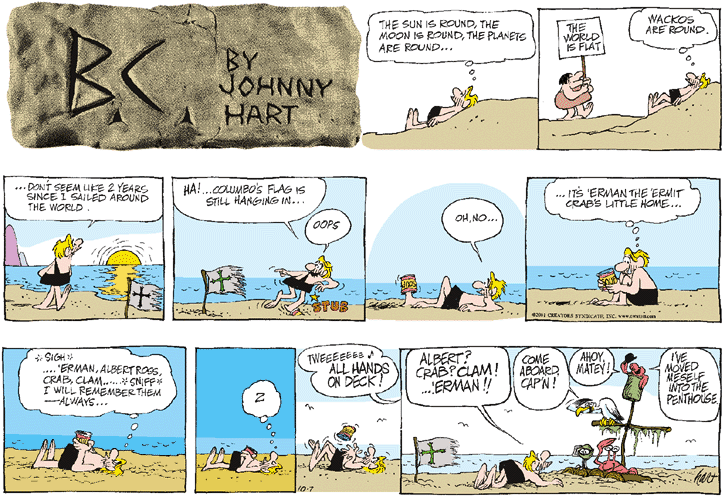
In terms of animal familiars, this would be the last appearance of Herman Crab... who wouldn't be fondly remembered until two years later.

Normally, this would've been the end of all this nonsense, and I could close out with a rather dark backstory about the Guru who oversees all...
...but Anno and Conahonty would make a rare appearance on January 21st, 2002, three years since their first appearance.


After all that build-up, you'd expect there to be more of a continuing storyline, but that's where it apparently ends.

Sunday, September 11, 2016

My Cartoon Observations

Before the onset of Wikipedia and TVtropes, one of the earliest sites for comparing weird factoids and arcane trivia in animation was The Cartoon Overanalyzation page, which can still be accessed on the wayback archive.  They covered a wide range of subjects, like how one of Filmation’s animators was a racist who refused to draw black people, so they had him doing the backgrounds instead; which was ironic, given they worked on properties like Fat Albert, which featured nothing but black people in it.

Or, if they took the jingle for The Smurfs being three apples high literally, then these Smurfs were HUGE.  (Go ahead, stack three apples atop each other) By extension, this meant that Gargamel was towering 20 feet high, and Azarael was the size of a mountain lion.

While purveying my old notes that I’d been accumulating, I came across several observations of mine that I wanted to contribute, but waited until I had at least three to consider them worth sharing.

I’ve had dreams where I’m reading books about comics that never existed.  Chief most among them, unprinted rejected strips of Calvin & Hobbes.  On one of these occasions was coming across a description of Warner Bros. Cartoon characters in Chuck Jone’s informative volumes, Chuck Amuck and Chuck Redux.  The passage I came across was delving into the psychological analysis of Yosemite Sam, who was created to be more of a challenging foil for Bugs Bunny, because Elmer Fudd was simply too easy to deal with.

Yosemite Sam hates being surprised.  Every time he confronts Bugs Bunny, he is always surprised.
When I checked these books, I was surprised to see that the relevant passage wasn’t there, since it seemed to fit so perfectly with the element that defined the overexcited pirate/cowboy/tycoon.

In other instances, it's noticing certain traits that while being innocuous in showing the broader implications of ignorance, how such portrayal can wind up helping others suffering similar symptoms without calling them out on it.  In this instance, I came to the conclusion that Baloo from TailSpin had Dyslexia.  Some of the most creative people happen to be Dyslexic, which goes to show that the barometer for intellect and creativity is not just limited to people who know how to read.  Rather, they ways they circumvent to get around the barriers required to recognize familiar words takes some creative managing.  As long as they’re happy doing what they do, whether it’s tinkering with solid materials or working with their hands, rather than trying to force themselves into the synesthesia that is converting written symbols to sound.

This is most obvious in the episode Vowel Play, where he downplays the usefulness of spelling things properly.  That is, until the code he’s explicitly expected to spell the skywritings in the correct manner, lest City Hall gets bombed.

If it were only one instance, that could be enough, but another example that bolsters my theory comes when he has to reapply for his expired flying license in On a Wing and a Bear.  In that, he’s overly anxious when he’s overlooked by an instructor who spells out instructions in alphabetical order, rather than his natural routine he’s more accustomed to.

Though there is some new software out there to make fonts of similar letters slightly different, making them easier to tell apart.

Going back to the Smurfs analogy, they were some of the most ubiquitous merchandising forces of the 80's, rivaled only by PokĂ©mon and Garfield, and parodied in The Simpsons as the infantile Happy Little Elves.  If they were released today, chances are they’d capitalize on more recent fads aimed at the extreme youth market, like Teletubbies or something.  But back then, Smurfs were the closest comparison we had.  They were introduced without much fanfare, and then promptly forgotten in later seasons for more worthwhile mindless entertainment along the likes of Itchy & Scratchy.  I just found it disappointing that while there was episodes devoted to comics, paying tribute to Watchmen Babies & Stan Lee, there was never an episode where Comic Book Guy acknowledged the existence of the comics the Happy Little Elves came from.

Like Teenage Mutant Ninja Turtles and CyberSix, which selected only the surface elements of a rather adult comic, Bart & Lisa would’ve been mortified to find out that the comics of the Happy Little Elves were satirical takes on society, deep distrust in the system they were in, and subtle political commentary on current events taking place back then.  And despite the politics being over 60 years out of time, the issues they raised were just as relevant today.

Now, ironically enough, The Simpsons have entered a holding patter of irrelevancy, their best years being long behind them, but they were also the force behind Prime-Time Animation and approaching subversive subject material in a humourous way.  And the American market being what it is, humour is the only way to guarantee an audience.

Monday, September 5, 2016

The Bad Kind of Hurt

For the last three weeks, I've been suffering an annoying bout of neck pain combined with a migraine, neither of which seemed to go away.  Normally, I bury myself with work to ignore such trivial annoyances and focus on other duties, but it turned out the mass amount of material I needed to work with was what was causing the pain in the first place.

My irritation started when after having completed the first part of a lengthy project, found out that there were other steps that needed to be added... and the papers needed weren't ready yet.  I like to assemble my files in a routine assembly line manner, and the constant factor of having to open and close literally hundreds of folders all the time was not a feasible design in my mind.  I attempted to leave these folders open, but they wound up taking up more room than expected.  Sure, it was inconvenient, but to me, the prospect of having to reopen folders with potentially sensitive material that could slide around anytime seemed more important to me.  These folders weren't designed to be opened and closed so many times.  Then, on one particularly stressful moment around the photocopier, I had a minor meltdown, and was told to leave early.  Even though my outburst gave me some well-needed cooling downtime, I still felt inconvenienced that I couldn't help out as much as I could.

Even after the job was finally finished a week later, the pain still lingered.

The sense of pain surrounding my body has always been a little weird.  When one part of my body hurts, it usually stays that way for a few days, until it fades away.  ...at which point, another part of my body which seemed perfectly fine before starts hurting again.  For instance, my knee might start hurting for a few days, before the pain transfers to my elbow.

While looking up my symptoms in a medical handbook, and looking at the boolean logic ladder, I was wondering whether any of the potential causes were from a ruptured muscle, or a slipped disc.  Since I was still able to walk and move my head, it seemed safe that neither of these options were plausible, and it was most likely the result of a pulled muscle.

I pointed out that the cause could've very likely been from when I accidentally fell out of a bus.  It was something that just happened last year, when the bus I was riding was taking a detour the other way it was supposed to go.  At a stop, I leaned out the door, holding the handlebar to look at the digits on the side to see if I'd gotten on the right one, since I couldn't see the number from the inside.  The driver, not knowing my intention, and figuring that I was getting off, pulled away from the curb, just as I was trying to hold onto the closing door I was gripping.  I landed on my back, my backpack cushioning the brunt of the blow (and ruining a pill capsule I was keeping spice in), but my head still slammed against the pavement, knocking my neck back.  The driver and passengers checked to see if I was alright.  Physically, I was fine, and managed to get back to my seat, but while resting my head against the wall, the vibrations made it difficult for me to relax, because I was still in shock, and starting to feel the effects of the fall on my neck.  That occurred to me when I was riding the bus lately, and noticed I couldn't relax as usual.

Equally annoying was my inability to sleep properly.  Having a hurting neck doesn't work wonders on a pillow, if the pillow you're sleeping on has been deflated to the point of limpness.  Much later, I was given a replacement pillow, but not a Dakimakura Anime pillow.  (While I like having a pillow pressed up against my stomach while sleeping, I consider those things to be rather worthless, since you can't see what's on them in the dark)  Turns out the new pillow needed some time to contort itself to my shape, and I was more comfortable with my old pillow.

But this lack of sleep was further exacerbated by a Reoccurring Dream I kept having.  No matter what I did, I kept coming back to the same scenario:  a young girl left in the Upper left corner of a park.  No matter what I did, I couldn't get rid of it, no matter how hard I tried.  I kept worrying that this was some kind of prophetic subliminal message .  Otherwise, why harp on the same scenario multiple times, when it has no meaning for me?  The dream only changed slightly when I shifted sleeping positions.  I was now leaving the park from a slightly different angle.  While the surroundings were annoyingly similar, there was a subtle difference - the girl mentioned that the area was beautiful, and never wanted to leave.  Upon waking, I wondered if that was the reason.  That is, my subconscious refused to let me go until I worked out an answer.  It must've been, because I haven't had that dream since.

One day, the pain got so bad that I couldn't even stay long enough to help out as much as I could.  Dealing with one localized pain was bad enough, and could be dealt with, but two from opposing different sides was another story.  I took muscle relaxants and aspirin to help ease the pain, but neither seemed to work.  I looked my symptoms up online, and found there was a rare symptom where a neck pain could be the indirect cause of my headache.  Finally desperate, I went out and got some medication specifically designed to deal with tense neck muscles.  Those worked better than the other brand, and seemed to work.

And yet, even with the new medication and applying cold compresses, my neck still hurt.  My parents were starting to become concerned.  My mother suggested a massage therapist she'd gone to recently, who had "magic hands" that made one of her persistent pains in her back go away after just two sessions.  Now, my mother is somewhat sensitive, having particularly fragile bones, and yet she still routinely goes out to play tennis, even though it causes her tennis elbow, along with tennis ribs, legs, spine, wrist, and any other body parts that require sports function.  When she gets injured, she always gets cranky on account of not being able to move, so I have to hope for a speedy recovery, so things will become peaceful around here.

I'm normally apprehensive about letting others touch my body, since I'm rather sensitive and ticklish, but given my mother's high referral and my desperation, I was willing to give him a chance.  Especially since the right side of my neck didn't hurt much - but by now, my left side was starting to feel sore.

A week later, my headache had subsided somewhat, though it had turned into a variation of the white elephant effect - it only hurt if I thought about it.  By then, I was in the waiting room of the legendary masseur, waiting for my turn to come up.  An appointment was made back when it seemed my neck was on the wane.  If it'd gotten any better, I could always cancel, no problem; but if it worsened, he'd have a slot to fit me in.

I was filled with apprehension about what I would be going through, since my general knowledge of massage pallors was limited to what I read in comics and seen on TV, most of it with negative connotations.  But then, humour plays off of things that go wrong, than on what goes right.

I figured that chances were that I'd be flat on my stomach for most of the session, being bored out of my skull, so I'd brought a book with me so I'd have something to occupy my time.  Most people would fill their time with music or books on tape, but since neither are obvious choices for me, I'm left with less options.

However, it turned out that there was much more internal movement involved than I thought.  First, I was told to sit on the table, while my back was prodded using various pressure points.  Then, I was laid on my back while he poked the underside of my back while pressing alongside my ribs.  Other times, he would be pressing the underside of my back, while moving my arm around.  Then I sat up again.  He would be testing both sides of my body, feeling around for what areas needed attention.  Throughout the session, I was rather ticklish, because some of the points he pressed were rather sensitive.  I'm rather touchy about being touched.

Throughout the procedure, the masseur talked about various things, most of which I missed since he was facing away from me.  Obviously, this was related to how barbers tend to ramble on random stuff while cutting hair, and since he hadn't had a Deaf client before, he didn't know how to talk appropriately to me.  I had to have what he said repeated back by my mother who was in the room.  One of the subjects that came up was that he knew someone who had a baby, and their parents were communicating via sign language.
Now, this kid wasn't born deaf, but overcoming the hurdles of lack of speech communication was no small task.  They figured they might as well get started via visible finger movements.

My mother remarked that the signing baby was much more proficient in learning sign language than me, since I never expressed much interest in it, beyond the basic alphabet, numbering and easily identifiable movements.  I responded with, "Well, that goes without saying."  Then, I repeated back what I just said slowly, like when Witch Hazel realizes she's just made an unintentional pun.  "Goes.  Without.  Saying."  I have a knack for coming up with appropriate stealth puns that aren't cringeworthy in the heat of the moment.

When he was finished, the masseur had reduced the pain down to two spots on either side of my neck.  They still lingered, but at least I had a specific point I could localize, rather than a scattershot broad area. And yet, even with this expert manipulation over my upper body, I still wound up hurting days later.  I was starting to lose sensation in my arm.

It was pointed out that a potential likely source of my pain could've been from sitting at the computer for long hours at a time.  Of this, I'm unashamedly guilty.  However, the cause could've very well been the unfortunate positioning of my keyboard.  Previously, I'd had my keyboard facing away from me, so I could rest my arms on the table.  But because I kept notes that I meant to write down later, I put those in front of my monitor, putting my keyboard closer to my chest, where I'd write via my armrests instead.  This new position meant that instead of writing straight ahead, I was now writing at an unnatural angle, which could very well accounted for my neck problem, because I was twisting my body around instead of facing forward.

Thursday, September 1, 2016

Back to Secret School

"Watch out for crossing cows".
Sandalwood hay bales on sale
"She takes everything literally!"
Aw No!  Not again!
What?  Calm down!
They have to harvest the wheat every year, don't they?
Yeah, but...
...how would he like it if I walked all over his plate?!
Where does Milk come from?
"The supermarket?"
Whut?  You're going on a great vacation?
Yup!  I'm wandering the countryside.