Friday, February 12, 2021

Weird Romance: Cathy & Alex

Cathy's relationship with men can be described as being desperate, while also being unsatisfied seekers of perfection only to attract disasters, and being the inspiration for missing Newspaper Comic Collection titles.

And in the rare occasions where there were acceptable men, they were either too good for her, leading the lead character to back off out of fear that there might be something wrong with someone who'd want her as a companion, or snapped up by her friends later.

Early on, there was a kind accepting boyfriend, Emerson, who had all the qualities Cathy wanted in a man, but just not in his kind of man.  And he was quickly forgotten.

For the most part, her definitive man was Irving, an irrepressible clueless jerk who was somehow endearing despite his faults.  He would be the backdrop against all the other awful men Cathy would go out with, serving as a barometer gauge of awfulness.

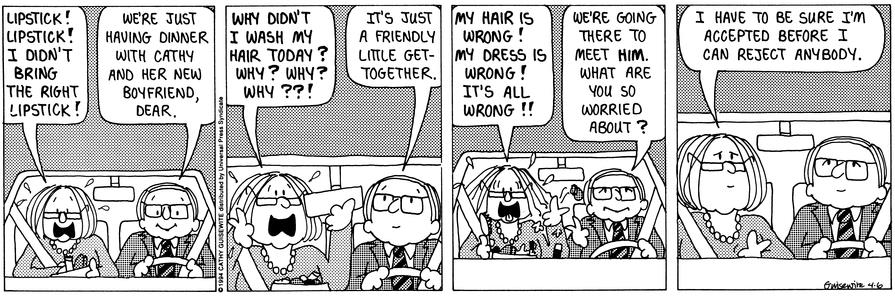
But there was one instance where Cathy found a potential soul mate that would wind up being one of her longest lasting relationships over the course of a year.  It all started innocuously enough in January 31st of 1994 when she signed up for gym membership.


Cathy is described as being a lot of things, (overeater, overdoer, workaholic, shopaholic) but a Cougar isn't normally one of them.


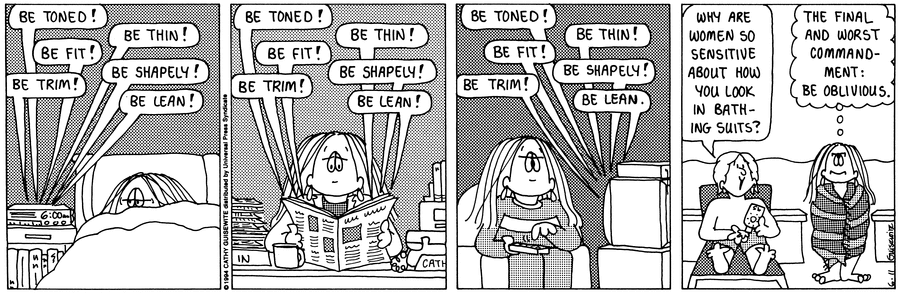
The following isn't Alex-related, but I decided to include it for continuity's sake in showing Cathy's reaction later.


I don't have a date for this Sunday, but this seems like the appropriate place to put it.


To further present the divide between Cathy and Alex, Alex decided to go on a camping trip.


If there's one complaint about Alex, it's that compared to Irving, there wasn't as much argumentative drama.  Alex was simply too easygoing, and his childish immaturity was more a core character than a fault.  If anything, he seemed simply too good for Cathy.


Assault on Irving was something that was deserved, but the same level of violence aimed towards Alex lacked that same sense of reciprocity.  It seemed somehow... mean.


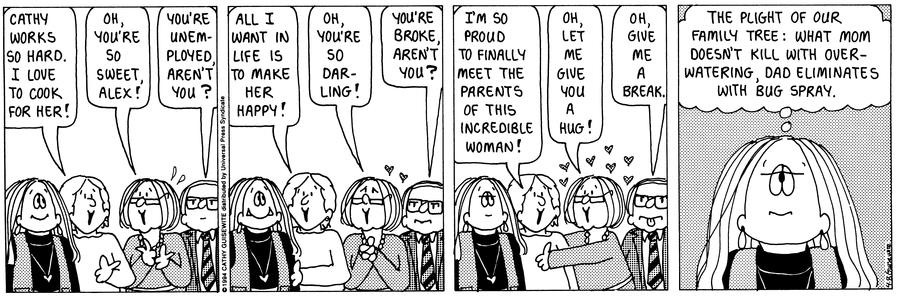
Then in an attempt to impress everyone involved, Cathy decided to undertake the laborous task of preparing Thanksgiving dinner all by herself.

Of course, when anybody ventures out into new territory, they have a tendency to fall back on the old patterns they're most familiar with.


Cathy's relationship with Alex while fraught, was still healthier than with Irving, and was said so in a Newspaper article I managed to find, back when going through physical microfiche archives was still possible.
At the beginning of February, we were treated to a teaser of what we could expect: the usual itinerary of anxiety of an approaching Valentine's Day and all the implied pressure it carries.


And then on February 14, 1995, a year after Cathy met Alex, without any fanfare foreshadowing or buildup, we were suddenly faced with this:


This isn't the last that Cathy and Alex would see each other, but this post is running long enough already, easily outpacing my Epic BC posts.  Maybe I'll post a followup sometime next year.

Thursday, February 11, 2021

License Re-request: Epileptic 2

David B.'s seminal comic biography about his epileptic brother is one of the most seminal comic works ever seen, easily outpacing the likes of Persepolis and Maus.  His drawings have a grandiose dreamlike essence with a strong Mayan influence, giving a monstrous symbolic representation of the disease that took over his brother's life.  Paul Gravett writes more eloquently about the masterpiece than I ever could.

Yet people may be largely ignorant of the fact that there was a followup after the 6-volume epic ended.

I only knew about this because there were samples made available in the pamphlets during Free Comic Book Day in 2006.  However, I only flipped through the pages of the Fantagraphics sample (inappropriately titled Funny Book #2), since I wanted to make sure I'd get my money's worth, and didn't want to get something that would take up valuable space. 

I'm guessing hardly anybody saw these pages, either from being largely unimpressed by the interior, or the subject material not being to their taste.  Don't worry if you're missing anything - you're seeing the best that the issue has to offer.  And it was freely available back then, so I have no compuctions in sharing it again now.

This seminal footnote was from Babel, and was only a scant 32 pages, with the promise of more to come.  So far, only 2 of the 3 issues have been translated.  As such, there's too little material to justify collecting everything in one comprehensive book.  It doesn't even qualify as an add-on for the already oversized tour de force tome that is Epileptic.  Not to mention that some of the material retreads stuff that was already covered before, retelling it in a different manner, making the addition somewhat redundant.

BTW, there seems to be a translation error here, where the text says "my brother ran into one of Professor T.'s assistants", when it clearly shows his parents instead.  The latter seems more likely - Jean-Christophe hardly talks to anyone outside his dwindling circle he’s not intimately familiar with.

That would've been the end of it, but there was another preview in 2008 in another FCBD book, not in Funny Book, but I.G.N.A.T.Z. instead.

There's been a smattering of David B.'s other works translated into English, such as, Black PathsIncidents in the Night, and The Littlest Pirate King, but none of these titles have really gripped my interest the same way that Epileptic does.  The only title that does is his adaption, Hâsib & the Queen of Serpents: a Tale of a Thousand and One Nights.

There were occasional forays in history and David B.'s dreams within the pages of Epileptic, but these segues however tangentially related still felt like part of the narrative.  When I read his other works, these elements don't mesh as seamlessly.  It's probably a mixture of history, violence and dream logic thrown together that works better for an adaptation than his other stories.

One fair criticism of Epileptic is that David B.'s sister makes her presence known, and then is completely neglected for the remainder of half the book.  A fault mentioned by his sibling.

I'm not entirely sure how a collection of just three(!) issues could be bound together.  It's something like how Super Spy: The Lost Dossiers was an expanded extra package never intended to be part of the narrative, just a special promotion for those who heavily invested in the property.  I don't really have a suggestion in the matter.  I just wanted to bring it up.

I greatly identify with the story, despite not being epileptic myself, seeing it as a cautionary tale for what could’ve been me.  If my parents hadn’t fought as long and hard as they did to overcome my deafness (and my Aspergers), I could’ve very well ended up like Jean-Christophe.

Despite all of David B.’s parent’s attempts to circumvent a cure for his brother’s condition, they never stopped trying, constantly moving from one to the next, never finding solace from any, as none worked for very long.  At a certain point, Jean-Christophe just gave up fighting, and became utterly dependent on his disease.  I still need help with basic living, but I can still contribute to family and society in my own special way.

Saturday, January 16, 2021

Computer AI Comics

There's been an ever-increasing influx of AI doing increasingly complex formulas to recognize the imagery and language that many of us intuit naturally.  But there's still one area that computers are sorely lacking in, and that would be the realm of storytelling.  Sure, there's the humourous botnik website showing mock algorithms displaying a kind of warped dream logic storytelling that showcases programs almost but not quite getting it.  Showing classics such as a Star Trek Next Gen script, or a lost Harry Potter chapter where all kinds of weird stuff happens, or Keaton Patti's claim of forcing a bot to watch 1000 hours of media and create a script based on what they read, then showing us the first page.

This has led to the amusing creation of turning human-made computer-prompted scripts into actual comics.  A kind of recursive creativity.  But this practice is far more different than what actual computers do.  See, predictive scripts while useful in spurts, has limited practical uses.  It can't plan ahead for long-term storytelling, such as inserting a Checkov's gun to be applied later.

When we look at a comic, there's more than one way to do so.  Some people look at the text first, before moving onto the pictures.  Some look at the pictures first before looking at the words.  And some skip reams of redundant dialogue and narrative, and skip to the end entirely to see how it all turns out, then goes back to see how it got to that point.  Those plans work fine for humans, but for machines, their thought process is much different.  Instead of looking at an individual panel and wrestling meaning from it and making connections from one panel to the next, the computer has no idea what's going to happen next.

To parse the difference between words and pictures, computers would have to take in two disparate elements of fiction at the same time.  A way to bypass this overwhelming influx of information would be that rather than analyze every page on a panel-to-panel basis would be to absorb the entire page at once.  This would be equivalent to devouring the entirety of a novel in one go.  There’s no sense of pacing, of slowing down or speeding up individual panels for personal dramatic effect.  There’s no wandering eye, trailing from the text, to the images, (or images to text) and back.  It’s akin to speed-reading on a quantum level.

Storytelling is basically telling a puzzle, making due with limited information gradually revealed over time.  When the story is finished, we may mull over it, trying to figure out what made parts of it work, and others not.  What possible reason could a machine have for going over the tropes of a story?  Other than trying to parse obvious connections that crop up over time.  (See TvTropes)  For a machine to appreciate comics, they’d have to understand narrative.  And the best way to do that would be to create works that speaks to their tastes.

I’m sure you can see the logical fallacy here.

In order to create a comic that would appeal to machines, we’d have to devise an algorithm that would work along their preferences.  And what appeals to machines may very well be indecipherable to human taste.  Here's an example of a comic created by an AI program:

As creative entries go, it's certainly different. The poetic nonsensical prose reminds me of Josei narratives. Still, the lack of clear cohesive storytelling and abstract art makes telling what's going on near impossible. What's the comic even about?? That's the kind of maddening question that's going to plague linguistic comic schools.

The AI also has trouble with exaggeration of facial expressions, even though a human could easily tell when someone’s deforming their body under extreme stress or for comedic reasons.  Then there’s psychedelic backgrounds to heighten emotion or using unique pay layout to showcase optical illusions.  All various ways of using the medium to convey a message.

What we’re seeing is like a child’s first attempt at making their first comic without really understanding what they’re creating.  Of course it’s going to be a narrative mess!

Before machines can conduct stories of their own, they need to understand how stories work.  And the best way to encourage them is by giving them a basic setup, then have them try to figure out what happens next.  The whole appeal of cliffhangers is that the audience is filled with anticipation for what may or may not happen in the next installment, which can lead to runaway imaginations that can sometimes be better than the actual product.

You know how in movies, they show the T-800 using their infrared sight, getting data helpfully analyzed for the viewer?  Chances are a smarter computer would multitask, inputting thousands of pertinent and irrelevant information all at once.

It’s the difference between seeing a movie play out, and reading the wikipedia summary.  The webpage could be taken in as a whole, but wouldn’t have the same impact as the film, despite both sources containing the same information.

Computers have enough difficulty deciphering a simple image all on its own.  How’re they supposed to figure out how two seemingly meaningless panels individually connect?

You’d think the randomized Garfields would be a logical parameter for working with, but the Garfields that've been popularized online only work best when given limited parameters.  When given only three panels to choose from, the alignment is completely randomized, with no thought given to whether the resulting mishmash is funny or not.  No actual creativity is applied there.

The Garfield computer-generated remix results in panels where the trio of the cast, Jon, Odie and Garfield morph into each other, the background and the text winds up being backwards and nonsensical with no meaning attached to any of the made-up panels present.  (Check the link to see the animated sequence in action)  In that light, that’s an *actual* presentation of a truly randomized Garfield.

I posted an entry that the best way for a computer to learn would be through constant repetition of repetitive layouts with different captions, so they could figure out the pattern for setup and punchlines.  The iteration of Wizard of Id and BC strips would be a better factor in figuring out patterns than anything, since the use of setup, timing and punchline would give computers a way to figure out the formula much sooner.

I think comics is still something solely dominant in the human domain... for now. (Randomized Garfields notwitstanding) The computer-generated Manga page I posted earlier may seem impressive at first, but it was actually half of a page.  Even if you saw the other half, you'd hardly notice.  Do the two sides narratively connect?  Look at the repetitive panel layout! Apart from the speech bubbles bleeding over the borders, it's static, but boring.  This?  This is the computer equivalent of doodling.  Free-thought association without coherent goals, letting ideas flow from one subject to another.

For computers to understand a narrative, it would be helpful to see them adapting another work of fiction to their interpretation.  Then we could see how much they put of their own take, depending on what they add and/or subtract from the narrative.  Though I would suggest starting with smaller simpler stories before moving onto more complex works such as Frankenstein.  But even the simplest Fairy Tales have a kind of internalized dream logic that has an inherent morality that would escape their mindset.

At least there's SOMETHING we puny humans are better at than computers!  Until a machine can comprehend the elaborate innovative storytelling of Cerebus, we're a useful source of amusement.

"I HAVE FOUND MY CALLING."

"Don't give up your day job."

Friday, December 11, 2020

Brought Low by my Knees

Two months ago in early October, I had a bit of a health scare.  Nothing terribly serious, but it was still alarming.  I had a red rash on my leg that also hurt at certain odd spots when I moved.  Notably on the thigh and below the knee.  At the time, I thought I could simply tough it out, and wait for it to go away.  Turns out that your motivation for toughing the pain away goes down dramatically when the pain doesn’t go away.

This perplexed me, because I hadn’t been in any kind of extraneous activity lately.  The closest thing I could think of was when I accidentally twisted my leg while in an uncomfortable position around the debris in my room.  But that shouldn’t have caused what was keeping me from moving properly.  Another confounding analysis was that I’d bruised my leg before, but it was the other leg that hurt.  My body has a strange reaction to pain.
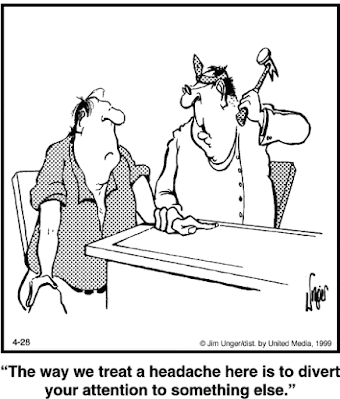
My sense of taste was heightened, yet I could hardly eat anything, and was throwing up multiple times in the middle of the night.  I couldn't eat a hardboiled egg, finding it loathsome even as I choked it down. To paraphrase a saying, when you're tired of eating, you're tired of life.  But I developed a taste for fruit. I liked the strawberry jam, but didn't like the strawberries. The grapes and pineapple and the cantaloupe tasted good. I even ate some off-brand clementines that had too much pulp, and finished off the leftover grape juice.

The last time I’d felt this bad was when I had my Kawasaki, which ironically enough, has some Covid-related symptoms.  If I experienced a milder version of what’s currently running around, then there was a chance I might be asymptomatic, and if so, take all precautions in preventing others from being affected.

What I was most upset about was that very same week, I had an appointment with my audiologist to get a replacement for getting my hearing aid replaced.  I’d been given a loaner after my old h-aid conked out, and was fortunate to have that done in March when the Pandemic just started.  (It's a wonder the loaner lasted as long as it did without breaking down.)  But before I could apply for a new model, I needed to do a hearing test to be eligible for a replacement, proving that I was deaf and hadn’t been faking it all these years.  And I couldn’t attend the simple 5-minute procedure since in terms of detecting dearness during a virus-laden society, it was low priority.

But now, it looked like I might not even BE able to make it to my audiologist, my mental willpower notwithstanding.  The pain was starting to severely intervene with my motor functions, my temperature fluctuated between a high of 101 and a low of 98.6, and I had a headache along with a high fever, all typical symptoms of Covid, though my breathing remained the same.  Any potential sniffle and cough was cause for alarm when they happened, and was only relieved when they’re gone the next day.  It’d been two days now, and my leg still hurt, even with applying cold compresses to the affected areas.  I looked up my symptoms online, trying to find a stronger link between my leg rash and Covid, and didn’t see much of one.  Not seeing an obvious connection, I looked up pain in the leg.  The results showed bruising and blood clots, but nothing specific.

Eventually, the pain got to the point that I figured I might as well bring attention to my parents.   When I showed them the upper portions of my thighs, they reacted with alarm.  Not at the discolouring rashes or my nonexistent shallow breathing, but from seeing the state of my knees.

I’d always had severely callused knees, not because of any kind of rough-housing, but because I often spent a large amount of time in front of the computer on my knees.  This was a result from not only shifting positions from sitting down for long periods of time at end (I know, I know, sitting is the new smoking), and also needing to feel the direct pressure of the desk against my stomach, which the thin veneer of the edge isn’t enough to satisfy me.  My early days of using the computer were of the bulky suitcases-sized variety which required heavy desks that could withstand their weight, and had large boards to press against.  Today’s makeshift desks now have a flimsy slidable tray keeping a far distance away from the keyboard, which isn’t to my liking.  To this day, I still have a kind of nostalgia for those oldschool wooden desks and chairs, even though my size and mass no longer fits.  In fact, attempts to squeeze into that wedged space is something of a guilty pleasure.

But it turns out those days of kneeling on my knees more often than a church preacher had unintended side effects.  In addition to building up calluses that flaked over my knees as a symbol of inappropriate pride, the resultant buildup was a pathway for pathogens to come through, and had a high risk of infection.  And it was likely a malignant virus unrelated to Covid could’ve entered my bloodstream.

I’d been warned about my knees numerous times in the past, but this was the first time it really sunk in that it could be detrimental to my health.  After all, one of the highest risk of old people is their legs, and like horses, when they can no longer properly walk, their independence fades away into the harsh sunset of the glue factory.  For all my precautions at avoiding human contact, I’d foolhardily allowed a backdoor into my body at a knee-high level.

My parents had gone out of their way to make things easier for me during this state of emergency.  My Dad braved out on shopping excursions, even though he could’ve simply ordered what he needed.  My mother bought a bunch of transparent plastic masks to make it easier for me to lipread people, and here I was, making things more difficult for them at their most busiest.  I always seem to get sick at the worst possible times, when it’s most inconvenient, such as when I had my gout.

Since going out to a clinic at this late hour (it was around 7:00 or so), my parents had to make do with getting a secondhand diagnosis with a family doctor by sending photos of the infected area.  It’s much easier to get an accurate result when you can see the symptoms for yourself.  After some back and forth conversation I was completely unaware of, the general consensus was that I most likely had Cellulitis, a deep infection inside my leg that could severely affect my internal nervous system and blood pressure if left untreated.  For this, I needed to take some antibiotics and painkillers for 2 weeks until it went away.

I thought my old antibiotic cream would still work, and I’d only applied deliberately when certain body areas developed a scab from overuse.  Turns out I wasn’t aware that there was an expiration date, and needed to get replaced, since it’d been sitting on the counter for over 10 years.

So my Dad went out to get the prescription for antibiotic pills and cream to apply over the infected area.  The cream insisted on washing the affected area first, and since it was to be applied twice a day, I opted for simplicity by taking a shower.  Easier than lifting my leg to fit under the faucet sink.  Then, after drying myself off, I’d apply two kinds of cream on my leg, the clear one first, and the milky white one after, taking care to wash my hands before and after.  While waiting for the cream to take effect, I noticed that the points where my leg hurt the most was the most used spots for when I’d rest my elbows in the bathroom.  So I couldn’t even enjoy reading in the ‘library’.

I thought this would be enough, but my parents didn’t want to take any unnecessary risks, and wanted to follow the doctor’s recommendation that I go to the hospital immediately.  Unfortunately, I couldn’t go to the hospital right at that moment because it was late at night, and raining, making for precarious driving conditions, even in the event of a potential emergency.  No point in getting into an accident and having to go to the hospital via ambulance.  Better to go early in the morning instead.

That night, I had trouble sleeping, not just from the pain in my leg, but my thoughts constantly racing over the certainty that I was going to die without having accomplished anything I’d set myself out for.  I still had loads of notes that still hadn’t been jotted down for my Web Novel which I’d kept putting off.  I had piles of old articles on Asperger’s I’d been organizing and left an awful mess out of.  One thing I can tell you, the fear of impending death is a great motivator for firing up the creative juices. Nothing like the impending threat of morality breathing down your back to motivate you to get your writing down.  That's why they call them DEADlines.  It’s also an appetite suppressor, though I wouldn’t recommend it as a diet plan.

Even though we were supposed to leave at 5:00 AM, I was so upset I couldn’t stand waiting, and sleeping on the wrong side (my hurt leg kept me from feeling comfortable) and having a thick Reader’s Digest Medical hardcover pressed against my stomach during times of stress wasn’t helping me much either.  I started off by preparing food for the upcoming trip, peeling the pulp off the off-brand clementines and packing grapes off their stems wrapped in napkins to absorb the moisture, not knowing just how long I would have to wait.  (No point using perfectly good paper towels when we’ve got plenty of napkins)

My Dad found me in the bathroom at 4:00 AM, throwing up for the third time and decided to leave earlier than expected, which was something of a relief, getting the suspense over with.  However, he was such a meticulous planner that, even with the two of us departing at an earlier schedule, we still wound up leaving at 5:00 anyways.

This early in the morning, there wasn’t much traffic, but still a few cars running at stop lights.  I was annoyed that even in the presence of a pandemic, there were still too many people around.  The air was cold, and the parking spot we found was far away from the main entrance, so we had to make our trek there, and I rushed peg-leg style, impatient to get this ordeal over and done with.

Upon arriving and seeing the white plastic sheet covering everything at the rear entrance of the Emergency room, all the strength went out of my legs, and I had to force myself to take further steps towards the daunting doorway, the enormity of the situation I was walking into began to weigh down on me.

I was guided to a waiting room with the resident nurse who’d determine the severeness of my illness, and where I’d get the chance to use the latest feature app on my Android cell phone, Live Transcribe, which I wrote an essay for a volunteer organization in a hearing magazine.  (Reproduced below)

Tuesday, November 10, 2020

Obituary: “Who was the Host of Jeopardy!”?

Since 1984 this well-known and widely beloved television game show host lent intelligence and class to one of the most popular quiz programs in TV history, until his passing today at the age of eighty.  --Karl J Martin

In a roller-coaster Chinese cursed year filled with unexpected disastrous cataclysmatic results, the death of Alex Trebek feels more like an anticlimax.  After the diagnosis of stage 4 pancreatic cancer, we all knew it was likely coming, but it still took us by surprise.  He continued to keep up his Jeopardy! appearances, allaying the illusion that everything was still fine, so the ensuing impact still felt like a low blow.

If there’s one thing that everybody seems to agree on, it’s that Alex Trebek was widely looked upon as a gentleman with hardly anybody saying a bad word of him.  He was one of the few universally loved and trusted figures left.  This was accomplished via his indefatigable gracious manner and sense of humour, always ready and willing to make a joke. "I try not to take myself too seriously," he told an interviewer in 2004. "I don't want to come off as a pompous ass and indicate that I know everything when I don't."

From MAD 347, "If God were One of Us".

For as long as I’ve known, he’s always been the host of Jeopardy!, and had a distinctive mustache.  But before that, he tried out at various roles, covering news, sports and other gameshows that have long since passed public consciousness, such as "The Wizard of Odds," "High Rollers," "The $128,000 Question", "Double Dare", "To Tell the Truth" and "Classic Concentration."  The ironic part is that back then, Alex Trebek remarked thatI don't want to do this all my life. Hell, I don't even watch game shows.”  Hardly the words of someone who would become a defining element of a nationally syndicated game show.

From MAD 350, "Quotes You Can Bet Were Never Said"

Perhaps it’s because Jeopardy! demanded a higher degree of knowledge from the contestants that other shows didn’t that elevated Alex Trebek to giving higher quality services that was absent elsewhere.

It also didn’t hurt that Alex Trebek kept his known reputation as a honorary Canadian, being a natural ambassador, and his playful attitude helped play down his reservoir of knowledge, even as he was regarded as the guy who “was arrogant because he had all the answers”.

And yet, even when the contestants were doing unevenly, when the contestants bet badly on True Daily Doubles, when the answers given were incorrectly stated, he never made anybody feel bad about having given the wrong answers.  Even on the rare instance where all three contestants failed to win in the final round.

When the Coronavirus was rampaging and Alex was recuperating, there were some old Jeopardy! reruns shown, back when the show had it’s name shown in giant blinking lights (leaving out the grand prizes presentations before announcing the final Jeopardy category, which was just filling up airtime).  One thing that surprised me was that back then, the interview with the contestants - which normally took place after the commercial break - happened before the commercials.

Somebody really should compile a collection of his most humourous lines.  Sometimes he’d give amusing feedback when reading the categories.  In one such instance, in an interview with one of the contestants, he’d mentioned he wasn’t good in classic opera.  And guess what specific category showed up?  The very same category the contestant was bad at.  To this, Alex simply muttered, “Uh-oh.”

A suitable replacement for Alex would be impossible to find, but the most speculated candidate would be Ken Jennings, fabled 74-time winner.  That would be quite the coup, going from long-lasting contestant to taking over the role of gameshow host.  Sadly, it turns out that Ken Jennings along with two other former Jeopardy! contestants is going onto another quiz game, The Chase.  We'll see if the show has any brand-name recognition a year later.  As a joke, Alex Trebek suggested that the person to replace him would be Betty White of Golden Girls fame, since audiences would want "somebody younger, somebody funnier to replace him."

The outpouring of affectionate compassion displayed towards Alex Trebek is in stark contrast to another certain gameshow host who thus shall remain nameless.  For future reference, the unnamed individual-1 shall henceforth be known only as "Ol' Whatsisname".

In fact, there's a surprising number of Jeopardy! comics devoted to crime, which is a stark contrast to the $64,000 Show, scandalized for informing the long-running challengers of the answers beforehand.

"What if we gave the contestants the answers?"

"Isn't that how the trouble started?"

"But then, they'd have to figure out the questions."

And that's how Jeopardy! was born. 

It's going to feel weird not having Johnny Gilbert introduce him anymore.  But at least Alex produced a lot of shows before his death.  His last airing will fittingly enough, be on Christmas Eve.