Saturday, September 24, 2011

Everyone was Sailor-Moon Fighting

Ever since it was announced that sales of Sailor Moon was selling gangbusters, I was wondering why news hadn't been reported on comic news sites. I was going to wait until it was confirmed nationwide, because maybe it was just for that region alone. Apparently, I needn't have worried, since sales were brisk and keeping with local demand. Never underestimate the appeal of ditzy cute girls in leggy outfits.

It's really amazing how Sailor Moon has managed to retain her popularity despite not being in public view for almost a decade. Apart from the nostalgia factor, there's also the fact that there hasn't been a popular iconic female figure for Manga in a long time. Even the impressive amount of Magical Girl Animes that it spawned, such as Cardcapturer Sakura, Magic Knights Rayearth, Tweeny Witches and Princess Tutu haven't managed to knock off the reigning champion from her throne. (Recently, Puella Magi Madoka Magica managed to deconstruct the Magical Girl trope starting around the third episode.)

Sure, the bad guys might've succeeded if they'd focused on more than one plot at a time, so the Sailor Senshi wouldn't always (somehow) stumble upon their plans to drain human energy, but it made the experience more enjoyable. The formulatic premise also helped cement the popularity of the francise. While people might've looked down on the monster-of-the-week formula, it also helped make it easier to jump into any episode without really missing anything. If you look at a lot of the early S-hero comics, you'll notice a lot of repetition at the beginning. The Hulk was always getting angry and crying "HULK SMASH!!!"

That simplicity may explain the inheirent appeal of Sailor Moon. Despite its large cast, the storyline's fairly simple. A forbidden love between Earth and Moon people were reincarnated to try their lives again. For some reason, the beings who caused their deaths want to stop them from getting together again. It's loosely based on the legend of Kaguya Hime, a baby girl found in a bamboo shoot. (This isn't as odd as it sounds - Momotaro was born from a peach) When she became of age, and five suitors began to ask for her hand in marriage, she had to decline their offers because she was actually a Moon Princess, and had to return to her true home.

Whereas, if you wanted to explain Wonder Woman's background, you'd have to delve into intricate backstory of Steve Trevor crashing/washing up on the shores of Paradise Island
where no man shall set foot, and Wonder Woman passing her initiation by hiding her face behind a flimsy mask. That setup's all fine and good, but it falls to pieces from there. Wonder Woman lost her powers in the 70's, and became a working woman. Steve Trevor becomes such a non-entity later on he was killed off - twice. (He came back later) Attempts to romatically pair her up with Superman or Batman have ended up in failure. And there hasn't been much of a relationship with her Queen Mother. Basically, she's an ambassador of peace, but is also held to an impossible standard of feminine equality and diplomacy. Only Greg Rucka's run managed to make a convincing portrayal, but it was spoiled by editorial interference by Amazons Attack, an event that's better left unknown.

In addition, Sailor Moon was also responsible for putting school miniskirts on everyone. It was one of the most iconic (and leg-revealing) designs that simultaneously conveyed power and sexiness. Just as strongman pants became shorthand for S-hero underwear, short skirts became synonymous with powerful pre-pubescent girls. The amount of influence is still felt to this day. Next to Slave-Leia, it's one of the most popular costumes you're likely to see at Anime/Comic conventions.


Even though the girls show off quite a bit of leg, they're still more tastefully done than most sexualized S-heroines who're closer to sex models than anything. Part of it may stem from everything being done by a woman who's admitted that she prefers drawing women to men, which makes for a refreshing change of gender imbalance. The love interest, Mamorou shows up less and less later on, and becomes the token male. The similarities to Wonder Woman can't be ignored either, especially since Sailor Moon uses her tiara just like the live-action show starring Lynda Carter.

Sometimes, you just want to feel like a princess.


Girls are more interested in admiring their role models as being the center of attention rather than the actual responsible figures of power. That's why they prefer princesses to Queens, since one is involved in ruling a country, and the other isn't. If we haven't seen the harsh decisions made that could make a queen considered unpopular, it's harder to identify with them otherwise. This was something that was touched on with the portrayal of Marie Antoinette in Rose of Versailles - we saw her rise and fall with the political intrigue that happened in between, so we couldn't hate her entirely. (The sparkly eyes didn't hurt either)

Below is a mash-up that I'm surprised hasn't been done before. You may hate me for this.


I thought about doing one of Sailor Sat-Uran, but couldn't find an appropriate sprite to use.

Friday, September 23, 2011

Right Text, Wrong Balloon

There was a recent discussion on what Manga publishers do that upset their customers. The answers ranged from cancelling a series only three volumes in its run, or even worse, just one volume away from completion. Then there's the other general pet peeves, such as transparent thin paper, and slipshod translation efforts.

However, there's one slight detail that's easy to make mistakes in that can occasionally get on my nerves. It's when dialogue gets placed in the wrong balloon. I've written before about text across the page that can be read the wrong way, but this is something different.


Even though this example is faithful to the source material, it would sound more natural if it were "My knife... and fork!" Not to mention having the words be consistent with Toriko's hand gestures.


Here's another example from Emma. At first glance, nothing seems wrong with this scene. But take a closer look...


In the green circle, there's the tiniest hint of a balloon tail. It makes it sound like the accused is admitting to being greedy, when her facial expressions say otherwise. Also, the offscreen teasing sounds coming from overhead would be more consistent.

If this kind of detail is too hard to see, there's another helpful shortcut. Just take a look at the size and shape of the balloon. A good rule of thumb is, if there's more space than usual, or if it's spiky, that's a good clue right there. Otherwise, important information would have to be squeezed into a smaller balloon instead of the larger balloon where it would naturally belong.


It bothers me that text is inserted without any regard for the context of the overall picture. It's as bad as exposition that explains what we're seeing right now. Sure, it helps if we're not clear on what's happening, but oftentimes, that's not the case.


In other instances, we get information that's revealed prematurely.


It's rare, but even scanlations can slip up on this little mistake. Here's an example of some crucial information coming out early in the wrong dramatic panels.


Part of the reason why this happens is because word balloons can be read either sideways or across, and it's not always clear who's talking. To make things even more problematic, those pesky tiny balloon tails? Sometimes they're intended to be spoken from characters across from each other. You might not be able to tell, but this was flipped to read from left to right. It doesn't look unusual at first, until you take a closer look at the dialogue, and realize that Astro is responding to something that Big X hasn't even said yet.


An even bigger mistake of this kind is when dialogue is translated, but organized the wrong way. This scene near the climax of the classic Astro Boy story, The Greatest Robot on Earth, is made confusing because the dialogue is translated, but the page itself isn't flipped. See how much easier it reads if the circled balloons are switched?


For the most part, this kind of thing is more likely to be looked over in Mangas that have lots of throwaway dialogue that's not likely to get a second look. Most modern-day Mangas don't suffer from this problem, since they're usually not too text-heavy, but there are exceptions. Here's a few examples from Yu-Gi-Oh!


This kind of mistake happens quite frequently in From Eroica with Love. Even now, I can't tell if there's anything wrong with this panel or not. (Apart from the obvious reasons)


In the 3rd panel below, Klaus is responding to James, the unseen stingy accountant (a man after my own tastes) under the table, which gives us a clue as to what's wrong with the 5th panel. The way Eroica talks there, it sounds like he's threatening to kick Klaus under the table instead of considering his offer.


Oftentimes, because the balloons are so close together, it's easy to get them mixed up. The lower one is closer, but the upper one should be read first.


You probably can't tell, but the circled balloons are pointing towards different targets. usually, the American way is to have balloons over the character's heads, but in Manga, they're more likely to be by the side.


Also, since panels are likely to be filled in from left to right, the first available open space is more likely to be filled in. If they're not numbered properly, this kind of mistake becomes easier to make. Here, in a sudden revelation that Eroica's been hoodwinked in a wild-goose chase, the internal monologue is in the wrong place.


During a scene where Major Klaus was being hit on by a rather ugly woman (actually Eroica in drag), he's getting some natural ribbing from his superiors. The agent with black hair, Lawrence, fancies himself to be a James Bond archetype, even though he has none of the Agent's charisma or skill. The line he's saying would sound more natural coming out of Klaus' mouth.


Here, a suspect of a terrorist organization sounds like he's accusing his interrogators, instead of the other way around.


For all of Lawrence's faults, he's surprisingly efficient in other areas, such as waking up on time. This is another example of somebody responding to something before they've said it.


Lawrence's not a telepath, otherwise he'd pick up on the intentional hostility of his co-workers. Unless he'd actually say what they were unconsciously thinking.


Just as Lawrence is inept in social etiquette, Klaus is equally ignorant of the art world. Or rather, he would be if he didn't guess what The Blue Boy was.


Despite being an extremely effeminate art thief, Eroica has an irrational dislike of women. So much that he's stolen the harem girls' introduction.


Context of this scene would help, but I won't give any, other than Klaus is impatiently buying a plane ticket.


Another example of reading from top to bottom, rather than from side to side.


Another example of somebody else stealing their lines.


If there's one thing that Klaus' butler is that Alfred isn't, it would be emotional. In this instance, it sounds like he's lamenting his own recollections, and Klaus is breaking out in tears because of it. (The butler actually broke up an argument between Dorian Klaus by talking about Klaus' childhood bed-wetting accidents. The result was so embarrassing that both men lost the will to continue fighting)


A scene of Eroica escaping by throwing scalding food back at his prisoners. The guards really should know better, otherwise they'd wind up reversing their pronouns.


Lastly, it sounds like Walrus-guy (Bonham) wants to buy a statue, when he's actually scared of it being haunted, and wants to run away. If Eroica had known how things would've turned out, he might've had a change of heart.


Despite these faults, I hope that a company will pick up from where CMX left off and continue the zany adventures of Eroica and Klaus. This, along with the remainder of Swan, Even a Monkey can Draw Manga, Club 9 and What's Michael? Hell, why haven't Viz done omnibus collections of their out-of-print Shojo lines? Classics such as Please Save my Earth, Basara, Red River and Banana Fish would be potential bestsellers, and solve the dilemma of finding rare volumes. Especially Banana Fish, which only begins to pick up steam around the 7th volume, and becomes an intense page-turning thriller similar to the last half of Cerebus' Church & State, and the 4th storyline of Sam & Fuzzy.

Wednesday, September 21, 2011

Tintin's Survival Skills

It seems like every major comic nation has their own personal boy scout ambassador. America has their Superman*, Japan has Astro Boy, and Europe (or to be precise, Belgium) has Tintin. The latter one may not be as powerful as the first two, but his ability to survive in the face of impending disaster is nothing short of miraculous.

There's been some renewed interest in Tintin with stills of the animated movie being released. For years, readers worldwide have enjoyed the exploits of the boy reporter, though it (along with Asterix) have had an uphill struggle in finding an audience in America. Even though the new movie's directed by Stephen Spielberg, and Tintin was the archetype of Indiana Jones, there's still a lot of reservation of the actual outcome. The director isn't known for his reputation regarding animation.

Still, even if the movie turns out to be an unintentional stinker, it still won't take away the power from the books. There's a reason they've managed to be read by readers of all ages for over 70 years - they're that good. And by all ages, I mean ALL AGES. From babies growing up to senior citizens indulging in nostalgia. There's a timeless quality to these adventures, even though they reference events that took place back when they were being serialized.

Besides, Tintin's endured past clunky adaptions before. The live-action movies, The Golden Fleece and The Blue Oranges were new stories that took the popular characters with stories written by other people. Having only seen the Fumetti books of these films and not actually watched them, I can't verify for their quality. Hopefully, someday, I'll be able to find a copy and judge for myself.
Tintin and the Mystery of the Golden Fleece, and Tintin and the Blue Oranges - British Film Institute DVD releases
Even the animated version which had to severely tone down the elements of Tintin's escapades, haven't severely impacted the integrity of the classic comics. One child reviewer complained that Haddock's swearing wasn't as imaginative or verbose as the comic versions. Drug-smuggling was toned down to diamond conveys, the storylines felt different on the TV screen, and the animation was somewhat jerky. The Nelvana series was more faithful to the source material, though they still had to tone down some elements, such as Captain Haddock's alcoholism.


All this is tied in to Tintin's earliest incarnation when he was Totor, an actual boy scout. He was so much of a blank personality that young audiences quickly latched onto him, and wouldn't be fleshed out until much later. This much is evident with Tintin's first adventure, where he endured an amazing amount of damage that would otherwise kill a normal man. There was a study that showed this hero would've been long dead if he suffered from the kind of abuse he'd accumulated over the years, which would account for his youthful appearance. Much like Jackie Chan, the amount of dangerous cliffhanger scenarios were toned down in the later years to appear more realistic, and the slapstick scenes were regulated to the supporting cast members who would be more accustomed to this kind of thing. Spreading the pain around = family entertainment!

Tintin in the Land of the Soviets was the only early Tintin book that wasn't coloured and redrawn and predates the controversial Tintin in the Congo book. Hence the following drawings, which weren't touched up, show how rough (yet charming) the first Tintin stories were. While the boy is entering a potentially dangerous country, he's constantly faced against agents who're trying to discourage the reporter from doing any negative coverage of their country. Since this (and the Congo one) were done for propaganda purposes, it's safe to say these sleeper agents failed. Within the first few pages, Tintin (and Snowy) is the sole survivor of a train bombing...


Falls out of a speeding motorcycle...


...and gets hit by a train in a getaway car. Keep in mind that this car was being attacked by bombs from a passing airplane.


Later during a lull in the action, Tintin tries to go to sleep in a sewer. Not the concrete platform itself, but actual sewer water.


Next is a common scenario that happens frequently - being lined up for execution. Tintin's
preparation plans here are very omniscient, and could only happen if he'd had foresight that this would happen to him. Since he was intending to sabotage the army he was traveling with, this almost gets a pass.


Next up, Tintin gets encased in a shell of ice. Don't worry - despite his proclamation of doom, he gets better.


And finally, he survives a plane crashing face front into the ground.


During all this, how do the Russians try to counter against this seemingly indestructible boy reporter? Halfway through the book, a Russian agent who looks suspiciously like Skunk Kusai hatches a spontaneous plan; having him slip on a banana peel and hope he'll break his neck.


Then again, the agent might've been onto something there. This theme would be picked up years later in Cigars of the Pharaoh as a successful way to capture Tintin.


This seems to be the most dependable technique to stopping the young detective - stop with the outlandish plans and just use common sense.

*Interestingly enough, America's other do-gooder icon, Mickey Mouse, had stories by Floyd Gottfredson that were reminiscent of ongoing serial adventures very much in a Tintin vein. If Disney had capitalized on his adventures, rather than making him a bland character, we might've gotten more cartoons benefiting of adventure dramas rather than hokey good-guy type stories.
It's rumoured that Mickey Mouse was how Walt Disney saw himself, and Donald Duck was how the animators saw Disney. To put this in perspective, there's about 50 Mickey cartoons, and over 200 Donald Duck cartoons.

Sunday, September 18, 2011

Fat is Phat

There's been a lot of (righteous) indignation over the downsizing of Amanda Waller, a rather imposing short stocky woman. She's always managed to intimidate people stronger than her just by sheer determination alone. In addition to the sudden weight loss, she's apparently gained a height boost to show off her new figure. Chances are, even if she goes back to her former impressive figure, the argument still won't be over. With Hollywood's self-imposed style of beauty, there'll still be a crusade against fat people. (And yes, I'm going to use the derogatory term. Obeisity is the last discrimination.)


However, Amanda Wallers is not the only woman in S-hero comics to suffer from a bout of reductionism. There have been other women who've had a serious reduction of the waist, such as Gail Simone's version of Etta Candy, and She-Hulk's partner, Weezi. In the world of S-heroes, It's rare to find women who've fattened up rather than slimmed down. Big Bertha from Great Lakes Avengers is a case of having her cake and eating it too, since due to being able to control her metabolism, she's able to become a fat S-heroine during emergencies, and a Supermodel during breaktime.

The difference is, when it comes to fat figures on the comics page, they tend to gain back their weight rather easily. Any rapid change from their usual look would alienate long-time readers, and a demand to revert back to the status quo.


Below is something that would be considered blasphemous and impossible if the original artist hadn't done it himself - a thin Fat Broad. Maybe this might inavertably inspire artists to do Rule 34 versions of the old gal in a similar vein to Velma Dinkley. Though with that dorky haircut, I doubt it.


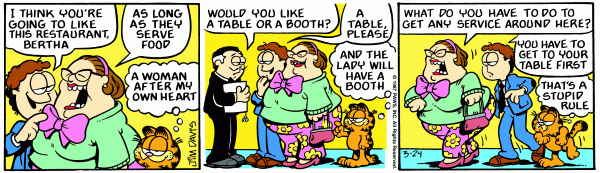
Remember Bertha, Jon's date with a fat woman?


She later returned for a Sunday strip, looking considerably toned down.


This could be seen as the female equivalent of dorky nerds becoming rich millionaires, spurning the ire of every jock and cheerleader who ever bullied them during High School. Now that their persistence and hard work paid off, their new figures would make them the envy of every man (and woman) who ever passed over them in real life. It's the ultimate revenge fantasy - being more successful than the people who once scorned you.


A recent study shows that preschool girls as young as three have already typecast fat people as undesireables. While most people would consider figures D and E to be perfectly acceptable, 69% of the participants wanted to be figure A. Considering how heroes and villains are portrayed in popular media, these young girls are picking up on these subtle cues very quickly. One wonders what their perceptions would be like if their worldview were reversed.


A look at fertility goddesses and Rubenesque art shows that the standard of beauty was different back then. Indeed, being fat was a sign of being healthy, since these girls were eating enough, and getting plenty of nutrients throughout their body. In another embarrassing factoid, guys find women hot when they eat a lot during meals. This makes it difficult for self-conscious women on diets to break from their habits of eating salads in front of their love interests - they don't want to scare them off.

For some people, an extra bit of poundage can be considered attractive. The claim that a pregnant woman "glows" during her later stages may not just be the hubby blowing airs to make his spouse feel better - he actually finds her attractive. Of course, this could be down to personal preferences... some of which may not always be very flattering as some recent artwork has shown. One could say that its the imperfections in people that make them notable. Not everybody needs to be a Bruce Timm stylized girl.


Even so, the desire to become perfect beings in the face of overwhelming odds is a scenario that's not going to go away anytime soon. As long as there's an unattainable standard to reach for, people will continue to clutch at it with their stubby fingers. "Man's reach should exceed his grasp, or what's heaven for?Robert Browning

In closing, here's some parting words from the Fat Broad that aren't repeated as often:


In fact, let's have her do it again.