Tuesday, December 7, 2010

Building & Demolition... One Piece at a Time

The One Piece Manga Moveable Feast recently passed, and likewise, I passed up the opportunity to comment on the series as well. I couldn't think of anything to add about the series that hadn't already been said multiple times by multiple people. They all came from the same consensus - it took a while before the series began to become appreciated for its innovation and genius. For some people, they were able to easily jump into the series without much prompting. For others, it was more of an uphill struggle.

I have to admit that I wasn't a big fan of One Piece at first. It wasn't the cartoony expressions - I'm used to that. I used to "read" various French children's comics with big noses. What I had trouble with was threefold.


1. Unlike DragonBall, which was easy enough to understand just by looking at the pictures alone, a lot of One Piece is expressed by what the characters say. More than that, a lot of the humour comes from how the characters react around each other.
2. Most of the first volumes takes a long time to show things happening. There are multiple pages of characters yelling their beliefs, and I began to find it increasingly tiresome. If it makes it any easier, Oda originally wanted to draw out the beginning even longer, but the Shonen Jump editor wisely told him to speed things up so they'd at least start the adventure on the 100th chapter.
3.
The increasingly seriousness of the fights. This may sound strange, considering it's a humourous series, but let me explain. The first villain fight that I really liked was Luffy's fight with Buggy the Clown. After that, it was Captain Kuro (sometimes translated as Captain Crow) who was a cool calculator. Then the One-Man army, Don Kreig, then the Shark-Fisherman, Arlong... For a long time, I was waiting for the fights to be fun again. It wasn't until the fight with Foxy that I began to like it again - and he didn't show up until past the 300th chapter!


There's one other factor that's been covered about One Piece, and that's Oda's creative world building. I'd like to take the opposite tact, and say that just as much as he likes creating unique countires, he also goes out of his way to destroying them as well.


When it comes to landscapes and architecture, Oda has the remarkable feat of killing his babies. He's not afraid to show the damages to beloved inanimate backgrounds, and even went so far as to make the beloved Merry Go inoperable due to all the rough travels it went through.


It wasn't until the Water Seven arc that I began to understand where this mentality came from. Japan routinely suffers from earthquakes and tsunamis, and that's reflected in their culture. They have a tendency to rebuild themselves from the ruins multiple times. Things may have gotten better now, but its that ability to bounce back no matter what that's likely stayed in the Manga medium.


When buildings get destroyed in S-hero comics, it's usually no big deal. We never consider the lives of citizens living in them, since they're not part of the story. Likewise, if the Baxter Building or the X-Mansion gets burnt in the crossfire, we don't care; it'll be mysteriously repaired later on. In the world of One Piece, it's different. We've seen these people living in the village, and therefore, care when their world is in danger of being destroyed. It's one of the lessons that Jeff Smith wrote about in drawing Bone - make the audience care about the village people, and they'll be affected when they want to protect themselves.


Wherever Luffy goes, he runs the risk of not just defeating the Big Bad of that country, but also destroying every major monument in the process. So when he wound up on Amazon Lily and saw the tyrant Queen's forbidden backside, I thought for sure the island was going to be reduced to a smoldering crater. So it was a pleasant surprise when the damage turned out to be minimal in comparision. In effect, the battle only ended after the fight with the Queen's sisters, without the need for the Queen to be defeated. Instead, she was impressed with his compassion to help him with his personal request.

In fact, everything starting from their arrival at Sabaody Archipelago (chapter 500) was a total subversion of the usual formula of island hopping. It is at that point that the sheer inventiveness of One Piece really begins to shine. It is with great thanks to Viz that they've sped up the One Piece releases up to that point where it'll be truly appreciated by an American audience.  So far, it's currently at the crux of the war between the Whitebeard Pirates against the World Government.

While most Shonen series have one-on-one fights to make it easier to stage fight scenes, Oda goes one better and has multiple pirates fighting against multiple marines in various combinations. One fight can just as easily switch to another if the situation warrants it, and on an unpredictable battlefield, anything truly goes.


You'd think it wouldn't be possible for so many players to have their moment in the sun without hogging the spotlight and making it look confusing, but somehow Oda manages to make it work. Even more impressive is that while showing multiple fights with multiple opponents with unique abilities, (many of who we never saw before), was done with continuous two-page spreads. Imagine the 75th issue of Fables' war against the Adversary multiplied by 100, and it still wouldn't come close to how awesome the One Piece war is. WhiteBeard's Quake-Quake ability makes Samuel from the 4th season of Heroes look tame in comparison.


One thing that I was amazed at in DragonBall was how the damage to the fighters and the battlefield would be consistent throughout the pages. If somebody's cheek was cut, it would stay cut. If a tile on the floor broke, it would stay broken. Oda's certainly taken the DragonBall influence to heart in the architecture. The people, not so much, since they're perpetual Timex machines. Up until the war, the only deaths that happened were in flashbacks when members of Luffy's crew had their tragic pasts revealed. It may sound a bit hyperbolic, but after this war, things will never quite be the same again... while feeling exactly the same later on. I don't want to spoil things too much for those who haven't read the current chapters, but rest assured; things will get worse before they get better.

The people at Marvel & DC should check out the latest One Piece storyline in the American Shonen Jump to get a better idea of how an epic storyline can be done right without degenerating into event fatigue. Sadly, chances are that they'll ignore the competition and focus on their already rapidly dwindling audience. For those of you getting sick of the current state of the American S-hero comic market, One Piece could be your cure. The length and intimidation factor is high, but the payoff is worth it for those willing to stick it out. You likely entered the S-hero world by grabbing a random issue and liking what you read enough to fill in the blanks later. You've supported your favorite S-hero characters for years through inane storylines and numerous price hikes. Isn't there any room for one more?

"Every act of creation is first an act of destruction. " Pablo Picasso.


EDIT - I added another update at the end of this relevant post. It appears destruction of private property follows the Straw Hat crew like little lost puppy shadows.

Sunday, December 5, 2010

Goodios

One of the saving graces of the old scansdaily site before it was taken down was that it was a bastion for alternate comics that otherwise would've never gained attention otherwise. We were treated to rare gems such as a Muppet Noir mystery written by Mark Millar, issues of 2000 AD when Judge Dredd wasn't always a jerk, noteworthy webcomics and if we were really lucky, translated pages of French comics.

Somebody even went to the trouble to put up black & white short stories with hillarious twisted endings which was an ongoing project at Marvel to collect such comics before it fell through. Anybody who remembers the titles "He Wished he was a Vampire!", "Inside is Ty!", and "The Last Look!" will have some idea of what I'm talking about.

One of the few things I saved was this satrical cereal comic. I'll say no more, save that I have no idea where it came from.


It took me awhile to figure out why the kids' shriveled mouths looked so familiar here, and then I realized it was a tribute to Will Elder of MAD fame. If Buddy Fact wasn't a nom de plume for the legendary artist, then it's an amazing likeness. Don't bother looking up the author online - I can't find him anywhere. Chances are, this post will be the only reference to his name.


As one commentor on the old scansdaily site said, "This was just perfect." I miss the days when children's commercials had cool cereal ads that tried their damnedest to convince you to buy them. Until parents concerned about the sugar intake of children protested enough to have them taken off the air. (That's my guess for why they're no longer available even though they were a staple for years.) At least we enjoyed a good run with the Honey Bee, Captain Crunch, Lucky Charms, Cocoa Puffs, Sugar Bear, Cookie Crisp, Fruity Pebbles and Chocolate Frosted Sugar Bombs before they were taken down.

As amusing as these commercials were, none of them actually convinced me to purchase any of them. The only commercial that was catchy enough to actually make me want to beg my mother to buy was a Chef Boyardee ad for Tic Tac Toe spaghetti. However, because I lived in Canada, she couldn't purchase this despite my complaints, which diminished my desire to ask for anything else on TV. Being unable to aquire most of the advertised stuff probably produced my reluctance to be influenced by TV ads. After all, what's the point begging for something if it's not nationally available?

Some company should seriously consider doing an archival DVD collection of all the commercials they've done over the years. In addition to seeing the evolution of iconic cereal mascots, they'd also be preserving their imaginative legacy for future generations to see what all the fuss was about. Plus, they'd have the nostalgic public practically paying for their own advertising. It's win-win!

EDIT: After doing a little searching, I found a site, Videomercials where Lionel J. was already going to the trouble of going through all his recordings from the 50's to the 90's and burning them onto DVD for mass consumption. It's even more impressive when you consider that VCRs didn't even become available for customers until the 70's.

Thursday, December 2, 2010

Missed Smurfoppurnities

With Papercutz's release of King Smurf, we finally got to see the results of Jog's elaborate essay of this charming satire of a medival political situation turned dictatorial. However, there were some instances where the previous translation job was better handled. The most obvious one being the title itself where it changed from the breezy King Smurf to the more clunky The Smurf King. Not only does this title make this nameless Smurf more distinctive from the others (Papa Smurf, Greedy Smurf, Harmony Smurf, Grouchy Smurf, etc) it also poses a problem that'll be pointed out further down.

Compare the previous translation job here...


To the current one.


The font for the group yell much stiffer and less organic (a common complaint whenever computers are used for lettering as opposed to the human hand). In addition, changing Grouchy Smurf's "I hate (whatever)" to "Me, I hate (whatever)" was an annoying faithful translation. The original version being "Moi, je déteste (French word for whatever)". But it gradually grew on me, when his way of talking was evident even when off screen.


Even at a blown up size, you can barely see the little note pasted on King Smurf's robes. It's made even more cramped up with having to fit the long term "The Smurf King", and totally ruins the joke.

Likewise, they also missed out on one of the best comebacks ever:


Papa Smurf should've said, "Euphorbium, Smurforbium!" here. If the earlier translation didn't have that quote, it should have. Just imagine how many memes that could've inspired. "Hurtful, Smurful!" "Foreshadowing, Smurfhadowing!" "Web Surfing, Web Smurfing!" "Turf Wars, Smurf Wars!", you get the picture.


After Papa Smurf resumes his former position of power once again, the former King Smurf retires his outfit to the fields similar to how Thanos used his duds at the end of the Infinity Gauntlet. This begs the question of what he would be called from that moment on? The Smurf formerly known as King Smurf? THFKaK Smurf is quite a mouthful in normal conversation, and would take even longer if he referred to himself in the third person multiple times. Chances are he faded into the background along the multitudes of nameless Smurfs, and was content not to be remembered as the one who almost drove their village to ruin.

These little mistakes weren't just restricted to the King Smurf story. The second story in the collection, The Smurphony (originally titled Smurphony in C) needed a better fact checker. Here, you can see from Gargamel's increasingly pathetic chase of Harmony Smurf that the monologue was repeated in two balloons. In the sixth panel, he should be complaining about getting a crick in his neck rather than getting a cramp in his other calf. That doesn't fit with what we're seeing here.


I only point out these inconsistencies in the hope that future reprints of this series will be corrected. I'm also hoping that we'll see The Smurfnapper (Gargamel's first appearance) in the next book, before the Smurfette appears, so we'll have some idea as to his motivation in capturing the little blue people. It would be a foresighted shame if it were only available in a separate comic book that's probably out of print by now.

Wednesday, December 1, 2010

Gaze and Despair

In one of my previous posts, I lamented that I was unable to find the cover to one of the most disturbing movies I'd ever seen in a video store. Fortunately, one of Chris Sims' recent articles at ComicsAliance featured a very helpful link to a comprehensive collection of old VHS tape covers. Thanks to this, I can now show the movie that emotionally scarred me as a kid.


I didn't even bother reading the tagline, since the image was disturbing enough. In my mind, I thought the plot was that people's eyeballs were coming to life and popping out of people's heads. Considering that I receive 99% of all my information through sight, this was an extremely horrifying concept early on.

While scouring the samples from multiple companies, I found several other covers that I'd long since forgotten.


Before a certain cantankerous doctor with a limp started harassing patients with mysterious diseases, you were more likely to associate the title with this horror movie.

While doing some inventory work for the NFB, I found in a movie book, the title to one of the most hilarious titles I'd ever seen:


I'm guessing these aren't the kind of movies that influenced Terry Moore.
Likewise, this probably isn't the critically exclaimed series starring Helen Mirren.


This cover was something that had me stumped for a long time. I originally saw it in French, when it was retitled "Metamorphosis". I'm guessing if Franz Kafka's insect story was Hollywoodfied like this, it would be a million times more interesting. Before I read the tagline, I thought that every portion of the man's body was changing against his will into something that he couldn't control. In that sense it would be like Parasyte squared.


While most teenage comedies tended to scare me off , this cover seemed to be so over-the-top that it looked like it might actually be fun. Keep in mind that I never took out any of these kinds of movies - the plot the concept art had couldn't possibly match what I thought would happen in the actual movie itself. Not to mention that many of the themes that they showed weren't the kind of things I was interested in. I wanted to watch comedies and the kept offering Rambo-style movies, teenage sex comedies and weird horror movies. In some ways, not actually seeing the contents of these movies was something of a mixed blessing. It kept me from having disappointed lower expectations and a desire to see better movies than unmemorable dreck.

Ironically, it was the title of The Naked Gun that made me reluctant to watch it as a kid, since it combined both elements of sex and violence in the title alone. I told my mother that I didn't want

By the time Nordberg smushed his face into a cake and fell off the poopdeck, I turned and accused, "You said this wasn't violent at all!" Despite my complaint, I watched the rest of the movie without any further prompting. Slapstick violence I could handle. Real-world violence I couldn't... yet.

Speaking of The Naked Gun, there was one last commercial of Leslie Nielsen I saw on TV a year ago that perfectly captured his deadpan appearance. He was spouting the virtues of a credit card company protecting itself from outside elements. While he was walking, a Man in Black in the background was protecting him from potential dangers, such as construction beams, wet cement and even a wrecking ball. With a flourish, he faced the camera, and with typical straight face, said "Visa's got your back", just as a plume of smoke puffed out from behind him, and he looked away with his wide eyes, while still smiling and never turning his head. It was perfectly Frank Drebin of him, and Youtube doesn't have it on video.

Monday, November 29, 2010

Don't Call him Shirley

Woke up a little later this morning, after having to deal with a puzzle in my dream that I was having trouble solving. I was in a Metroid-like environment, and in order to get past the first door, I had to destroy three canisters. Problem was, they were suspended in mid-air, like some sort of anti-gravity spaceship. There were two missle cases a floor below one carrying 4x missles, the other 6x, which seemed odd, since all the missles in the Metroid franchise were in the 5x category. I kept firing weapons at the cases, but everything kept bouncing off the coating. After fidling with the cases for awhile, I figured out that the trick was to open the spray a bit from all three canisters and then fire.

Problem was, for some reason, I decided to use my lighter around that time to set them off. Not only was I putting myself under unnecessary risk to light them, I also couldn't get the lighter to work properly. I kept clicking and clicking the thing, and the canisters were floating further away from each other, which would mean I'd have to start all over again...

...And then I woke up. What's really aggravating is that I originally woke up an hour ago, but promptly fell back to sleep, thinking I'd only need another five minutes or so. I could've stayed in bed longer to solve the puzzle properly, but had to get up because I was late.

Shortly after that, I went downstairs to check the latest headliners, which are usually less interesting than the rest of the paper, when an obituary in the lower left hand corner caught my eye:

"Leslie Neilson dies at age of 84"

I was just as shocked as everybody else. Like many humourists, I based much of my personality on his dry straight-man speech which was quite up my alley. The interesting thing is, even though he started out doing serious roles and only entered comedy for the later third of his life, you can't take his earlier roles seriously anymore. Since they're done in such a deadpan manner, you keep expecting him to come up with a witticism when there isn't one. A little tip - if you want to respect the man's works, don't look for pre-Airplaine! movies with him in the cast - you'll only be setting yourself up for disappointment.

After the decline that was the third Naked Gun movie, he wasn't able to obtain the heights he'd grown to. He was being continuously cast for less and less sophisicated parodical roles that demanded only the barest strands of his talents. The scripts couldn't match up the the genius of the early Naked Gun movies, and relied too much on visual cues that became less funny the more they were used.

However, because I woke up late, I missed the boat, and other bloggers were more eloquent, insightful and informative than I was. Not to mention that many of the commentors beat me to the punch in potential one-liners.

One thing that I never understood was why when the DVDs of the Naked Gun movies were released, did they never show the outtakes that were shown on TV, such as when Frank accidentally turned off Nordberg's life support system. Or the fight with the football fans before exposing the fake Meinheimer. Or Frank's continuous exploits at the sperm hospital getting him penile surgery. Hopefully now we'll get a chance to see these exploits that originally showed up on TV get a proper release.

Friday, November 26, 2010

Doug Wright's Cats

I seem to have a kind of knack for finding rare books that I like. I was lucky enough to find garage sales that sold old collections of Sunday comics of For Better or For Worse and Herman, especially since they're no longer printed anymore. I even found some old Pogo books of original stories that weren't in the newspaper for $0.25 each. (I highly recommend Pogo's Peek-a-Book, which has two of the funniest stories I've read that had a direct influence on Calvin & Hobbes) In that same bookstore, I passed up five issues of the colourized Akira comic, issues 1, 2, 13, 19 and 27. Incredibly enough, I later found those very same issues for sale at a garage sale just outside my jurisdiction. That led me on a serious comic-hunting spree to find the rest of the series once I got the most expensive issues cheap.

Some months ago, I was doing some book-hunting at library booksale looking for bargains. After finding several out-of-print children's books, I didn't want to leave just yet, because I felt a slight buzzing in the back of my head that gave me the sense that there was still a good book lying around, just hiding in plain sight. Then, tucked in a corner of the non-fiction section, I saw the title Stolen Innocence, a biography about growing up in a polygamous society. I figured my mother would like it, since she enjoyed the first three seasons of the HBO series Big Love, a kind of cross between Desperate Housewives and the Sopranos. Once I found it, the buzzing stopped and I was able to pay and leave.

Prior to that, I made an amazing discovery. Buried somewhere in the humour section was a collection of Doug Wright's editorial cartoons. Knowing that Doug was finally gaining some respect in the comics field by having his Nipper comics reprinted, it seemed too good to pass up.

It feels a little unusual seeing Doug's normally silent people giving lengthy monologues in a New-Yorker style of speech. It's the same problem I have when reading Groo - I'm so used to Sergio's pantomime that Evanier's script seems overly redundant. Most of the comics are in the very dry joke category, rather than the laugh-out-loud kind. Not to mention that despite the title, many of them are hardly political at all. They seemed more like large one-panel strips that could fit comfortably between Hi & Lois and The Family Circus. Except that there's no reoccuring characters; it's a different set of people and location every time. The closest it gets to an editorial comic is a meeting between Nixon & Trudeau, who're doing each other's makeup on live TV. What this is supposed to mean is anyone's guess.


The front cover isn't much to look at, but it's the back cover that's the main selling point. I'm always amazed at how much effort artists put on the unseen portion of a cover, when they're likely to be overlooked. Most online bookstores don't even bother with the back cover unless it's covered with reviews of glowing praise from multiple sources on how good the book is.

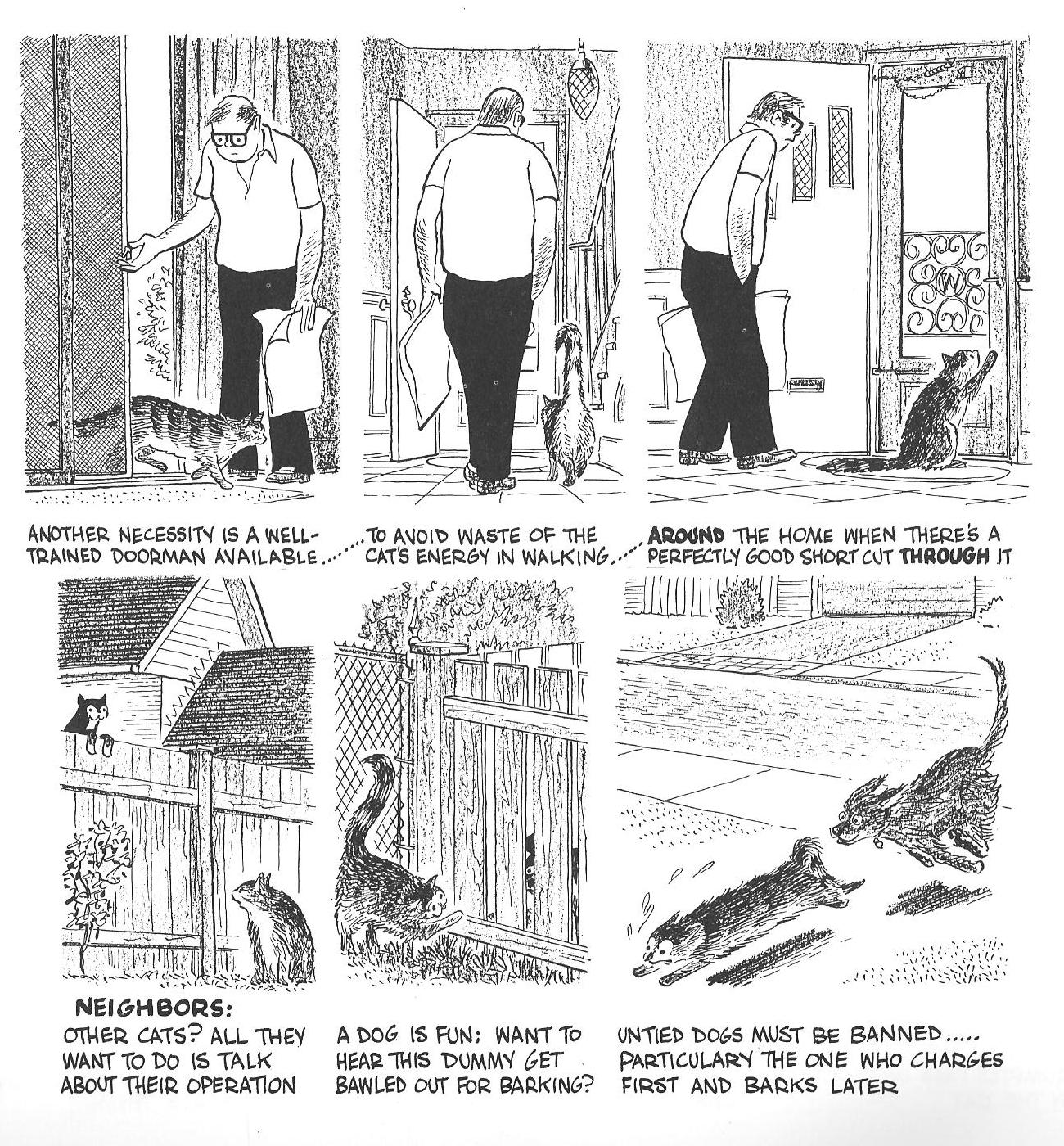
There is one saving grace though. There were three pages about a cartoon cat, whose philosophies seemed pretty much spot on. It's radically different from any of the other strips in the book and seems to be done for a special in the Spectator magazine it originally ran in. For the sake of saving anybody's bank accounts from having to pay for an overpriced book online just to see the best parts, I'll be reproducing them here:


The cat's exasperation in the next-to-last panel there is very reminiscent of Sheldon from The Big Bang Theory. Even better when you consider that there's a children's book titled All Cats have Asperger's Syndrome. This could tie in to how Sheldon could relate to cats when his "girl-not girlfriend" didn't want to see him anymore.

Next up is a perfectly explainable reason for why cats are constantly wanting to go in and out of houses, seemingly on a whim.


The dog in that last panel there is modeled exactly how Farley in For Better or for Worse tended to run. Goes to show just how influental Doug Wright was.

Pay special attention to the upper left hand corner of the next strip...

Wednesday, November 24, 2010

Lack of Drawing Skills

Recently, the creator of Xkcd formally announced that due to a family emergency, he would have to take a slight hiatus from his popular webcomic. Despite this, he was still able to update his webpage with doodles of half-finished bad jokes. In light of his remarkable devotion to his fans, other cartoonists sprung out of the woodwork to contribute guest strips to help fill in the four-five month gap while he deals with his family illness.

I would've liked to contribute something myself, if not for two conflicting interests: 1. I'm an even worse artist than the Xkcd guy, which is saying something. 2. I don't have a webcomic page. Apart from my submissions to Square Root of Minus Garfield, I don't have much experience drawing comics. It's rather ironic, since I think and read about comics daily, and even envision writing an enjoyable comic that'll be read and reread for generations to come. But I utterly suck at drawing, when I can easily see the panel layout for a theoretical comic that doesn't even exist yet. Even the act of doing rough drafts tire me out.

I can never work myself to draw properly, because I'm always upset at how the comic character comes out. It never looks like the way I envisioned it to be. It makes it even worse if they're looking at me, silently demeaning me for warping their pure existence.

Cartoon: What are you doing? My jawline should be shaped rounder and my nose should be curvier!
Me: Sorry.
Cartoon: Oh great, and now you've completly drawn my arms out of proportion to each other! Are you trying to disfigure me?
Me: (clutching my head in shame) I'm sorry.

I could escape my fear of drawing eyes by drawing totally blank eyes in the same vein as Little Orphan Annie or the Sins from Jack. However, to me, it feels something like a visual shortcut, and not something I could build on. I've tried to break down my inepitude by focusing on one facial body part at a time, drawing it over and over until I get it right. It's easier when I just have to focus on one thing at a time. Then I'll be able to put all the pieces together in a way that makes sense.

Problem is, this approach fails me too, since I can never bring myself to stay interested enough to work on the details. Not to mention that drawing the same open mouth multiple times and not getting the same results I wanted is extremely demoralizing. For some reason, on the rare occasions that I can get a doodle to work exactly the way I want it to, when I think about it too much, I can't capture that essense I wanted again.

This is why I prefer to write instead of draw. At least if any of my characters say something stupid, I can change it to sound more profound and memorable. Still, this didn't stop me from trying to create crude drawings that could work. Every year, in order to save money, I would write a creative card for my parents' birthdays and Mother's/Father's Days. Thing is, I could never just create a card with a simple "Happy Birthday" in it, oh no. It had to have social commentary that would tie in to whatever current theme was happening around then.

One such example was around my grandmother's 91st birthday. Like any geriatic, she was rather shy about revealing her true age. I had two characters argue over whether it was ethical to create a monument to her surviving this long. Eventually, there was a scuffle over the banner covering the number, causing the hook of the "9" to fall off. When it hit the ground, it created a dense plume of smoke covering both characters as they looked in horror at the remaining numbers, which now spelled out "11". The soot-covered supervisor was going to say something about modifying the monument, when the designer said, "Forget it. It's too soon. Maybe next year."

It probably loses a little something in the retelling. I may post it online if there's any interest, but for now, I might as well show two Xkcd-style comics that I drew.

First up, I can't take any credit for the idea here. I found somebody's doodle of this page in High School, and was impressed enough to copy it and tape it on my bedroom door as a kind of warning of what would happen if anybody set foot in my room. Because, like one of my other signs said, "Occupancy of more than one person is considered unlawful and dangerous". I added the mutant fish, and the looping plot myself.


The other comic I drew for my Mother's birthday was a rebus that I thought she'd be easily able to decipher. Sadly, I grossly underestimated her capacity to understand pictures, and had to explain it to her. My sister who's an artist and a comics fan was able to understand it instantly.


For the less observant among you who remain baffled, maybe this link will give you a clue. But don't click or highlight it until you've considered every option. The fun of puzzles is figuring things out in the end.

Of course, the real reason I posted these up here was that I had no guarantee that my comics would even be accepted, and didn't want to take that risk. After all, what would Randall Munroe have to gain from linking to my blog? My comics don't have any mathematical relevance to them. Not to mention that I have no real desire to redraw my comics again. The panda one was hard enough.

Conversely, I’ve heard of artist who suffer from the opposite problem. They can compose scenes of elaborate poetry in their images, but they can’t tell a story to save their lives. There has got to be a way for these authors with visions and artists with talent to get together somehow.

Monday, November 22, 2010

Koko be Nimble, Koko be Good

After the recent discussion of the lack of success of homegrown Manga, it would be remiss of me to not support such works when they're worthy of spreading the word and letting the outside world know they exist.

One such work I recently read that impressed me was Koko be Good. When I first read the first chapter, I was rather bored, since it started out very wordy, and focused on a lonely guy pining for his girlfriend who was currently in another country. It seemed like another one of those books that would be the archtype for those stereotypical "oh-woe-is-me" autobiographical comics. Things only perk up when the titular character pops up. From that moment on, Koko litererally steals the show with every appearance she makes. From her free-spirted personality to her expressive appearance, everything she does make her a joy to look at.


After her gatecrashing entrance, before she can be arrested for trespassing, she makes off with Jon's taperecording from his overseas girlfriend in the confusion. So it's up to him to track down this elusive maniac girl. While it seems like an obvious setup for a romantic comedy between two opposing people, I'm glad to say that the story doesn't follow those conventions. Jon manages to find Koko and get his tape recording back (slightly overtaped though), but the two of them still go off their paths in their separate ways. They converse with each other, but there's never any sexual tension or chemistry between them. I'm always impressed when there's stories done without having to rely on gender roles.


Koko's character design and personality reminds me a lot of the snake-girl-like appearance from Solanin. This isn't a knock against snake girls - I find that the wide mouth gives them an incredible air of expressiveness. Just look at the popularity of Gin from Bleach as an example. My first experience with a Snake Girl was one of the cast members in the out-of-print Mr. Arashi's Amazing Freak Show who didn't appear in the book. I wondered why she didn't appear, despite looking much better drawn than the other characters. It wasn't until years later that I found out it was an in-joke reference to Kazuo Umezu's Reptilia. That's the kind of thing that'll fly over your head unless you're paying attention.


Where was I? Oh yes, Koko. She's impressed with Jon's devotion to his girlfriend overseas (even as she ridicules him) and decides she wants to contribute something to society. She thinks that the best way to do so is to donate money for a underpriviliged child. Trouble is, she's something of a dilettante and can't settle down on any one job to acquire the funds she needs.


One thing that I really liked was Jon's pose here:


While most Manga characters usually put their hands behind their necks when they're slightly uncomfortable, it's also become something of a shortcut for too many artists. Check out the positioning of multiple Mangas, and you'll notice that there are a lot of similarities between character's stiff poses. When someone's making a speech, they'll spread their arms across to take up room on the panel. But not everybody worldwide uses the same positions like everybody else. It's important to have as much variety as possible to gain that sense of authenticy. The fluidity of the charater's body language also helps here.

This review covers a lot of the subtlety that I missed when reading it the first time around. I'm much more interested in the mechanics behind a comic and whether they work or not. Trouble is, with works like these and Solanin, when it comes to recalling a specific piece of dialogue that stands out, nothing comes to mind. It leans too much into real-world conversations, which is generally unmemorable, such as it is. That's fine when you're conveying a realistic world view - neither overly optimistic or pessimistic, but somewhere in between. But it makes it incredibly difficult to pinpoint a point you're trying to make.

This is the kind of story that I'd be incapable of writing. When I tell a story, I always do so with the intent of choosing the most interesting path possible.

Thursday, November 18, 2010

Red Ketchup


There’s been some recent tributes to Canadian cartoonists who are well-regarded, but are virtually unknown in their home country. This is hardly a secret shame, since there’s plenty of unsung cartoonists worldwide, and due to the competition, some have better PR than others. Still, its surprising when some works aren’t better known considering their imaginative quality.

I’ve just recently reintroduced myself to a French Canadian comic titled Red Ketchup. He originally ran in CROC, the Quebec equivalent of MAD Magazine, only raunchier. Red Ketchup is an albino FBI Agent who could be described as a cross between Arnold Schwarzenegger and Hunter S. Thompson. He’s very effective at interrogation, killing, and regularly takes various drugs to starve off the “shakes & headaches”, and is absolutely insane.

It’s not that he’s a rogue agent, but rather that he’s too dedicated to his country. He usually goes off on whatever madcap caper he’s on until he’s ordered to otherwise. By the time the higher authorities are informed on what he’s up to, its too late to find and recall him.

Steve “Red” Ketchup originally started out as a side character in Michel Risque in a series of Black & White comics similar to European comic designs. Given the amount of imported French comics Quebec gets, this isn’t an unusual disposition.


Once he grew popular enough to have his own spin-off, he got what could be described as his origin:

Born an albino, Steve Ketchup was the son of Polish immigrant, a violent alcoholic who beat his son regularly to "educate" him. He used to force Red to play chicken with oncoming trains to help him "become more of a man." and would beat Red if he dodged the train too quickly. His father suffered a massive stroke after beating Red's older sister for her hippy lifestyle. Months later, Red was asked by his sister to take their wheelchair-bound father for a walk around the neighborhood. Red took his dad for a nostalgic trip to the trainyard and left Dad's chair (complete with Dad) on the tracks (you can imagine the result).
As soon as Red was sixteen he enlisted to get away from his father, and was sent to Vietnam, where he became heavily decorated. After the war he joined first the Detroit police force, and then the F.B.I.
In the Bureau he swiftly established a reputation for being extremely violent, but terrifyingly effective. "Red" Ketchup, as he had become known, was investigating the drugs trafficker Raul Escobar, when he was exposed to a mixture of drugs including cocaine, and somehow became nearly invulnerable. Since then his boss in the F.B.I., Edgar G. Sullivan, has employed him on the most dangerous missions that the agency encounters, including (from what I can devine with my non-existent French) tracking down Elvis, taking on a cloning racket, and going to Hell.

Shortly after his appearance in Michel Risque, he was gravely wounded by a shotgun blast to the face while tussling with a drug lord. The colour comics pick up from where the Michel Risque scenes left off.


The chief is justifiably surprised, since Ketchup was in a condition that would put a lesser man in a coma for months. He tells Ketchup that despite his enthusiasm to go back to work, he doesn’t have anything for him right now, and should go on vacation. Ketchup takes this a code that he’s being ordered to go undercover. Shortly after Red Ketchup leaves, the chief wonders where the Denver file is.


Sure enough, Red Ketchup stole the file lying on the Chief’s desk. The file shows the profile of a football player who’s suspected of having drug connections, and if proved, should be approached discreetly. Upon finding a packet of cocaine in his locker, what does Red Ketchup do?


He tackles the football player from making the winning touchdown in front of millions of viewers in the audience and on TV. Red Ketchup then breaks the Football player’s arm and congragulates himself on a job well done, using the packet of drugs he found earlier.


Here's Ketchups' room before...

And here's his room after. You can see the parallels with H.S.T. right there.


Later, using information from his last connection, he finds a plane shipping cargo to an undisclosed country. Hiding onboard, he finds the crates are packed with guns. He decides to hide inside one of them with the intent of surprising the gun-runners...


...just not in the way he originally intended.


This brings a diplomatic note of complaint back to Washington about interfering with domestic affairs.


After Red Ketchup regains his senses, he gets a migraine that demands immediate treatment. His first instinct is to knock out the guard and go to the infirmary. Upon arrival, he shoots everyone there. In the immortal words of Fletcher Hanks, “even the nurse is destroyed”. The gunfire noise attracts the attention of soldiers surveying the camp from the sidelines, causing them to enter the fray.


To recap, after waking up from a comatose state, he tackles a drug-using quarterback, stows away in a illegal weapons crate, sparks an international incident, and all he cares about is curing his headache. Sounds like a typical day at work to me.

After being taken in by the army, he's led to an interrogation room where a soldier had been torturing a terrorist to reveal his plans without much success. Red Ketchup offers to lend his expertise.


Jack Bauer’s got nothing on this guy. If Red Ketchup was the protagonist of 24, it would have to be retitled 12, considering how quickly he mows through his enemies to get to his target. In this case, a nuclear bomb in a suitcase was going to detonate at the Washington Monument at 8:00. Upon calculating that he’s not going to be able to make it to the detonation site on time, what does he do?

He hijacks the plane he’s riding and pilots it towards the terrorism spot just so he can shoot the dirty bomber at point-blank range.


Unfortunately, he’s too late. With her dying words, the suicide bomber tells Ketchup that it’s already armed and unstoppable. Faced with the impending explosion, he throws himself on the briefcase to absorb the blast, much like a grenade... even though a nuclear explosion doesn’t work like a normal bomb. The radiation would rip through his body like paper and spread out into a radius despite his best intentions.


However, it all turns out to be moot, since the dirty bomb turns out to be a dud. Congratulations are offered to Red Ketchup for his duties, even though all he wants an aspirin and the chief wants to get rid of him. The chief will routinely send Red Ketchup on suicide missions in the hopes that he'll get rid of him, usually without much success.


Keep in mind that all of the above took place in the span of less than twenty pages, and that’s including the origin. There’s two more stories in the book after this, but I figured I’ll save that later if anybody’s interested.

He’s what the Implacable Man would be like if he was a main character. However, because of it’s casual nudity of both male and female anatomy, it’ll probably never be translated in English. Maybe a scanlation will be available on a 4chan board, but I’m not holding my breath.