Showing posts with label Muppets. Show all posts

Saturday, February 25, 2017

Making Some Good Points


Arcade centers may have fallen to the wayside, thanks to the proliferation of the home console market exploding in popularity, making quarter munchers something of a rarity, appealing only to the few outlets that still allow access to the mainstays that haven't been converted to the home video treatment yet.  Not that there aren't some diehards who won't stop at the opportunity to top the latest world record in terms of useless challenges.

This has led to multiple instances of other media implementing their references without really understanding their appeal, such as Tony Soprano "playing" a lap of N64 Mario Kart one-handed just by handling the joystick without actually pushing any buttons.  (You need to use both to move)


including the Star Trek episode, The Game, where the whole crew was being subjected to being brainwashed by an addictive game that basically consisted of mentally throwing discs down funnels.
somewhat unusual for a futuristic utopia that prides itself on

Probably the biggest insult would be the cameo appearance of Toru Iwatani, the creator of the instantly identifiable Pac-Man, who quashed his moment of immortality in an Adam Sandler movie.  (I'm not even gonna justify naming it - you can find it yourself)

Then there's an outer-space Spider-Man story from Electric Company, that may or may not have been inspired by The Last Starfighter, where an average kid who's really good at a Space Invaders-esque game finds himself roped into an intergalactic war, because reasons.


And yet, despite dozens of genres ranging from Platformers, Street King Fighters, Puzzle Droppers, Rail Shooters and the lot, the go-to representation of console games seem to be the ol' blast-em-Commies-outta-the-sky edition.

The demonization of Videogames is nothing unusual.  People have been complaining about how the latest newfangled devices these ungrateful younglings are abusing to their whim will bring about the downfall of civilization as we know it.  Well, they're technically correct, since these lawn-standing children are rewriting the rules of the previous generation that will pave the route to the NEXT batch of unforeseen upgrades, which will carry their own baggage of complaints from future Luddites.
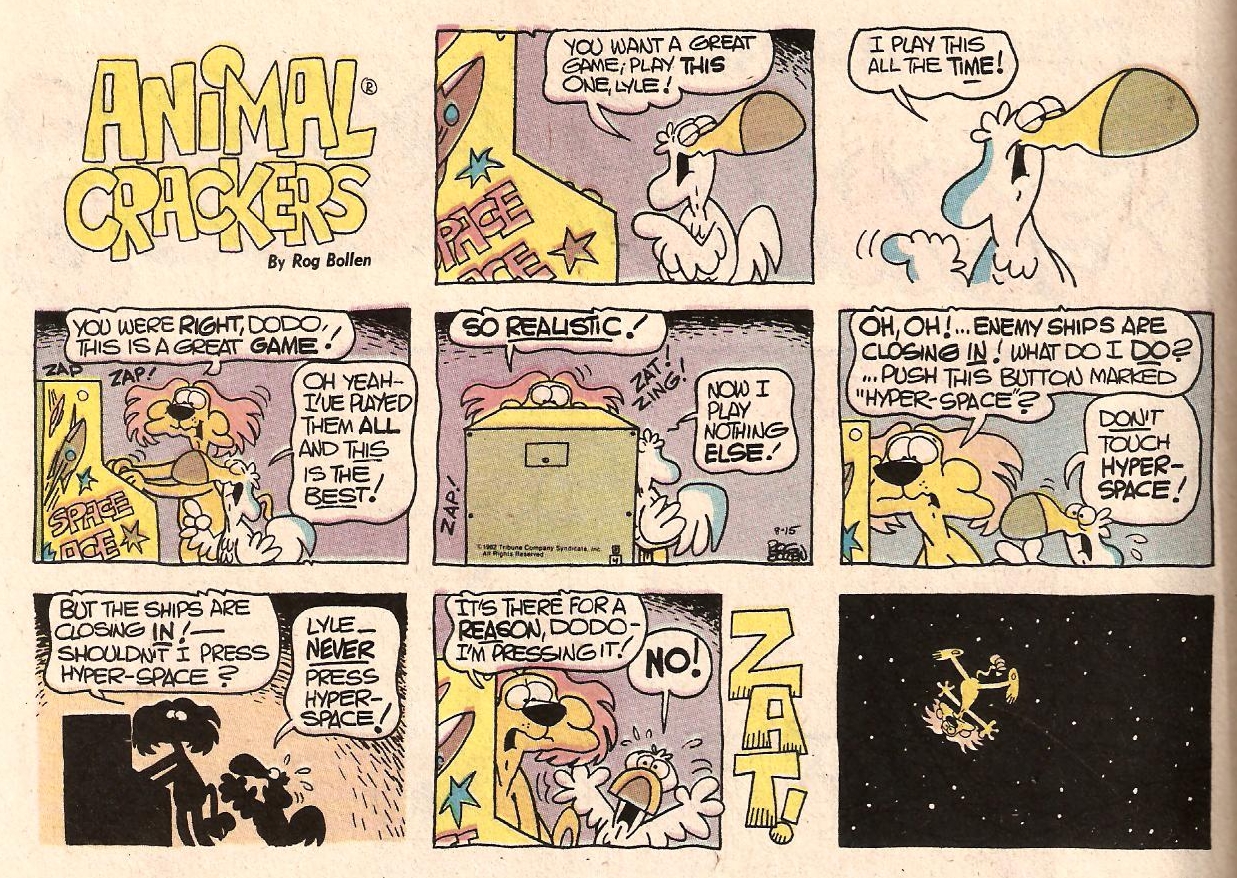
But it's not so much the rush of playing the games themselves as is the sense of accomplishment of actually succeeding in a monumental repetitive task.  After all, if Video Games were as mindless as everybody says they are, everybody would be passively pushing buttons waiting for their turn.  In The Game Believes In You by Greg Toppo, an adult tried his hand at playing a typical gateway game, and was surprised at just how difficult it was.  (Granted, most beginner console games were Nintendo Hard)

It wasn't just the learning curve of having to readjust his preconceived notions of hand-eye coordination, but also the intense amount of concentration needed to get through a typical level.  He was surprised that despite his apparent smarts, that he was having great trouble at re-learning new traits that for all intents and purposes, should've been deceptively easy.  If you pay attention to a gamer's expression while they're playing, they intensely focused on the action happening on the screen.  (Unless it's an unskippable cutscene, at which point, they're just waiting for the mini-movie to finish so they can get back to the action)

Indeed the purpose of a good game is to force the player to keep trying over and over, compensating for their mistakes until they succeed in overcoming their surmountable tasks.  The very first Mario game level is easily recognizable and iconic, but it was actually designed near the end, so Shigeru Miyamoto could properly showcase everything the beginning player needed to learn about the basics of playing.  (Though it took a computer ages to learn what came naturally to grade-age kids)

Despite their high degree of difficulty, the game allows you to try again over and over until you manage to succeed, all for the sake of that elusive A WINNER IS YOU! end screen.  This is accomplished by memorizing dozens of patterns, calculating various formulas, testing strengths and weaknesses, using items in every conceivable combination possible and deferring to the game's internal logic, usually consisting of warped reality that naturally appeals to kids.  (And resorting to cheats when they're ultimately desperate)

In fact, because of the way games are made, the techniques and tricks you use to get past creative enemies, obstacles and traps in later hair-pulling stages are designed to gradually teach the player how to develop these traits and integrate them into their playing without being fully aware that they're learning.  In this sense, videogames are actually better teachers than most schools.  (And more fun too)

Another worthwhile quote - If schools were relied on to teach children about Pokémon, they would lose interest almost immediately.  Part of the reason is because when schools were first designed, they were intended to be suitable for children whose highest aspirations were to become factory assembly line workers, whose iteration of input and fixed formulas was a necessity.  But the latest appliances and digital devices have largely supplanted that need, resulting in teachers having to dictate an authoritarian stance over unruly children.  The earliest concept of a school worked just fine in the early 20th Century, but their model no longer applies to the modern world.  Everybody learns in a different way, and expecting everybody to conform to a single model is just asking for trouble.  Nowhere is this more clearly stated than in Japan's schools, which is more suited to produce Businessmen who are more likely to be brown-nosers and yes-men than innovative trailblazers.  In fact, the lack of harmony between Sega USA and Sega Japan was because one company was willing to take risks, and the other wasn't.  (As seen in the Sega Vs. Nintendo book, Console Wars)

Rather than demonizing the infantile traits of empowering videogames, scholars should be using the traits of videogames that best appeal to their senses.  Rather than have everybody in the class compete with each other over who gets the highest marks or best memorization, singling out the class pets, fostering an epidemic of cheating and stress, it would benefit greatly using a Warcraft model where struggling students can get farther ahead by working together.  Instead of grading students over an outmoded grading system where mistakes are seen as a black mark demerit that'll follow them for the rest of their lives.  They should be given the chance to experiment with alternate solutions that best suits their needs, substituting calculating methods with more adequate means, where they can take their time to fully understand the logic ingrained behind the theory.  Following formulas is good for starters, but shouldn't be strictly restricted to only that if the students already understand the basics, and compensate by using similar models closer to their line of thinking.  There's not just one way to calculate algebraic math.

In one instance where a student was failing in a particular field, another student offered themselves up to compensate for her loss, even though it meant losing some points himself.  The purpose was to teach how to game the playing field so that everybody gets their fair share.  In other words, compensating for their weaknesses until they're able to confidentially assert it themselves.

Thursday, June 23, 2016

I've Got You Covered

A major update to the last time I came across a batch of old newspaper Sunday Comics - I've just recently come across another large collection of old strips that had just been made available.  This latest batch helps greatly in filling in a majority of years that I had large gaps in, particularly 1980 and 1981.  So far, I've only got a few missing dates here and there, but my collection of old Gazette Comics is mostly complete.  I can't do much about the comics I'm missing from the second half of 1987 to 2000, when the pamphlet format stopped, unless someone as fanatical as me saved those as well.  I was offered some Edmonton Comics for sale, but was reluctant to purchase those without being aware of those contents.  I didn't want duplicate strips, not to mention my interest wanes the further back I go beyond my birth date.

The earliest Sunday strip I wasn't aware of that was cancelled early on was Corky Trinidad's Zeus!, a retelling of ancient Greek Myths.  Since this is a subject that's less well-known compared to Anachronistic Cavemen and Medieval Tyrants, it didn't catch on.  That should be easily remedied with a quick purvey into George O'Connor's Olympians, a retelling of the Greek Gods that've captured the world's imagination, though little is known about their history.  It's currently up to the 8th book, Apollo, as retold by the 9 Muses, but for context on the above strip, you need to look no further than the 3rd book, Hera, Zeus wife who makes it her life's mission to personally punish all of her husband's out-of-wedlock children, the most memorable being Hercules, also known as Heracles.

The very next week, it was replaced by For Better or For Worse.  In a competition for familiar territory, the former stood no chance.

Going through these ancient comics was a memorable trip down memory lane, but would've been only relevant to someone who'd pored over their contents and discarded them to be forgotten later.  Only, the scant images that stayed with me for years had been tickling the back of my mind without gleaming any content of their meaning.

A word of advice - daily Newspaper comics are meant to be consumed on a daily basis.  Marathonning a singular comic is hard enough, but can be made worse with the lack of theme or storyline.  Going through multiple strips gives some variety, but after awhile, a certain kind of numbness starts to seep through.  Unless you'd been heavily acquainted with these comics in your youth, you'd be hard-pressed to make a compelling argument for why these comics were so valued in the first place.

In a way, I was likely the first reader to ever open these comics since their printing.  This was confirmed when I found a comic that had it's pages stuck together due to a printing error, and no attempt was made to dislodge them apart so the interior pages could be seen.  They'd been lounging in a collector's long box for years, and never seen the light of day in that time.

What particularly surprised me about these "Comic Books" was the sheer variety given for the children's drawings on the covers.  For the most part, many of them were devoted to the contents of the Comics Page.  The most popular strips, such as Peanuts, Wizard of Id, BC, Garfield, Beetle Bailey and others were a given.  Some drawings had some... interesting view of some of the comics present.

Iterations of Snoopy had some decidedly weird results, with him looking more human than usual.


There were even drawings of cartoon characters who weren't even in the comics, such as Ziggy, The Pink Panther, Mickey Mouse and Popeye.  Such was the power of their ubiquitous appeal.  But there were the rare covers that would have fan art of comics you wouldn't think of having illustrations in the first place.

The Gazette comics briefly ran The Lockhorns on its pages before they were phased out for The Better Half.


Even the extremely British strip Andy Capp got an appearance, with Flo taking charge front and center.

There were other Muppet covers, but I included this one solely because it resembled the poster for Gone With the Wind so much.  (Which would be an appropriate role for Kermit & Miss Piggy, come to think of it)

The most impressive was the only fanart for For Better or For Worse, back in its early unremarkable days when it was still finding its voice.

As you've no doubt noticed, a high proportion of these covers have their characters wanting nothing more to do than read the funnies.  Since their livelihood depends on their audience, this shouldn't be too surprising.

For me, the most interesting drawings were those that didn't focus on specific cartoon characters, but on random, sometimes abstract childish drawings, perfectly emblematic of their target audience.

Expect to see more contents of my finds in the next couple days... when I've got the time.

Wednesday, July 8, 2015

Muppet Noir

Just recently, it was reported that a long-awaited personal project of Brian Henson, entitled The Happytime Murders, a Noirish take on the Muppet world is finally being developed.  One of the challenges of an art form that's normally thought of being aimed at children with little more entertainment value and plotting than a typical Punch and Judy show is elevating the medium to new heights that it'll be enjoyed by all ages, and not be restricting to parents who'd otherwise be bored out of their skulls.

You could say that Jim Henson managed to achieve that monumental feat with giving hand puppets distinctive personalities that could be gleamed by their appearance, manner and speech.  Then that was further ramped up by having the same puppets interact with celebrities who somehow managed to convincingly talk to them without giving away what Berkeley Breathed called "The Big Bird Secret".

Then, later technologies and innovations with foam gave rise to animatronics that could emulate more complicated facial movements than could be achieved by manipulating the interior of a ventriloquist dummy, even as operating such a system required co-ordination between at least three people.  The finale to the quasi-Simpsons rip-off, The Dinosaurs is well-remembered for being devastating in its hard-hitting message.

Such efforts are made possible by having said puppets becoming more than just stage props to be bandied around whenever convenient, and bypassing the audience's suspension of disbelief by making the puppet's actions appear fluid and believable, even when the wires are visible.  Yet despite their effectiveness, Hollywood Studios are more concerned about expanding their efforts on CGI, even when actors are more receptive to responding to impressive large scale monsters appearing in front of them, as opposed to play-acting against a green screen, which is an occurrence that's happening with alarming frequency.

All this is pretty much moot, since chances are you've been paying more attention to this Future Shock 2000 AD short story by Mark Millar, which surprisingly enough, succeeds at bringing the Muppets into the realm of noirish underbelly of overhanded prose in a world where cops are corrupt, women are dangerous and the streets are forever running with blood, and you can only relate to events through double-entendred metaphors.

It's too bad that there's only five blotted letters in victim "D"'s last words, since it would be extremely 4th-wall breaking  if the alphabet serial killer happened to be Mark Millar himself.

Tuesday, December 16, 2014

Not Quite a Pet Peeve: Off-Colour Comics

This week's Sunday For Better or for Worse rerun gave us this little ditty with Elly's inconvenience with store clerks taking their time on the job.

This is very different from the first printing where the employee had much more makeup and blush on.  In addition, Elly's embarassment is much more pronounced in the last panel.

This wasn't the only instance of a reprint having less impactful colouring, as these two strips can contest.


In fact, a large majority of For Better or for Worse Sunday reprints have had a particular amount of toned-down appearance that makes them less dramatic than usual.

As you can tell, quite a lot of it comes from the characters screaming at each other.  For the longest time, I thought this was typically normal behavior.

It was suggested that Lynn Johnson was suffering from some kind of colour blindness for appealing for Magenta and Turquoise which would've accounted for her bizarre taste of mishmash of fancy words that actually look ugly.

However, that wouldn't account for the various previous Sunday comics where her stand-in family would constantly display sudden rushes of blood to the head that were less unsettling than Emily Carroll's His Face All Red.

There have been complaints about reprints of old material given a glossy shiny look that looks unappealing to long-time readers of newsprint comics on lousy paper, and those complaints aren't unjustified.  The paper can be too shiny, resulting in having to constantly tilt the book so the glare doesn't get in your eyes, and the colouring can be garish compared to the earlier toned-down appearance.  On the plus side, the new reprints give Lawrence a healthier shade of brown than his whitewashed earlier version.

This isn't solely limited to FBOFW, but other newspaper comics as well, where records weren't as meticulous in their archival collections as others.

The wife's expression above seems more intense than the one below.  I wonder why?

At first, I thought this one was a misprint in the first Herman Sunday collection, giving the prehistoric man a Bravehart-like tint, but I've got the Sunday comic in question, and it actually appears like that.  It was faithful to its source material.

This isn't the only caveman to be cast in a strange light.  An odd deciption of Wily from BC (Found at another intensive Sunday Comics blog here) can be seen.

This would be akin to those instances where first depictions of cartoon characters such as Wayland Smithers (Black), Vegeta (a natural Redhead) were mistaken first impressions later corrected in later versions. However, all previous initerations of the curmogodeon peg-legged water hater poet have shown him to be as pale as his brethen.

Despite the misgivings these comics might have in being incorrectly portrayed, they provide an interesting contrast to the regular colour schematics of cartoon characters, and provide an alternate vision of what it must be like for someone with colour blindness.

The Flintstones are some of the most iconic cartoon characters despite their formulatic upbringings.  So when it came to being adapted to the comics page, how were they portrayed?  Not with Fred's Orange outfit, and Barney's Brown suit.  Instead, they opted to present them as blue and orange.  The women Betty and Wilma were known for being in Blue and White, which is almost impossible to mess up.  Instead they showed themselves in basic orange and black.  With tiger stripes yet!  (Apparently, Black Pearls are rarer and more expensive, which wouldn't lie with their anachronistic domestic appearance) Whether this was to present a more attractive design for the funny pages is up in the air for consideration.

A random sampling shows the women's dresses changes colours and outfits almost interchangeably.

One thing I've noticed about these Flintstones comics is how many of them end with confrontations with large dinosaur creatures.

In some cases, the warped colour can give a whole new meaning to the background, giving previously passive elements a whole new flavor.  In this Baby Blues, it looks like the father's hair is being drained away as he thinks of his past.

In this Herman, it looks like the boss is gradually becoming greyer, eventually revealing his true nature underneath.

When I first saw this Hi & Lois comic, I thought that Dot intentionally placed a plastic apple that Trixie couldn't eat, since she picked up the same pink apple.

This Garfield comic is an interesting study in contrasts.  For years, I thought this was another iteration of Odie, who'd suddenly jumped owners from Lyman (who originally owned him) to this cute girl, and the two of them shared a history that was never explained or expanded on.  It was only years later that I found out the original colour schematics for this dog were brown.  Draw your own conclusions here.

It turns out that a large majority of Garfield strips staring Odie turn out the be tonetically weird.


When it comes to portraying crowd scenes, the American comic book had tendencies to go the quick and dirty method by using pale colour schemes among crowd scenes to save time and energy of having to go through colourizing every individual person.

At times, colour can have the element of portraying a prevalent mood throughout.  The very first Asterix book had scenes where entire characters were coloured a deep shade of red or purple depending on their feelings at the time.  This was only shown in the first album, and was never repeated in subsequent books.

Some more miscellaneous comics that I can't think of enough of a clever summary for:


At the time of this strip, Cliff Robertson was still alive.  I suppose the Star Phone also works for actors who everybody thinks are dead, since they haven't been in the spotlight for a long time.
Here's one last bonus - a FBOFW that appeared on July 19, 1986.  If the reprint shows Elizabeth to be less upset than in the throwaway panels, you'll know what was overlooked.  Feel free to make your complaints where applicable.