Thursday, July 16, 2020

License Request: Asper Girl

There’s been a vested interest in showing Autistic representation in popular media, usually in the vein of showing savant skills, though with very few exceptions, portrayal of high-functioning Autistic women remains a minority.  And even then, they're little more than walk-on supporting roles which is little more than thinly veiled shorthand for showing blunt rudeness, missing the point.  Being socially unaware doesn’t mean getting the opportunity to act like Gregory House, it just usually turns out that way, because there’s a whole plethora of unwritten rules that’s supposed to be intuited and not spoken, because they’re so obvious.

For the longest time, portrayal of Autism has been largely male-focused, leaving female portrayal relatively untouched.  I haven’t exactly been a big fan of representation of Autistics in mainstream media such as The Good Doctor or Big Bang Theory, since they portray a lower common denominator preconception worldview that’s more fixed in stereotypical expectations than what I would’ve personally related to.  They’re aimed more at mainstream audiences than Autistic audiences.  And mainstream entertainment seems more interested in hitting specific story beats, very much like how a racecar is supposed to go through checkpoints to win a race.  The layout may vary, but the car is still restricted within the confines of the racetrack.

For the longest time, showcasing mentally different people had to be shown using metaphorical allegories, such as logical robots, and Star Trek faves such as Data, Spock, Seven of Nine and the EMH Doctor have been beacons of identification for Autistics.  This trope video about robots shows some excellent examples of representation sometimes missing the mark, particularly around the 11:08 mark.

The closest a show came to showing an accurate portrayal of an Autistic woman that wasn’t a metaphor would be Saga Noren from The Bridge, and that was from doing research.  But that show lost its appeal once it veered away from that viewset of human nature.

It's only recently that the field has expanded to include a more diverse female perspective, no doubt bolstered by Temple Grandin's presence.  While Camouflage: the Hidden Lives of Autistic Women isn't the main focus here, I still feel the need to include it here, since it thematically fits, and I wanted to include these two pages outlining the differences.

The main difference being that while the stigma of missing social cues is still present, Autistic women are more socially aware, having been pressured into taking other people’s feelings in effect.  As such, they may be more likely to look people in the eye, even as their male contemporaries find the influx of details too overwhelming to handle.  They’re better at hiding their outer symptoms and more likely to conform to society’s standards while remaining unaware of social conventions.

I am always in the outlook for anything Autistic-related, even if it relays information I've read a thousand times before.  No two itterations are exactly alike.  So it was with great reluctance and enthusiasm that I chanced upon Asuperu Kanojo, also known as Days with a Girl, or alternately, Asper Girl.  Reluctance because mental health is always a tricky subject in Manga, since the need to socially conform is even higher in Japan, and stigma to avoid such terms are best avoided.  But I needn't have worried, since my high quality standards were not only just met but exceeded.

While reading AsperGirl, there were several instances where I thought, “That’s exactly how *I* would’ve handled that situation!”  Until then, my favorite cartoon representation for Autism was Peridot from Steven Universe, episode Log Date 7-15-2, since so many of her reactions to being caught indulging her embarrassing special interests were similar to mine.

The woman, Saito-San, has a severe history of trauma, having been mistreated due to her misunderstanding of social norms and not fitting in with regular society, and greatly identified with the Artist, Yokoi-San (penname Gesui Seijin), who wrote mainly depressing stories that spoke to a small niche audience.  It also helps that the Artist has some Aspergic tendencies himself.  (Though I’d be unnerved by having someone constantly watch me while working)

Portraying ignorance about proper interactions yet maintaining a keen grasp of human nature is a difficult concept to convey properly, and can come across clumsily if not handled properly.  The interaction between the secluded Manga Artist and Rabid Fan who uses her prowess to find and live with him could be considered cliched in so many circles, but here, it’s just SO GOOD.

The Artist basically lives with this new addition in his life, and deals with her presence by offering emotional support with her sudden panic attacks and suicidal tendencies.  Their relationship grows organically, taking the time to know each other and not just rely on wacky hijinks.  When events spiral out of control, he has to figure out ways to cope and calm her down so this kind of thing won’t happen again.  It manages to feel real in a way that most romances don’t.

And even the times when perfectly normal stuff is just happening and nothing drastic’s going on, there’s always an undercurrent that things could potentially go wrong at any moment.  It’s that tense yet calm atmosphere that really speaks to me.

While there are multiple instances where she could’ve taken advantage of the Artist’s generosity, at no point does she ever emotionally manipulate him to her benefit.  She is always relentlessly honest about her thoughts and needs, and giving TMI whenever the moment happens, especially if the moment doesn’t warrant it.

While she appears composed, there are times when intense emotional feelings rise up without warning, prompting her to do actions that would be considered shocking.  When annoyed, she can react without thinking, and then become remorseful of having caused unintentional damage.  In one such instance, she retaliated against a wife’s child for causing a ruckus in the bathhouse, and didn’t see why she needed to apologize over something so trivial.  By chance, later, she happened to see the wife’s husband having a covert affair, and considered showing the wife the proof.

And yet, she couldn’t see that her proposed plan for revenge could have negative consequences resulting in a domino effect that could effectively ruin the wife’s family.  While she might feel some initial joy out of getting payback, the backlash of being responsible would be more than she might bear.

That’s the main difference between Autistics and Psychopaths - Psychos don’t care about the fallback, even if it affects them, as long as they get their revenge.  Autistics who understand what they’ve done wrong are more likely to feel guilty about having done something that hurt others without meaning to.

While she requires constant attention to keep from falling back into depression, her actual materialistic needs to remain content remain modest.  She doesn’t care that much about fancy gadgets or the latest expensive transportation, just the basic necessities of life, such as simple meals, an inner working bathroom and AC.  It doesn’t take very much to make her happy, and I’m pretty much the same way.  As long as things remain consistent, I’m fine.

Online fan translations come once a month with varying unscheduled releases, but it's always a pleasure when they come.  On the official scanlation page is the following information:
The author of the manga is requesting people send a message to the editor on Twitter to gauge interest in an official English release. You can find his tweet and the editor's response here.
The author has also requested that you don't message the author or artist about it, only the editor.
That interest is being shown is a good sign.  Apart from a few clunky passages that would need further notes, such as being overwhelmed by being in an Air-Conditioned room, and the perplexing need for a plastic bag would require notes for understanding, there's very little that's actually objectionable, save for maybe a moment early on that might upset animal lovers.  But those niggling details shouldn't detract from the strong pluses the story conveys.

Friday, May 29, 2020

Japan's Junglest Day

One thing that the current Covid-19 panic has done, other than giving me more free time than I ever needed or wanted, is that being devoid of my usual routine of going to the library has forced me to seek out avenues of escape by delving into my old stack of books that I'd been keeping for a rainy day.  It also made me seriously use digital e-books after great reluctance in doing so.

I still vastly prefer using the dead tree form, since I can only use my tablet under very specific conditions.  Due to its reflective nature, there's only two spots I can feel comfortable, and I'd much rather be doing other things during that time.  I can't take the tablet in the bathroom, because its protective casing causes too much discomforting sensations, distracting me from reading the text.

It also made me register using the online internet library database, which is far more applicable to me, since I can access the material onscreen on a PC monitor more to my liking.  Not everything is available, but the stuff I was able to find was of palpable relief.  Though for comic material, there was some stuff not seen elsewhere.  Do you know that despite the vast amount of DragonBall scanlations available, there's no records of the interior cover art to be found?

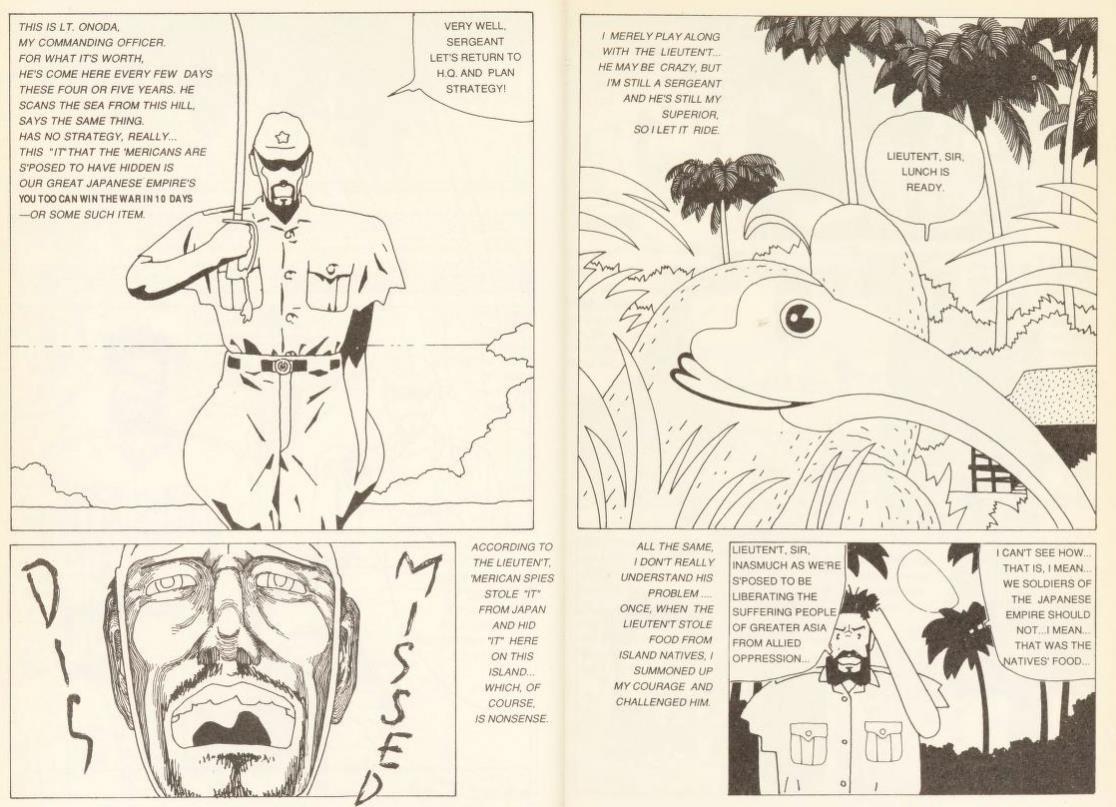
We have a generally perceived perception of how Japanese comics are nowadays, despite the constant proclamations that "All Manga looks the same", a laughable prospect considering how similar most American entertainment is.  But for someone reading Monkey Brain Sushi (1991), anyone who hadn't read Frederick Schodt's Manga! Manga! or subscribed to Nintendo Power, this would've been their first introduction to literary Japanese comics.  And Michio Hisauchi from Garo magazine is as far removed from mainstream as possible.  It's artstyle and storytelling is closer to underground comics than anything else.

For the longest time, I wanted to scan these pages, but was worried about damaging my copy by cracking the spine open too widely.  But thanks to the online library, after a little borrowing and saving, I was able to make these images without having to use my book.


I hope you like the word 'Misery', because you're going to be hearing a lot more of it, to the point of feeling like Paul Sheldon in front of Annie Wilkes.

Pay no attention to that anthropomorphic medkit with realistic finely-dressed feet.  Nothing to see here.


In any other publication, inserting a charity-collecting space alien in a post-war metaphor would be a sign of livening things up.  No such luck here.


And now, we start into the realm of expositional infodumping, which while talking a lot, doesn't really explain anything.


I've read this several times, and I thought I must've been missing some philosophical underpining that escaped my notice.  Surely it'd make sense when I was older.  For a brief moment, I was sure that I understood it's deep philosophical message.  Now, rereading this again, I realize that I still don't get it.


Honestly, if it weren't for the Commanding Officer's mental breakdown, this story would remain utterly unremarkable in itself.


Tuesday, April 28, 2020

Oil Swell

At the beginning of this year, things in an already perpetual downward spiral started off with a bang with the killing an Iranian General, Qasem Soleimani, known for his brutality.  That happened in the first week of January.

This came as a complete surprise, since embassies weren’t notified of it.  The argument basically boiled down to, "We didn't want to alarm the embassies about an imminent attack! That's why we didn't tell them!"  The flimsy excuse given was that “Soleimani was threatening to blow up our embassies!” without showing any evidence or benefit from it.
"I didn't see any evidence, but I believe there would've been an attack!"

Trump likely did this ill-advised move in an effort to curry favor along the likes of Obama killing Osama Bin Laden.  (“Obama will start a war with Iran to re-election!”) But apart from Military veterans heavily invested in the subject, Soleimani failed to register on the public radar.  Bin Laden took down the Twin Towers.  What did Soleimani personally do to the Americans?  Trying to emulate Obama in his last year without understanding the moves taken is so typical of Trump.

There were fears of retaliation that could’ve potentially led to another war, either through subvert sabotage, preferably targeting Trump properties, or price gouging of oil.  After a tense conflict between Russia and Saudi representatives (Russia wanted to encroach their oil depositories, and Trump LUVS rich dictatorships), Trump fought for increasing their shares, because what Americans needed right now were higher gas prices.

A little over a week later, the storage space for oil reserves has become so overcrowded, because not as many people are driving around and using up as much oil as expected, so they’ve had to stockpile the excess oil, which is costing them money, driving demand down to the point where it’s in the negative integers, so they’d wind up owning others money.  As much as Trump has been labeled the Reverse Midas for bankrupting surefire things (wine, casinos, steaks),  tanking the oil market was not something that was on anybody’s Bingo cards.

Wars in the Middle East have started due to a decline in oil.  This could be the first time that a war was instigated solely due to a surplus of oil.

All this is just a long-winded way of giving some background for the following pages.  I meant to show these scans two months ago, but couldn’t recall the exact book I first read them in.  I thought it might’ve been in a memoir or autobiography, or even an anthology.  So I scoured through the archives of three libraries, trying to narrow down where I might’ve seen it.  All I could recall was that it was in black and white, with cartoony facial expressions, and possible bleeds across the panels.  I got the panels part wrong, but everything else right.  By the time I finally found what I was looking for, everyone had forgotten what all the fuss was about.

It's only recently that things have turned around so that the events have made my intended post relevant again.  Before I go into the relevant scans, here's some history from the third book of Arab of the Future.  Riad's father is a mass of contradictions, where he has multiple opposing ideologies reflected throughout his worldview.
In the course of trying to find what I was looking for, I thought the relevant scans would've been in Economix, since it certainly fit the profile, but that book only devoted a single page to the topic.
It was only when I finally found the comic I was looking for in A People's History of American Empire: A Graphic Adaptation of Howard Zinn's research.  It's a disturbing look into the brutal tactics implemented that I never would've bothered reading it otherwise.
Practically an entire chapter is devoted to the CIA's contribution to the coup d'état on Iran, which has the hallmarks of a well-crafted thriller, even as the outcome is never in doubt.
There's also some extra information about the Shah, which I've included, along with a certain fanatical Religious extremist.  The Ayatollah Khomeini didn't come out of a vacuum.
Because the interests of powerful people didn't align with progressive movements, they did their utmost best to quash any attempts of advancement to the detriment of society.  As a result, we're now in an age where people are so desperate for miracle cures that they'll do anything, no matter how harmful it is to them.
I want to highlight one of the sections from earlier.  At the time, I thought that this deal would've been passed over by the public since no one would've willingly accepted having such obvious demerits among its positives.  Nowadays, I'm not so sure.