Wednesday, November 10, 2010

Jump Spinoffs


When I saw today's announcement of a Shonen Jump magazine that would have stories of Chopperman, Rock Lee, and whoever's going to show up in the Hitman Reborn! and Toriko spinoffs, I felt very apprehensive. It got worse when I saw that these side stories were going to be done by artists other than the original creators. The reason I was feeling uneasy was because it reminded me of this:


Even Chibi Spies couldn't save the languishing comic magazine from floundering and reducing it's distribution from monthly to a bi-monthly schedule. (It needed a well-deserved break after too many issues of unfunny articles) This doesn't exactly bode well for a Manga magazine that once boasted sales of 3 million and now seems to be relying on gimmicks such as these. It makes them seem desperate in finding readership.

The fact that it's going to have three new Mangas doesn't exactly ease my suspicions any. (It also has three Mangas that're running in a video game magazine) I've heard rumours that the monthly magazine, Jump Square, is more successful in terms of creative stories that the regular weekly magazine isn't.

Monday, November 8, 2010

Reluctance to read American Manga

Lately, there was an essay by former Tokyopop editor Tim Beedle making the argument that American-made Manga weren’t popular enough compared to the Japanese product. As lamentable as it sounds, fans don't graviate towards Original Manga for several reasons, not because they're Japanophiles, but because they've been burned on seeing highly advertised comics being less than stellar than they were led to believe.

I’m going to echo what I already wrote on the MangaBlog and AllAboutComics’ comments section with a few new additions.

Of all the OEL Mangas that I’ve seen, only Nightschool and Hollow Fields stand out as above-par work. Maybe its because the creators are from Russia and Australia that explain the exoticism in their work. Maybe its the similarity in tone to Harry Potter and Gunnerkrigg Court. Or maybe they just put more effort in their creation than the competition. Too many of the attempts to emulate Manga that I’ve seen try too hard to copy the styles and don’t lend themselves to freely experiment the layout of the page. Telophase covered this kind of thing more eloquently than I can, so I'll let the links speak for themselves.


To the untrained eye, some pages can feel almost indistinguishable from authentic Manga pages, but others who’ve grown used to the flow of characters and camera angles in a cinematic sense, the rhythm between panels feels “off” somehow. I recall a particularly good analogy that fits. If you want good Mexican food, do you go to a Mexican restaurant, or get a meal produced by an actual Mexican? The difference lies in how immersed in the culture someone was when growing up. Oftentimes, a lot of the concepts used by OEL creators seem to be ripped-off versions of already existing Mangas. If given the choice between a cheesy replica or the authentic version, which one do you think the customer would want to choose? Hopefully, the more today’s children are exposed to a wide variety of various comics around the world, the more interesting their influences in storytelling will be.

So far, the most successful of the American Manga companies has been Seven Seas Entertainment (better known as GoManga, and the publisher of the aforementioned Hollow Fields). Of course, “successful” is a relative term, since I haven’t noticed any of their titles listed on an Amazon bestseller list. They produce Manga that’s designed to read from right to left, which feels more like a quirk than anything. Their homepage even has multiple pages of previews of their available Mangas to an interested public. However, anybody interested in browsing their titles will be likely turned off by the covers, since the character designs seem “off” somehow. I haven’t had much of a chance to read much of their titles, so my opinion may be biased, even if it’s common.

One good way to tell if someone is taking the right influences from Manga is how cinematic the comic looks. Usually when people talk in Manga, there’s a cutaway view to an outside landscape, a view of the back of someone’s head, or a close-up of someone’s face. This isn’t an ironclad rule, but it shows how they make the act of conversation interesting. You’ll notice that when people are walking, there are oftentimes shots of their shoes to give a feeling of motion.


While American comic companies may feel reluctant to adopt the Manga style, that didn’t stop European and French Comic companies from jumping on the bandwagon. Many of their early attempts were embarrassingly amateurish, but they were able to learn from their mistakes and eventually evolve their style in a manner that embraced both types of storytelling without having to sacrifice one over the other. One example I can think of that’s been translated over here is the Elsewhere Chronicles.


Rather than try to compete with Manga on its own grounds, we should be taking what works in combination with ours to create a new entity worthy of reading. The goal shouldn’t be to produce Pseudo-Manga, but Quasi-Manga that’ll work on its own terms. If you’re going to try to beat the competition on their home ground, you’re going to lose unless you’re immensely talented.

Trying to intentionally create the next DragonBall / Naruto is a losing proposition. As much fun as it is to see long drawn-out fights, if they’re not supported by strong characters or addictive storytelling, such “homages” are can grow tiresome. Especially if you start intentionally stealing from the source of inspiration you’re paying tribute to. Those Mangas already have a devoted fan following, and would only take a brief look at the imitation to see just how badly they were emulated. What we should be focusing on are stories that we don’t even know that we want.

Part of the reason for the success of Scott Pilgrim might have been that each one of its volumes concluded with the defeat of one of Ramona’s Evil Ex-boyfriends. It set a comforting rhythm that while the fights with her Ex’s was inevitable, Brian O Malley could fill the rest of the volumes with whatever free-association crap he could think up and make it work. The absurd video-game references probably didn’t hurt either, nor did Scott’s unexplained fighting powers when he showed no inclination of possessing any such skills before. (Of course, nobody tried to attack him when he was slacking around)

Another factor is that when the Japanese Mangas are being created, they’re usually in the form of one-shot pilot episodes to see if their concept is interesting enough for readers. They usually start out doing short stories that eventually graduate towards longer-story terms. These little exercises not only help the creators from honing their storytelling, but also lets them experiment with narratives that might or might not work. A lot of some popular stories was usually the result of a happy accident that wouldn’t have happened. Viewer reaction and opinion also helps, since it gives the creator some idea on what their audience like to see, and may make story changes accordingly. It’s the brave artist who doesn’t bow to public opinion and blazes their own path, even if it makes them unpopular.

There’s also the problem of how to bring attention to your works when distributors are extremely reluctant to try anything that looks interesting, but don’t want to risk supporting it, because it might not sell. To compound the problem, there’s no one distribution factor that can help spread the word of a particularly well-done work. It may take years for a webcomic to garner a cult readership and who has the time? Not to mention that spending a year on a book that may produce very little return can be physically and emotionally draining for someone hoping for higher aspirations. Europeans have it slightly easier, since they can spend a year working on their books (48-62 pages in length) and have it shown in snippets in various comic magazines. I suspect that Yoshihiro Togashi (of Hunter X Hunter fame) was influenced by this model to go on multiple hiatuses to work on his Manga and spend more time with his family.

Another fault I have with American Manga is that, while they may look like Manga, they’re written like an American comic. I have trouble getting into Ben Dunn, Fred Perry and Adam Warren’s works because their cartoony characters usually wind up talking too much. Overzealous boisterous dialogue can be funny when done right, but it often feels counterproductive when I’m reading their stories with tons of redundant words. They’re of the school of thought that any page they’ve worked hours on should be looked at with as many words as possible so their audience will appreciate just how hard they worked on the pictures. Manga in comparison has multiple pages that breeze by quickly. As Brian Michael Bendis wrote in his autobiographical comic Fortune & Glory (about pitching one of his comics to Hollywood), “notice how little dialogue there is in movies.” The fact that Fred Perry’s balloons are written in tiny font doesn’t help either.


I’ll close out with a partial of Lee Barnett’s essay from the now-defunct Savant-Mag site on why children don’t read comics, postdated June 14, 2002.

I asked him why he liked reading some books and not others. To my surprise, the answers were ones that I’d not considered previously. For a start, as far as Philip was concerned, there’s a big difference between ‘reading’ a comic book, i.e. understanding what’s going on in the story, and ‘reading’ the comic book, meaning actually reading one word at a time, and linking it to the artwork. In a tribute to the artists, and their interpretation of the script (for which the writer also deserves credit), Philip didn’t have a lot of problems in understanding some comic book stories, even just by looking at the pictures. I should say that at this stage, I’m limiting these comments to the US ‘animation’ style comic books like Superman Adventures, Gotham Adventures and X-men: Evolution.
So why did he have problems actually reading the books? The answer, when it came, was simple in one respect but no less far-reaching. And it astonished me. It was something that never occurred to me, and when I asked around, with friends, and other comics fans, not one of them had considered it either. To quote Philip: “The words are too small.”
Now this confused the hell out of me when he first said it. Did he mean that the words are too simple? No, he meant exactly what he said. The words are too small. The typeface is literally too small for him to comfortably read. And though both his parents wear glasses, according to his latest eye check his sight is fine. And then, to test the hypothesis, I grabbed something I bought a while back, Jill Thompson’s The Little Endless. Yes, it’s a prose book with painted art, rather than a comic book, but Philip read it happily to me, giggling away, asking me questions throughout. When I asked him why this was so much easier to read, his response, as expected, was: “The words are bigger...”
Could it really be that simple? Could we get more children reading comic books if it was just easier to read them?
It’s something to think about.

Wednesday, November 3, 2010

More Scary than Hen’s Teeth

After posting my Halloween entry, I was reminded of other things that scared or disturbed me as a child. (This blog’s title is from Kazuo Umezu’s Fourteen, staring Chicken George, who isn’t talked about here, sorry. Maybe when I read more past the first volume.)


As I said before, children can be scared of things that aren’t intended to scare us, such as clowns or Santa Claus. For example, in The Wizard of Oz, I was absolutely terrified when Dorthy was trapped in the Witch’s castle with the running hourglass. I felt that something horrible would happen once the sand ran out. Exactly what would happen was something that was never elaborated, so I had to resort to my imagination. By contrast, the sequel Return to Oz didn’t scare me that much despite its darker storytelling and faithful adaption. It felt more honest than the earlier movie. The fact that the iconic characters the Scarecrow, Tin Man and Lion were replaced by similar avatars Jack Pumpkinhead, Tik-Tok and the Gump probably made things easier.

Another children’s movie that scared me was The Peanut Butter Solution. The general plot was a boy who was a boy who was so scared that his post-traumatic stress had all his hair fall out overnight. The cure for this was a chemical made of peanut butter (naturally) that overdid the results, causing hair to grow all over his body. As freaky as his scared reaction was, I was more concerned about his initial symptoms first. The kid looked like a cancer patient, and it was made even worse that he had no idea why his family was looking at him so strangely. I couldn’t handle seeing his reaction to his condition. The concept of losing ALL my hair at a young age was too frightening to even contemplate that I couldn’t even watch the rest of the movie afterwards. I still haven’t seen the movie in years, but that could be that it simply isn’t that much of a classic.

There were also some cartoon episodes that had potential nightmare fuel. One was in a Garfield episode where Garfield made a bet with Jon that if he could stop watching TV all day, Jon would stop using his vacuum cleaner, interrupting his TV time. Garfield went through some withdrawal symptoms at first, but managed to make it to the night... which was where things started to get weird.

The TV came to life, calling for his name, and pestering him, wondering why he was ignoring watching him when there were so many good shows to watch. The fact that it went back to normal when Jon wasn’t looking and the warped backgrounds when Garfield was running away from the living appliance didn’t help either. Nor when Garfield pulled the plug, and the TV still managed to remain spooky down to its dying regretful voice. It’s no wonder why, even after Garfield won the bet, he was reluctant to turn it back on.

Another more subtle form of scariness was on an early season of The Simpsons. It wasn’t a Halloween episode - that would be too obvious. It was when Bart sold his soul to Milhouse on a joke, and had all kinds of weird things happening to him. Animals were hostile towards him, the motion-detector doors wouldn’t open, and he lost his sense of humour. When Lisa experimented with slapstick violence without result and said, “That’s creepy Bart. I think you really did lose your soul.”, I felt extremely uneasy for the rest of the episode.

If there’s one problem I have, it’s that I’m too empathetic about the cartoony characters I read. The Smurf short story, The Smurfnapper was left out of the first English version of the Smurfs, with a promise to be released in a future volume. Chances are it’ll be in the next volume, King Smurf, since the 4th volume, The Smurfette would make more sense if we knew about Gargamel about an antagonist. He may be a wizard, but he’s also the cheapest wizard I’ve ever seen. He lives in a run-down shack, wears patched rags and has a mangy cat for company. No wonder he wants to turn the Smurfs into gold.

However, if The Smurfnapper story is in the Smurfette volume, that means it’ll most likely replace the Smurf famine story. That story had the Smurfs foraging all their foods for the long winter, until their warehouse caught fire and burned everything they had. (The water kept freezing so they couldn’t put it out) Seeing these little elfin creatures going crazy from lack of food was (and still is) disturbing, especially since I was much more used to cartoon characters eating too much food. Jughead, Garfield, Dagwood... try imagining these beloved cartoon characters with hunger pains, and you’ll get the general sense of what reading this was like. There was maybe one funny joke in that story, which may be why Papercutz feels reluctant in releasing it. It's not quite a far cry from the blue critters who were used to dramatize a Unicef bombing commercial.

One of the most ironic things that I was most scared of was Anime/Manga characters. I regularly saw Anime VHS videos with the labels Not intended for children on them. I was morbidly fascinated in seeing these things, but was terrified of watching them, because their large eyes freaked me out. I felt that their eyes were TOO emotional, and made me uncomfortable to look at because of what they were conveying. It wasn't until I read the first five volumes of Ranma 1/2 in a bookstore that I was able to alleviate my curiosity. Now, I simply can’t get enough of them.


My library had plenty of adult French comics with disturbing themes. Although I couldn’t read a word that was said, the imagery was clear enough in the end. There was a house that faithfully followed everything the designer’s model did to it, including blemishes on the walls and people, and even people’s deaths. There was a racing car that burned up fuel so quickly it had to suck its driver’s blood to finish the race. There was a pool that held the ghosts of all the people who committed suicide in it. Save for the last one, Calypso, I don’t remember the names of the other books, but I’d recognize their art styles if I saw them.


All those European books paled in comparision to the 3rd part of Katsuhiro Otomo’s Domu. It was my first foray into an adult Manga, and I had no idea what was going on. The level of destruction was so one-sided that I thought Cho was the good guy. Then after pages of talk, we got to the denouement where Cho met his climatic anti-climatic end. Kodansha should really re-release this oneshot now that Dark Horse’s no longer bothering to reprint it.

As long as we’re talking about scary stuff, I might as well share some idle speculation on the 100th issue of Fables, which will no doubt feature the big showdown between Frau Totenkinder and Mr. Dark.

SPOILERS APLENTY! Don’t read any further if you haven’t read the comic up to now.

I was probably one of a handful of people who remembered the story of Rose Red, from a children’s book titled Snow White & Rose Red. So when I saw Willingham’s reinterpretation of the dwarf with the long beard, it called back long-forgotten memories of that story.

The penultimate issue had a parlay with Mr. Dark with the North Wind giving proper notice of the duel that Mr. Dark would be facing, as well as a warning to cease what he was doing, since his presence would be attracting forces beyond him imagining. I don’t know about you, but I’m more interested in the aftereffects of his lingering action than the outcome of the duel, due to a subtle hint slipped in the conversation:


I was reminded of another children’s book, about an old fearless woman who lived with her cat, Cornel. Not to be confused with The Little Old Lady Who Was Not Afraid of Anything. This woman was only afraid of one thing - mice, which was why she had a cat around her.

In this children’s book (whose title I can’t find) - [found - Do Not Open, by Brinton Turkle], the woman was taking a walk on the beach when she came upon a bottle that sounded like it was crying. Upon closer examination, it was a simple bottle, and a child’s voice was saying that it had been trapped for years, waiting for somebody to release him from his prison.

The woman uncorked the bottle, and hear a roar of FREE! in what was obviously not a child’s voice. A plume of black smoke rose from the bottle, forming a 100 feet tall humanoid black creature who thanked the woman for releasing him. He then listed all the atrocities that he would do, causing fear in the people of the world, enjoying their cries of terror, and infesting their dreams.

The woman casually glanced at the black creature in front of her and said that she didn’t find him that scary. The creature then transformed, turning into a horned 4-legged animalistic version with spikier teeth and asked, “Then do you find this form frightening?” “No, not at all.” Then the creature turned into a grotesque green monster so big that only the head was visible on the page. The woman turned away from him, her arms crossed, saying that the only thing she was afraid of was mice. Without further ado, the creature turned into a mouse.

And like any arrogant overpowered demon who cares what the little people think, he was instantly eaten and devoured by the woman’s cat.

“Cornel! Are you alright?”, she asked. The cat just licked its lips and smiled.

As much as Mr. Dark feeds on fear, if his opponent turns out to be more sophisicated than he thought, he would eventually tire out and resort to old tricks, such as finding the one thing the witch is repulsed by, which would’ve been supplanted before the fight started. A simple glance or phrase by Totenkinder’s dislike of mice would make him easy pickings for Ozma’s cat who’s gone unnoticed this whole time.

It would be anticlimactic if after all this buildup, Mr. Dark was beaten by such an obvious tactic. There are several ways that this could be avoided:

1. He turns into hundreds of mice, not just one.
2. He summons mice from whatever surroundings they’re hiding from. No need to transform himself.
3. He sees through the tactic and creates a double that looks like him turning into a mouse, then lets the double get eaten by Ozma’s cat. THEN pull the double whammy on both opponents, thinking the threat was over. THAT would unnerve them.
4. What would be really ironic would be if, upon hearing that Totenkinder was afraid of a mouse, Mr. Dark summoned up Mouse of Fafhrd and the Grey Mouser fame.

That could be why Willingham turned Frau Totenkinder back to a younger girl. It would look bad if he plagiarized from an identifiable souce. Of course, this is all idle speculation, and may be pointless if the results are something else entirely.

Just remember, if the 100th issue of Fables has what I just predicted, you heard it here first!

Sunday, October 31, 2010

Spooooky Disturbing Comics

At Robot6, there's a continuing post of various comics creators on what comics scared them as a kid, and they're going through the usual gamut of obvious horror titles.

Like this blogger, I find Horror comics to be more goofy than actually scary. I can barely read any of the E.C. titles because they've got so many useless narrative panels that only serve to give redundant details on what's happening in the story. It also doesn't help that the central storytellers, the Cryptkeeper keeps making awful puns at the beginning and end of the stories. When it comes to narrative spokesmen, I much more prefer Rod Sterling or Count D from Petshop of Horrors.

Not to mention that like most kids, what scares us is not the stuff of fantasy, but things that could happen to us. Horror movies are supposed to scare us, but they wind up being more silly than actually scary. When it comes to on-the-edge-of-your-seat action, I much more prefer suspense movies, since you're worried about what'll happen to the characters and how they'll get themselves out of the predictament they're in. Some good suspense titles I heavily recommend are:

Nick of Time, staring Johnny Depp, and whose claustrophobic timely format greatly inspired the 24 TV series.
Enemy of the State, staring Will Smith, and about a man being hounded by the Government because he's suspected of holding a national secret that he is unaware of that could threaten a Governor.
The Arrival, a Hitchcockian Sci-fi movie about global warming. You'd think that such a concept wouldn't be interesting, but there's intrigue and conspiracies underfoot. I don't normally like Hitchcock, save for Dial M for Murder & Psycho, so this is a good choice.
Dirty Pretty Things, illegal immigrants working in a hotel have to worry about not getting caught & deported back to their home country. But one worker notices that there's strange going-ons happening at the hotel he's working at. Worse yet, he can't bring his suspections to the police, lest attention be diverged on him.
Event Horizon, a horror Sci-fi movie with Lovecraftian/Hellraiser overtones. It's a very overlooked and underappreciated movie about a lost experimental spaceship that mysteriously returned after vanishing. If you can manage to watch the first minute without being scared, you should be able to handle the rest of the movie.

Most people regard the 6th Sandman issue as one of the most disturbing comics they've ever read. When I read the Sandman 24 Hours comic, I wasn't that impressed with the scenario or outcome. It was basically one man randomly forcing the people at a dinner into various situations without any sense of increading tension. My general reaction at the 22 hour mark was, "What? They're dead already??" If Dr. Destiny had given their minds back after the Asian had gouged her eyes out, it would've been more effective.

I was much more disturbed by the first Sandman comic I read, Calliope, where a muse was used solely as a means for inspiring a writer's work. When reading most of the Sandman stories, I had a tendency to have a very dry mouth, since it wasn't the kind of material I was used to reading. It wasn't "BOO!" scary, more the kind of creepyness that sneaks up on you and you know is on your person, but you don't dare brush it away since the alternative is worse.

I posted about one of the most disturbing comics I ever read that I'll reproduce here:
I didn’t get much of a chance to read many horror comics as a kid, since they weren’t my cup of tea. But there was one French comic in an anthology that still horrifies me to this day.
I can’t remember the story, where it appeared in, or how it started, but I know it involved a rich spoiled bratty little girl. She was always carrying a doll and looked a lot like Alice from the Wonderland series, To further clarify, the art style was done in a slightly realistic style, reminiscent of British Girl’s stories.
My earliest recollection of the beginning of the story was a full page spread of the girl crying because a horse was eating her hand.
If that wasn’t enough, her guardian slapped her for making so much noise, which only further prompted her into two panels of tantrums. Eventually, she was kidnapped and held for ransom. When her guardian got the note, she jumped for joy. Since the kidnappers didn’t get any money from their attempts, the little girl died.
But it didn’t end there. She got into heaven, but was deemed so annoying that Saint Peter kicked her down to hell, where she continued to happily play with her doll while countless devils casually walked around her.
What made this even more disturbing was that this anthology also had a comic of Super Goof who was tricked into finding a nonexistent meteor, and because of his flying in space, was breaking several light speed records to the point where he was growing a long grey beard.
If there’s anybody who has any idea about the French comic I just described, let me know. I’ve been dying to know where it came from.
The images that scare me have never come from Horror comics, but in another genre entirely. One of the most disturbing images was the cover of the second chapter of the 2nd Maus book. I was going along at a normal pace, enjoying the very-well done funny animal book, when this image popped up.


It took me a whole day to get back to reading, and put me off my supper. It greatly upset me, which was kind of the point. I glossed over the scene where it was explained in further detail. Did I mention that I was 10 years old when I first read it? I didn't even know there was a first volume, so when I read the first volume years later, I was wondering why so much of what I was reading seemed so unfamiliar to me.

There have been only three instances where I've actually fainted, or nearly fainted. The first was when I was watching InnerSpace, and the spacecraft fired a harpoon at the guy's eyeball from inside. At that moment, I felt an empathetic jolt of pain inside my eye and thought for sure that something hit my eye. When I came to, I was wondering why I was lying on the floor, then groggily remembered, and had to be carried away to the nurse's office. I daren't watch the rest of the movie after that, especially since the little glimpses I caught were the pilot pulling back on his controls, and we saw the cord being taut, giving the mental image of an eyeball being sucked in from the inside. It didn't help that there were tons of bubbles, giving the sensation of leaking fluid escaping the man's body. It wasn't until years later that I was able to gather up the courage to watch the movie and find out what happened. When they eyeball scene came up again, I still winced in pain.


I've noticed that a lot of my most horrific images have been injury towards eyeballs. I recall one of the scariest images I ever saw in a video store where there was a woman lying on her back, lying face up, clutching her face, and we saw the tendrils of an eyeball extending from her face to the foreground. The back of the box was even worse - there were men who had bloody black holes for eyes with shocked expressions. I've tried to find the cover of this movie in vain - there's plenty of titles I saw that I'd like to remember from the VHS age.

The above image is from Kazuo Umezu's Left Hand of God, Right Hand of the Devil, and that's just in the first five pages. (Don't worry, it's just a dream, but she winds up puking even weirder stuff later on) This is the kind of thing that could serve as an alternative to the Comics' Code "Injury to Eyeball" motif - just stab them from the inside. Campfire ghost stories must've been very interesting for Kazuo Umezu as a child.

The second thing that made me faint was the 1st issue of Mixxzine, which had Sailor Moon, Magic Knight Rayearth, and two other adult titles I wasn't familiar with. I practically snoze my way through Ice Blade, but reading Parasyte for the first time was extremely nerve-wracking. For starters, there was no cover title giving any hint of what would've happened. Secondly, there was no break between the first and second chapters, showing it as one long seamless entry. When "Lefty" first appeared and explained his existence, I felt so woozy I had to lie down.

The third thing that almost made me faint wasn't from a comic, but an autobiographical novel. It was Ayaan Hirsi Ali's Infidel where she described in graphic detail the first-hand experience of her genital mutilation. It was so harrowing that even sitting down, I felt lightheaded. It didn't help that I was on the subway when reading that particular section. The general difference between male & female circumcision is like night & day. Male circumcision is designed to increase pleasure, but female circumcision is basic butchery to preserve her virginity and reduce her pleasure. It's all for the male's benefits.

Getting back to the campfire stories, I imagine it went something like this:

Camp boy: "...and then the hand leaped out and strangled him!"
(peals of horror, turning to laughter)
Camp Counselor: "Well, that was very good. Is there anybody else who has a story they'd like to tell? How about you Kazuo Umezu?"
(groans of dissent around the campfire) "Oh no! Not him! I still haven't recovered from the last story he told!"
Camp Counselor: "Alright then. Let's pass the torch to Junji Ito."
(more noise of complaints) "Even worse! You're killing us! I want to sleep!"
Camp Counselor: "You're not going to go very far if we keep excluding certain people from the group. I'm passing the baton over to Shintaro Kago."
(screams of outright horror fading with running footsteps)
Camp Counselor: "That was very impolite of them. I'd be perfectly happy to hear whatever you have to say."
(Three short stories of horror later)
Camp Counselor: ...I want my mommy.

Thursday, October 28, 2010

Le Chat

You can tell a lot about the culture of a comics' country by the most popular comic cats being merchandised there. America is well known for Garfield and Felix. Japan has dozens of cartoon cats ranging from Doraemon to What's Michael?, and that's not even counting the countless catgirls. They're also most known for Hello Kitty. In Europe, the most popular cat is an archtype almost unknown here, a fat intellectual simply known as Le Chat.
That's me... That's him.
Created by Philippe Gluck in 1983, Le Chat is different in that he's a straight man without an audience. Oh sure, he has the occasional mouse to talk to, but they're more his foils than anything, and he's usually onstage alone.
Biff.
Bam.
Pow. / My finest debut.
Like Hello Kitty, he generally has one facial expression, but is tempered by his nonsensical observations. He's not just a sarcasic speaker or a blank state. He has something to say about the world around him.
ASSAULT of decencysex BOMB
What a violent world!

My lack of French limits me from understanding the majority of the strips, but I've chosen a few examples from what little I could decipher, with a little help from Babelfish. Here's an example that reminds me of Scott McCloud's argument in Reinventing Comics on two different examples of black blocks, one which was comics, and one which wasn't.
Here are two photos of "A" and "B".Photo "A" shows absolutely nothing. 
Photo "B" shows photo "A".
Ironically enough, his one-note tone and lack of a larger storyline may be what contributes to his popularity. There was one time he disguised himself as cheese to capture some mice, and the mice broke off his body parts like pieces of brie. No matter what happens to him, he always goes back to normal. He's a lot like the comfort food of legacy Newspaper strips - a familiar face to come back to.
Riiiiiing Riiiiiing
Okay, okay! I'm coming!
No one there...
Riiiiiing Riiiiiing
Not again!
Alright, alright! Coming!
? / Very strange...
It can't be the door. / It must be...
Hello?
Knock, knock, knock!
As you've no doubt noticed by now, Le Chat has one almost unchanging facial expression throughout the panels, usually face front, and is only seen from the back when he turns away to look in the distance. When he's turned around, it becomes clear that his large eyes are actually glasses as seen from behind.
You want to see me in profile?Really? / Fine.
In addition to the 3-panel strips and full-page strips, there are also single-panel jokes or drawings that are just as effective if they'd been done in 3 panels.

Whose bright idea was it to show the strip this way?
So with all these things for it, why isn't Le Chat better known over here? Part of it may have to do with some jokes that would lose something in the translation. Here for instance, in French, a candy is known as a bonbon. I'll leave it up to you to figure out the puzzle here.


Another reason for the lack of recognition would be that some of the jokes may be considered too intellectual for the American public.
(Nonsense words)
(Uproarious laugher)
You wouldn't get it. / It's Belgian humour.
EDIT - I've just been informed that the words in the first panel are actually in Cyrillic (a Bulgarian language), and thus may actually mean something. Also, I know that he's saying "Bulgarian" humour in the last panel there, but I thought that Belgian humour sounded funnier. Like the Garfield comic and episode, there are some words that sound funnier than others.
A better reason is that some of the later strips could be considered too risique for the casual nudity of Le Chat. Unlike most cartoon animals, Le Chat is anatomically correct, and there's very few publishers who'd bother with a fat cat casually showing their uncircumsiced penis. (That'll probably answer any questions that nobody wanted to ask)
I will tell you an avante-garde joke.
Oughha... Brr! Glzz / Woof woof.
It may take 15 to 20 years / before it's appreciated.
Still, there's always a chance that something no matter how unlikely will get translated for a wider audience. Some of the more adult strips could be left out without having to lose anything. Like most foreign comics, this is something of an acquired taste, and might not be for everyone. Of course, when compared to the competition, there's not much reason to listen to a fat cat in a suit.
How lovely...
LEAVING IN 3 MINUTES
Could you possi...
MY HOUR'S UP, AND I'M NOT GOING THAT WAY
I'm not upset, I just...
THE HOTEL IS FULL
It's for dinner and I...
CLICK
Dear friends, you can't imagine...
SUPPER TIME!

Monday, October 25, 2010

Manners & Mannerism

In my last post, I mentioned how artists tend to borrow from each other all the time in terms of inspiration. As Pablo Piccaso said, "Bad artists copy, Great artists steal." In particular, I was thinking of this mini essay from Dirk Deppey - four years ago.

For those of you who had better things to do than study art history: Mannerism is the decadent stepchild of Italy’s High Rennaissance. Whereas the artists who engineered the first real flowering of realism in Western art since the fall of Rome — Leonardo, Michelangelo, and all those other guys who would later have turtles named for them by two guys in a garage — made careful studies of live models, animals, dissected corpses, natural phenomena and the general world around them, the artists who followed in these titans’ wakes learned their crafts by studying the finished output of Leonardo, Michelangelo, and all those other guys who would later have turtles named for them by two guys in a garage. These trail-following artists came to be known as the Mannerists, and they are the Rennaissance’s tombstone. As Horst de la Croix, Richard Tansey and Diane Kirkpatrick would later write in that textbookus genericus of community-college Art History 101 classes, Gardner’s Art Through the Ages (I’m quoting here from the Ninth Edition), “One could say that whereas their predecessors sought nature and found their style, the Mannerists looked first for a style and found a manner.”


The painting, Parmigianino’s
Madonna with a Long Neck (oil on wood, 1535; larger version available at this link) is an excellent example of where this approach can lead: The figures are technically polished but unnatural as hell, with supple shadows and drapery folds unable to fully distract the fact that the bodies they depict are warped and deformed. The Madonna’s fingers and neck are unnaturally long, the infant in her lap has the body of a nine-year-old but dwarfish arms and a newborn’s face, the figure behind her holding a scroll has an arm longer than his leg — and goodness knows where the stomach of the waterbearer to her right is supposed to go. Parmigianino has the surface tics of the Rennaissance masters down pat, but his work displays none of the anatomical understanding by which they came to be able to create such accomplished illusions of form and light. Mannerism is an artistic game of Whisper, with details lost and distorted as they move further away from their point of origin.

I have a very selective memory - I can recall things I've read ages ago, and be very upset when my search results turn up nothing because I can't recall the exact wording that would help limit my research. Conversely, I cannot retain anything I hear for more than five seconds unless it's written down. If I don't meet somebody over the span of two weeks, I'll forget about them. I'm usually surprised when somebody comes up and says they remember me when I clearly don't remember them. When asked if I know who they are, I usually respond with, "Let's pretend I do.", so I won't come off as rude, and we can get to the point of the conversation.

I'm reminded of a short story in the guidebook, Laughing and Living with Autism, which is a collection of humourous stories involving Autistic kids. Despite all the pain, there are times where Autistics do things that make parents gape in awe for doing things that no normal human being would ever think of doing. The example I'm thinking of was where there was a teenager who would always greet everybody he met with an enthusiastic "Hi!", even if he never saw them before. Complete strangers would try to recall who this friendly young man was without much luck.

In the occasions where he would get a welcome reply of "Hello! How are you doing?", he would respond with a confused, "Do I know you?" The stranger's facial expressions must've been very interesting to see as they tried to figure out this Memento train of thought.

This is me in a nutshell. I always assume people know more about me, since they know me better than I know them. It fits with my paronia of everybody having open access to my profile, while I don't have anybody else's folders. I simply don't have the patience to figure out somebody's likes or dislikes by talking to them. I'm much more comfortable seeing their tastes online, so I can determine whether they're worth talking to or not.

Autistics/Aspergers use the term Neurotypicals when referring to people who have no trouble talking to people around them, but I find that term demeaning. I prefer to use Doug Camill's description. As he mentioned in a column about narcissism: "Why am I not surprised to learn that Celebrities are more in love with themselves than us Dull Normals?" To everyone who's perfectly content with just being part of the population and not having higher aspirations, you can be counted as being a Dull Normal.

Badass Normals don't count, since they're usually involved with the military and are more focussed on staying alive, and aren't really considered part of society as a whole. What I really want are people who are more Interesting than dull. As long as you've got one saving grace, I'll overlook any other faults you may have.

Just don't go around blatantly stealing off obvious ideas. If you're going to rip off someone, rip off an incredibly obscure source, so that once you get rich & famous, they can try to sue the pants off you for stealing their idea and making it popular. After all, it was their idea first, so by all rights, that money should be rightfully theirs! Right? Right?

Friday, October 22, 2010

Ripping off Her Man

This Wednesday's Blondie seemed very similar to me, and possibly a few other humourists as well:


It's an exact retelling of a classic Herman comic, almost down to the exact wording used. Only substitute "messing around" with "fooling". Who'll tell the difference?


Well, I did, and sadly, we didn't get to see the visual image of Dagwood with a large button on his shirt. If it makes things easier, just mentally superimpose Bumstead's head where Herman's is. (I won't ask you to transfer Blondie's head, since that would be punishment enough)

This isn't an isolated incident. A Nu-Shoe comic done by Jeff MacNelly's family shoes - I mean shows - (typographic error) this particular strip, shown on the Comics Curmudgeon:


Which was eerily reminiscent of a Sunday Herman that was never reprinted:


Keep in mind that this isn't the first time someone's plagiarized someone else's work for their own. History is rife with examples of artists drawing someone else's popular art style to attempt their own take so they'll be popular themselves. Comedians have outright stolen other people's schticks without batting an eye. And cartoonists do it to themselves too when they run out of ideas.

There used to be a comic magazine that would find comparisons between old and new comics, and show them side by side. I can't remember the name of that magazine, but I remember an example showing the same joke involving a Mickey Mouse prank, back when the mouse was actually mischievous and not a blank state.

The premise went something like this:

Mickey finds a fancy top hat, and gets the sadistic idea of putting a brick under it. He puts it in the middle of the street where an unsuspecting passerby might feel like kicking it, much like Captain Haddock did near the end of The Seven Crystal Balls. Goofy readies himself to kick the hat, then suddenly has second thoughts.


He looks at the hat again, then slides the top hat out of the brick and puts it on his head. Then he takes his dumpy hat and puts it on the brick. Then Goofy winds his leg back and gives the hat a good solid kick, and is surprised at how painful it is, much to Mickey's amusement.


The French comic that stole this (one-page) idea was Achille Talon (a play on the name Achille's Heel), who's also better known as Walter Melon. The Achille Talon comic is much more verbose than shown here, and oftentimes veers off into irrevelant nonsensical tangents. Oftentimes, it seems like he talks more than a Claremont character.


Try saying the above in one breath.

In that panel, he thought he was receiving a mail from a destitute orphan looking to him for inspiration, when in actuality it was a letter from a 53-year old man complaining about the quality of the magazine.

In truth, Achille is more of a pretentious blowhard who thinks he knows more than he actually does.

Wednesday, October 20, 2010

Wedding Synchronicity

There was an amusing anecdote leading up to my sister's wedding that I didn't mention in my last post. Prior to the wedding, my mother being a traditional deadline motivator decided to do a serious overhaul over the clothes in her closet. Like me, she has a tendency to leave things till the last minute, when the job becomes impossible to avoid. This was something that'd been building up for years, and only felt compelled to do so once the threat of multiple people walking through her house was looming over her. It's also the only thing that gets her in a rabid cleaning mood before company comes over. If we didn't have our annual New Year's parties, the house would still be packed with random stacks of papers everywhere.

This kind of thing was something that seemed particularly essential, because guests love to snoop behind other people's doors. Especially since they need to know what's behind door number two. And if all they saw was a mess, it wouldn't look good. Better to tidy up the house a bit so the housecleaners won't balk at how dirty the place is.


Anyways, she was organizing her clothes by style, design and make, on whether they were sweaters, pants, shirts, and the like, whether they still fit her or not, as well as a separate pile of clothes to get rid of. Eventually, the job grew so large that she had to keep notes on which piles were which.

By the time she finished the majority of her chores, she started putting everything back in their prospective places, leaving her clothes in a more organized manner than usual. While doing so, she left one of her notes on her dresser with a bunch of photos.

When I walked past her bedroom, I noticed that a note was next to a graduation photo that perfectly fit the theme of my sister's wedding, and also seemed to serve as a reminder for my father.

It was only after I told them about the synchronicity of the two unrelated objects that my parents laughed at the final results. I was surprised that neither one of them noticed it before I pointed it out.

After this overly long setup, you've probably figured out the joke by now. For those of you impatient enough to get to the point, here's the frame in question:

Monday, October 18, 2010

Wedding Outtakes

It's been about a month since my sister's wedding, and I figured now was as good a time as any to show the comics that for one reason or another, I left out. First up are the Phil/Georgia Wedding comics.


Actually, these FBOFW strips were included in the Wedding comics collection, but I felt my last post was getting too long already.


At the time, Michael's friend Gordon getting married before he did, seemed like a revolutionary moment for the strip. Usually it's the main protagonists who get married first. Unfortunately, Lynn seemed more impressed with Gordon's sudden maturity than everybody else. To be honest, the later strips involving Gordon's garage business were rather dull.


But I'm getting off topic. Next are some proposal comics that I missed the first time around. One of which has the occasional character, Fast Freddy.


Likewise, here's the reciprocal of being married. As interesting as this view is, I felt it wasn't the right mood for my sister's celebration. Not to mention the punchline wasn't that funny.


To this day, I'm still perplexed as to why the wife is still smiling at the last panel.

Then there's Posy Simmond's Wedding comics.


Because they were incredibly verbose, I knew that the guests wouldn't have the patience to read through these strips to find an elusive punchline. The Doonesbury & Bloom County strips were pushing it, and I knew when to hold back my punches.


Benji's statement of "Bye-bye" in the last panel could have another double meaning here, since this was almost certainly the last weekly Posy strip in the Guardian. I say "almost", because the book this was collected in, Pure Posy, ended not long after this comic, with a smattering of a few unrelated strips. Given the out-of-chronological order of the collections, it's a safe bet.

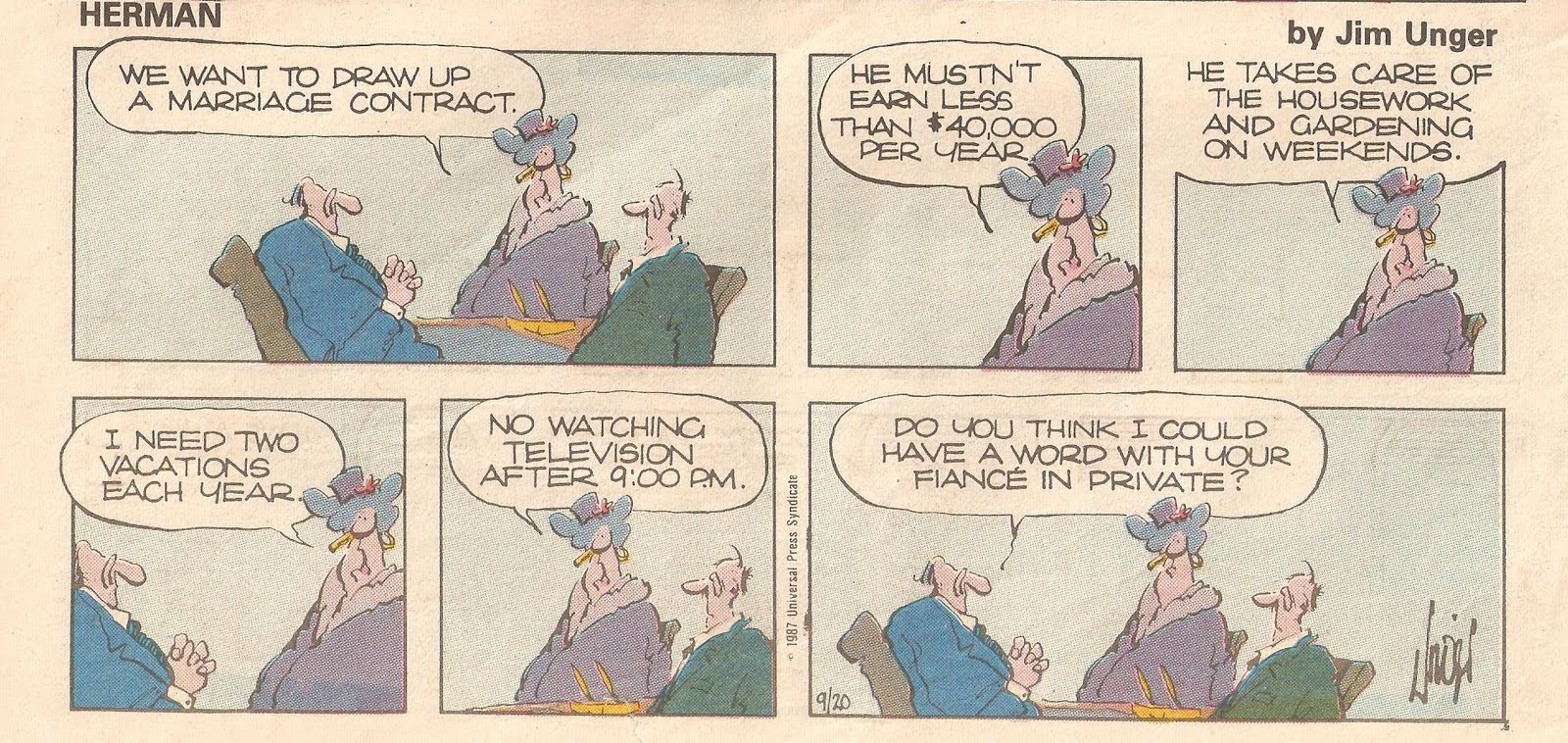
Now for the big finale - Herman.


My behavior during the Wedding was explementary to the point where I was able to keep my flinching to a minimum. Normally, I can't stand the constant flashing of cameras, but made nice for my sister's day. These Wedding photos are probably the first photos that've been made of me in years that haven't been for my medicare or bus cards.


This Herman wasn't included, since it felt too close in tone to the "As a matter of fact, I went to all this trouble just to say I don't" comic.


Here's the strip that was left out of the Honeymoon's Over portion of the collection. I had nine of them, and could only fit 4 to a page, so one of them had to go.


And then there's the strips that even I had trouble figuring out. Even Jim Unger's admitted that there are times where he doesn't understands his own jokes! The Far Side's got nothing on this guy.


The interesting thing about Herman is that unlike Lynn Johnson and Dave Sim, Jim Unger stopped producing Herman strips when he felt like it. His sudden retirement was a huge shock, but understandable. After all, he'd been working continuously for over 20 years without a break.


He might've been creating variations of the same jokes multiple times, but they were always interesting and varied in how they were spoken or drawn.


It wasn't until the released of a coloured (and dumbed-down) collection of Herman that it was revealed that Jim Unger was the victim of early marriages that ended in disaster. Taken in context, his alimony strips can be seen as a way of relieving his stress. There are ways to relieve your frustrations on the comics page without sacrificing humour or clarity.


To my sister, if you're reading this, here's hoping you enjoy your (belated) one-month anniversary present.